Results by title
1882 books match the query 'Criticism and interpretation' and 78 start with b

Bach Perspectives, Volume 10
Bach and the OrganMatthew Dirst
University of Illinois Press, 2016

Bach Perspectives, Volume 12
Bach and the Counterpoint of ReligionEdited by Robin A. Leaver
University of Illinois Press, 2018
Bach Perspectives, Volume 13
Bach ReworkedEdited by Laura Buch
University of Illinois Press, 2020
An insightful look at how composers build on each other's work, Bach Reworked reveals how nuanced understandings of parody procedures can fuel both musical innovation and historically informed performance.
Contributors: Stephen A. Crist, Ellen Exner, Moira Leanne Hill, Erinn E. Knyt, and Markus Zepf
Bach Perspectives, Volume 14
Bach and Mozart: Connections, Patterns, and PathwaysEdited by Paul Corneilson
University of Illinois Press, 2022
An official publication of the American Bach Society, Bach Perspectives, Volume 14 draws on a variety of approaches and a broad range of subject matter in presenting a new wave of innovative classical musical scholarship.
Contributors: Eleanor Selfridge-Field, Yoel Greenberg, Noelle M. Heber, Michael Maul, Stephen Roe, and David Schulenberg

Bach Perspectives, Volume 7
J. S. Bach's Concerted Ensemble Music: The ConcertoEdited by Gregory Butler
University of Illinois Press, 2007
Gregory Butler focuses on Bach's Concerto for Harpsichord and Strings in E Major (BWV 1053) as a pastiche created by a process of assemblage of three earlier heterogeneous movements. Pieter Dirksen delves into the source history of the Concerto for Harpsichord and Strings in F Minor (BWV 1056) and concludes it represents a transcription of an earlier violin concerto in G minor. David Schulenberg investigates the generic ambiguity of the concerto in the early eighteenth century and how it diverged from the sonata to become a distinct genre. Completing the volume is Christoph Wolff's examination of the ""Siciliano"" as a slow movement in Bach's concertos and its implications for the source history of his Concerto for Harpsichord and Strings in E Major (BWV 1053).

Bach Perspectives, Volume 8
J.S. Bach and the Oratorio TraditionEdited by Daniel R. Melamed
University of Illinois Press, 2011

Bach Perspectives, Volume 9
J.S. Bach and His Contemporaries in GermanyEdited by Andrew Talle
University of Illinois Press, 2013
In this volume, Wolfgang Hirschmann proposes an ethnographic approach that contextualizes Bach's works, addressing the aesthetic paths he took as well as those he did not pursue. Steven Zohn's essay considers Telemann's contribution to the orchestral Ouverture genre, observering how Telemann's approach to integrating the national styles of his time was quite different from, but no less rich than, Bach's. Andrew Talle compares settings and strategies of Vergnügte Ruh, beliebte Seelenlust by Bach and Graupner. Alison Dunlop presents valuable primary research on Muffat, the most commonly cited keyboard music composer in Vienna during Bach's lifetime. Finally, Michael Maul sheds new light on the Scheibe-Birnbaum controversy, contextualizing the most famous critique of J. S. Bach's compositional style by discussing the other composers that Scheibe critiqued.
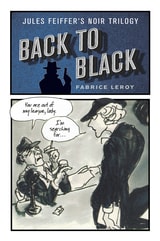
Back to Black
Jules Feiffer’s Noir TrilogyFabrice Leroy
Rutgers University Press, 2025
Named the Best Academic Work of 2025 by The Comics Journal
The legendary American cartoonist and author Jules Feiffer has enjoyed a long and varied career, working on everything from illustrating The Phantom Tollbooth to writing the screenplay for the film Popeye. But some of his most innovative work came very late in his career, with a trio of graphic novels he composed in his eighties: Kill My Mother (2014), Cousin Joseph (2016), and The Ghost Script (2018).
Back to Black provides the first full-length critical analysis of this trilogy, exploring how it pays homage to the iconography and themes of film noir through constant graphic experimentation and a striking reinvention of Feiffer’s distinctive style. Fabrice Leroy shows how Feiffer deftly alternates between dramatic and satirical tones as he plays with the conventions of noir to provide a caustic yet moving commentary on mid-twentieth-century American life. Through close readings of each novel in the trilogy, he examines Feiffer’s singular depiction of the central political issues in the United States from the Great Depression to the 1950s, which still resonate today: unionization struggles, cinematic propaganda, McCarthyism, the American Dream, immigration, antisemitism, civil rights, and gender discrimination. Placing the noir trilogy into the context of Feiffer’s long career, Back to Black demonstrates how he offers a loving pastiche of the genre without losing his unique voice or critical edge.
Badiou and Politics
Bruno Bosteels
Duke University Press, 2011

Barrio Dreams
Selected PlaysSilviana Wood; Edited by Norma E. Cantú and Rita E. Urquijo-Ruiz
University of Arizona Press, 2016
Barrio Dreams is the first book to collect the work of one of Arizona’s foremost teatristas, playwright Silviana Wood. During her decades-long involvement in theater, Wood forged a reputation as a playwright, actor, director, and activist. Her works form a testimonio of Chicana life, steeped in art, politics, and the borderlands. Wood’s plays challenge, question, and incite women to consider their lot in life. She ruptures stereotypes and raises awareness of social issues via humor and with an emphasis on the use of the physical body on stage.
The play Una vez, en un barrio de sueños . . . offers a glimpse into familiar terrain—the barrio and its dwellers—in three actos. In Amor de hija, a fraught mother-daughter relationship in contemporary working-class Arizona is dealt an additional blow as the family faces Alzheimer’s disease. In the tragedy A Drunkard’s Tale of Melted Wings and Memories, and in the trilingual (Spanish, English, and Yaqui) tragicomedy Yo, Casimiro Flores, characters love, live, die, travel through time and space, and visit the afterlife. And in Anhelos por Oaxaca, a grandfather travels back in time through flashbacks, as he and his grandson travel through homelands from Arizona to Oaxaca.
Part of Wood’s genius is the way she portrays life in what Gloria Anzaldúa called “el mundo zurdo,” that space inhabited by the people of color, the poor, the female, and the outsiders. It is a place for the atravesados, the odd, the different, those who do not fit the mainstream. The people who inhabit Wood’s plays are common folk—janitors, mothers, grandmothers, and teenagers—hardworking people who, in one way or another, have made their way in life and who embody life in the barrio.
Barry Le Va
The Aesthetic AftermathMichael Maizels
University of Minnesota Press, 2015
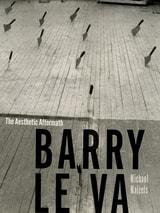
Of the conceptual artists who began their careers in the 1960s and 1970s—Bruce Nauman, Chris Burden, Vito Acconci, and Mel Bochner among them—Barry Le Va may be the most elusive. As this first study of his work reveals, his rigorously planned art was instigated to mask its creator’s intentions and methods, presenting itself as an “aftermath” of modernism’s claim to permanency and civil society’s preferred mode of monumentalism.
For Michael Maizels, Le Va’s work constitutes a particularly productive subject of inquiry because it clearly articulates the interconnection between the avant-garde’s distrust of autonomous art objects, two decades of social unrest, the emergence of information theory, and lingering notions of scientific objectivity. Barry Le Va: The Aesthetic Aftermath explores how Le Va used such materials as shattered glass, spent bullets, sound recordings, scattered flour, and meat cleavers embedded in a floor to challenge the interlocking assumptions behind blind faith in lasting beauty, just government, and perfectible knowledge. Taking inspiration from popular crime novels as well as contemporary art theory, Le Va charged his viewers to attempt, like detectives at a crime scene, to decipher an order underlying the apparent chaos.
Le Va’s installations were designed to erode not simply the presumed autonomy of the art object but also the economic and political authority of the art establishment. In his concluding chapter, Maizels looks at the more fixed work of the past two decades in which Le Va turned to architectural themes and cast concrete to probe the limits of dynamism and the idea of permanence.
Beauty's Rigor
Patterns of Production in the Work of Pier Luigi NerviThomas Leslie
University of Illinois Press, 2017
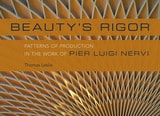
Beauty's Rigor offers a comprehensive overview of Nervi's long career. Drawing on the Nervi archives and a wealth of photographs and architectural drawings, Thomas Leslie explores celebrated buildings like Palazetto dello Sport built for the 1960 Rome Olympics, St. Mary's Cathedral in San Francisco, and the UNESCO headquarters in Paris. He also sheds new light on unbuilt projects such as the Pavilion of Italian Civilization for the Universal Exposition of Rome E42. What emerges is the first complete account of Nervi's contributions to modern architecture and his essential role in a revolution that realized concrete's potential to match grace with strength.
Beauvoir and Her Sisters
The Politics of Women's Bodies in FranceSandra Reineke
University of Illinois Press, 2011
Beckett after Wittgenstein
Andre Furlani
Northwestern University Press, 2015
Among the best-represented authors in Samuel Beckett’s library was Ludwig Wittgenstein, yet the philosopher’s relevance to the Nobel laureate’s work is scarcely acknowledged and seldom elucidated. Beckett after Wittgenstein is the first book to examine Beckett’s formative encounters with, and profound affinities to, Wittgenstein’s thought, style, and character.
While a number of influential critics, including the philosopher Alain Badiou, have discerned a transition in Beckett’s work beginning in the late 1950s, Furlani is the first to identify and clarify how this change occurs in conjunction with the writer’s sustained engagement with Wittgenstein’s thought on, for example, language, cognition, subjectivity, alterity, temporality, belief, hermeneutics, logic, and perception. Drawing on a wealth of Beckett’s archival materials, much of it unpublished, Furlani’s study reveals the extent to which Wittgenstein fostered Beckett’s views and emboldened his purposes.
Becoming Mikhail Lermontov
The Ironies of Romantic Individualism in Nicholas I's RussiaDavid Powelstock
Northwestern University Press, 2011
By bringing to light Lermontov's operative version of Romantic individualism, Powelstock is able to make sense of the poet's relationship to "romantic irony," his highly modern concept of the reader (both real, and implied in the text), and his vexed passion for his predecessor Alexander Pushkin--a relationship that is almost always treated sentimentally, but is here given its true competitive edge. Furthermore, Powelstock offers the most persuasive account ever given of Lermontov's exceptionally odd treatment of, and success with, women--both in real life and in fiction--and of his cruel overlapping of these two planes.
Clarifying what has remained perplexing for so long, and correcting what has been misinterpreted, Powelstock's work illuminates Lermontov's views of dignity, death, love, nature, society, and ethics--and, finally, gives us an intellectual biography that is deeper and more subtle than any written before.
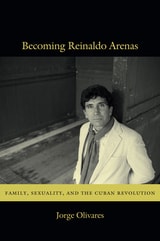
Becoming Reinaldo Arenas
Family, Sexuality, and The Cuban RevolutionJorge Olivares
Duke University Press, 2013
Through insightful close readings of a selection of Arenas's works, including unpublished manuscripts and correspondence, Olivares examines the writer's personal, political, and artistic trajectory, focusing on his portrayals of family, sexuality, exile, and nostalgia. He documents Arenas's critical engagement with cultural and political developments in revolutionary Cuba and investigates the ways in which Arenas challenged literary and national norms. Olivares's analysis shows how Arenas drew on his life experiences to offer revealing perspectives on the Cuban Revolution, the struggles of Cuban exiles, and the politics of sexuality.
Becoming Willa Cather
Creation and CareerDaryl W. Palmer
University of Nevada Press, 2019
Willa Cather has long been admired for O Pioneers! (1913), Song of the Lark (1915), and My Ántonia (1918)—the “prairie novels” about the lives of early Nebraska pioneers that launched her career. Thanks in part to these masterpieces, she is often viewed as a representative of pioneer life on the Great Plains, a controversial innovator in American modernism, and a compelling figure in the literary history of LGBTQ America. A century later, scholars acknowledge Cather’s place in the canon of American literature and continue to explore her relationship with the West.
Drawing on original archival research and paying unprecedented attention to Cather’s early short stories, Palmer demonstrates that the relationship with Nebraska in the years leading up to O Pioneers! is more dynamic than critics and scholars thought. Readers will encounter a surprisingly bold young author whose youth in Nebraska served as a kind of laboratory for her future writing career. Becoming Willa Cather changes the way we think about Cather, a brilliant and ambitious author who embraced experimentation in life and art, intent on reimagining the American West.
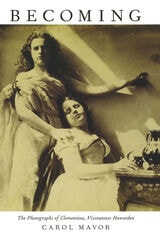
Becoming
The Photographs of Clementina, Viscountess HawardenCarol Mavor
Duke University Press, 1999
With drama, wit, and verve, Lady Hawarden’s girls, becoming women, entwine each other, their mirrored reflections and select feminine objects (an Indian traveling cabinet, a Gothic-style desk, a shell-covered box) as homoerotic partners. The resulting mise-en-scène is secretive, private, delicious, and arguably queer—a girltopia ripe with maternality and adolescent flirtation, as touching as it is erotic. Luxuriating in the photographs’ interpretive possibilities, Mavor makes illuminating connections between Hawarden and other artists and writers, including Vermeer, Christina Rossetti, George Eliot, Lewis Carroll, and twentieth-century photographers Sally Mann and Francesca Woodman. Weaving psychoanalytic theory and other photographic analyses into her work, Mavor contemplates the experience of the photograph and considers the relationship of Hawarden’s works to the concept of the female fetish, to voyeurism, mirrors and lenses, and twins and doubling. Under the spell of Roland Barthes, Mavor’s voice unveils the peculiarities of the erotic in Lady Hawarden’s images through a writerly approach that remembers and rewrites adolescence as sustained desire.
In turn autobiographical, theoretical, historical, and analytical, Mavor’s study caresses these mysteriously ripped and scissored images into fables of sapphic love and the real magic of photography.
Beethoven's Symphonies
Nine Approaches to Art and IdeasMartin Geck
University of Chicago Press, 2017
Martin Geck opens the book with an enthralling series of cultural, political, and musical motifs that run throughout the symphonies. A leading theme is Beethoven’s intense intellectual and emotional engagement with the figure of Napoleon, an engagement that survived even Beethoven’s disappointment with Napoleon’s decision to be crowned emperor in 1804. Geck also delves into the unique ways in which Beethoven approached beginnings and finales in his symphonies, as well as his innovative use of particular instruments. He then turns to the individual symphonies, tracing elements—a pitch, a chord, a musical theme—that offer a new way of thinking about each work and will make even the most devoted fans of Beethoven admire the symphonies anew.
Offering refreshingly inventive readings of the work of one of history’s greatest composers, this book shapes a fascinating picture of the symphonies as a cohesive oeuvre and of Beethoven as a master symphonist.
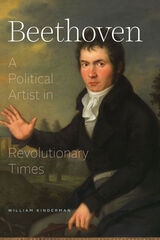
Beethoven
A Political Artist in Revolutionary TimesWilliam Kinderman
University of Chicago Press, 2021
William Kinderman presents Beethoven as a civically engaged thinker faced with severe challenges. The composer lived through many tumultuous events—the French Revolution, the rise and fall of Napoleon Bonaparte, and the Congress of Vienna among them. Previous studies of Beethoven have emphasized the importance of his personal suffering and inner struggles; Kinderman instead establishes that musical tensions in works such as the Eroica, the Appassionata, and his final piano sonata in C minor reflect Beethoven’s attitudes toward the political turbulence of the era. Written for the 250th anniversary of his birth, Beethoven takes stock of the composer’s legacy, showing how his idealism and zeal for resistance have ensured that masterpieces such as the Ninth Symphony continue to inspire activists around the globe. Kinderman considers how the Fifth Symphony helped galvanize resistance to fascism, how the Sixth has energized the environmental movement, and how Beethoven’s civic engagement continues to inspire in politically perilous times. Uncertain times call for ardent responses, and, as Kinderman convincingly affirms, Beethoven’s music is more relevant today than ever before.
Being Here Is Glorious
On Rilke, Poetry, and PhilosophyJames D. Reid
Northwestern University Press, 2015
With a new translation of the Duino Elegies
“Who, if I cried out, would hear me among the angels’/orders?” Rainer Maria Rilke’s Duino Elegies opens with one of the most powerful poetic expressions of the search for meaning in the modern world. Published in 1923, the Elegies would influence important philosophers on the Continent, including Heidegger. But with a few exceptions, Rilke’s poetry has not had an impact on philosophy in the Anglo-American world. In Being Here Is Glorious, James D. Reid offers a fresh translation of the Elegies, which hews to the form of the original and provides his own meditation on the place of poetry in philosophy. Reid makes a convincing case that poetry and philosophy can address the problem of finding things significant and worth affirming in light of various reasons to doubt the value of the world in which we find ourselves cast.
Being a Skull
Site, Contact, Thought, SculptureGeorges Didi-Huberman
University of Minnesota Press, 2016
What would a sculpture look like that has as its task to touch thought? For the French philosopher and Art Historian, Georges Didi-Huberman, this is the central question that permeates throughout the work of Italian artist Giuseppe Penone. Through a careful study of Penone’s work regarding a sculptural and haptic process of contact with place, thought, and artistic practice, Didi-Huberman takes the reader on a journey through various modes of thinking by way of being. Taking Penone’s artwork “Being the river” as a thematic starting point, Didi-Huberman sketches a sweeping view of how artists through the centuries have worked with conceptions of the skull, that is, the mind, and ruminates on where thought is indeed located.
From Leonardo da Vinci to Albrecht Dürer, Didi-Huberman guides us to the work of Penone and from there, into the attempts of a sculptor whose works strives to touch thought. What we uncover is a sculptor whose work becomes a series of traces of the site of thought. Attempting to trace, by way of a series of frottages, reports, and developments, this imperceptible zone of contact. The result is a kind of fossil of the brain: the site of thought, namely, the site for getting lost and for disproving space. Sculpting at the same time what inhabits as well as what incorporates us.

Ben Hecht's Theatre of Jewish Protest
Garrett Eisler
Rutgers University Press, 2025
Hecht introduced a new heroic Jewish identity to the American stage, one that challenged popular stereotypes of villainy or weakness. This powerful and (still) controversial body of work stands as a striking testament to the power of theatre to rise to the moment. The book also features a supporting cast of famous collaborators on these projects, including Paul Muni, Edward G. Robinson, John Garfield, Moss Hart, Kurt Weill, and a young Marlon Brando. In their use of the stage to aggressively engage with history as it was happening, the story of Hecht and his colleagues is a compelling case of artists who made a difference.
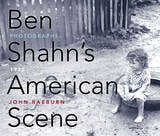
Ben Shahn's American Scene
Photographs, 1938John Raeburn
University of Illinois Press, 2010
The paintings, murals, and graphics of Ben Shahn (1898-1969) have made him one of the most heralded American artists of the twentieth century, but during the 1930s he was also among the nation's premier photographers. Much of his photographic work was sponsored by the New Deal's Farm Security Administration, where his colleagues included Dorothea Lange and Walker Evans.
Ben Shahn's American Scene: Photographs, 1938 presents one hundred superb photographs from his most ambitious FSA project, a survey of small-town life in the Depression. John Raeburn's accompanying text illuminates the thematic and formal significance of individual photographs and reveals how, taken together, they address key cultural and political issues of the years leading up to World War II. Shahn's photographs highlight conflicts between traditional values and the newer ones introduced by modernity as represented by the movies, chain stores, and the tantalizing allure of consumer goods, and they are particularly rich in observation about the changes brought about by Americans' universal reliance on the automobile. They also explore the small town's standing as the nation's symbol of democratic community and expose the discriminatory social and racial practices that subverted this ideal in 1930s America.
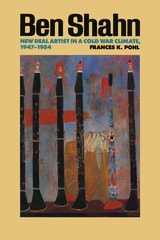
Ben Shahn
New Deal Artist in a Cold War Climate, 1947-1954By Frances Pohl
University of Texas Press, 1989
In the first, most intense years of the Cold War (1947–1954), New Deal liberals often found themselves in great disfavor. Ben Shahn's experience presents something of a paradox, however, since his paintings appealed in different ways to both liberals and conservatives. Blacklisted by CBS during the McCarthy era and yet, ironically, incorporated into presidential "campaigns of truth" aimed at improving the U.S. image abroad, Ben Shahn is a pivotal figure, revealing the complexities and contradictions inherent in this highly polarized moment in American history.
In this pathbreaking study, Frances Pohl traces the political and artistic struggles Ben Shahn became embroiled in as he tried to remain a socially concerned artist during the early Cold War period. She shows how he rejected the argument, voiced by many Abstract Expressionists, that art and politics should not mix, yet at the same time searched for a way to depict, in universal and allegorical terms, the broad human condition rather than simply specific instances of injustice. Perhaps most important, she makes critical connections between U.S. social and political history and the art it provoked, thus illuminating both the later career of Ben Shahn and the Cold War era in American cultural history.
Beneath the Veil of the Strange Verses
Reading Scandalous TextsJeremiah L. Alberg
Michigan State University Press, 2013
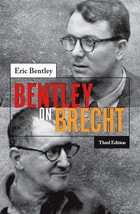
Bentley on Brecht
Eric Bentley
Northwestern University Press, 2008
Winner of 2006 International Association of Theatre Critics Thalia Prize
Winner of 2006 Village Voice OBIE Awards Lifetime Achievement Award
Since their first meeting in Santa Monica, California in 1942, Eric Bentley has been Bertolt Brecht's other, offstage voice. Just as Brecht reshaped modern theater, Bentley's writings on Brecht helped shape his reputation in the United States and the rest of the world. Bentley on Brecht represents a lifetime of critical and personal thoughts on both Brecht as friend and Brecht as influential literary figure. Brought together in this volume are Brecht-Bentley correspondence, Bentley's personal recollections of his years with Brecht, including Charles Laughton's production of Galileo, Brecht's testimony before the House Un-American Activities Committee, and Bentley's analysis of Brecht's plays.
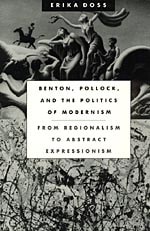
Benton, Pollock, and the Politics of Modernism
From Regionalism to Abstract ExpressionismErika Doss
University of Chicago Press, 1991
"A welcome addition to the growing body of literature that deals with the art and culture of the depression and cold war eras. It is a pioneering work that makes a valuable contribution to our understanding of a puzzling conundrum of American art—the shift from regionalism to abstract expressionism."—M. Sue Kendall, Winterthur Portfolio
"An important scholarly contribution. . . . This book will stand as a step along the way to a better understanding of the most amazing transition in the art of our tumultuous century."—James G. Rogers, Jr., Art Journal
"A valuable and interesting book that restores continuity and political context to the decades of depression and war."—Marlene Park, American Historical Review

Berlioz and His World
Edited by Francesca Brittan and Sarah Hibberd
University of Chicago Press, 2024
Hector Berlioz (1803–1869) has long been a difficult figure to place and interpret. Famously, in Richard Wagner’s estimation, he hovered as a “transient, marvelous exception,” a composer woefully and willfully isolated. In the assessment of German composer Ferdinand Hiller, he was a fleeting comet who “does not belong in our musical solar system,” the likes of whom would never be seen again. For his contemporaries, as for later critics, Berlioz was simply too strange—and too noisy, too loud, too German, too literary, too cavalier with genre and form, and too difficult to analyze. He was, in many ways, a composer without a world.
Berlioz and His World takes a deep dive into the composer’s complex legacy, tracing lines between his musical and literary output and the scientific, sociological, technological, and political influences that shaped him. Comprising nine essays covering key facets of Berlioz’s contribution and six short “object lessons” meant as conversation starters, the book reveals Berlioz as a richly intersectional figure. His very difficulty, his tendency to straddle the worlds of composer, conductor, and critic, is revealed as a strength, inviting new lines of cross-disciplinary inquiry and a fresh look at his European and American reception.
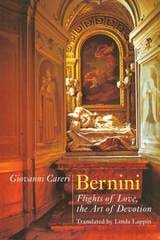
Bernini
Flights of Love, the Art of DevotionGiovanni Careri
University of Chicago Press, 1994
In the Fonseca Chapel, the Albertoni Chapel, and the church of Sant' Andrea al Quirinale, all in Rome, Careri identifies three types of ensemble and links each to a particular spiritual journey. Using contemporary theories in anthropology, film, and reception aesthetics, he shows how Bernini's formal mechanisms established an emotional dynamic between the beholder and a specific arrangement of forms. As an inquiry into the ways art in a certain historical context transformed and was transformed by its audience, Bernini: Flights of Love, the Art of Devotion is also a penetrating investigation into the aesthetic principles of multimedia composition.
Between Heidegger and Novalis
Peter Hanly
Northwestern University Press, 2021
An entirely new approach to both Novalis and Heidegger, this book will interest scholars and students engaged with continental philosophy and the legacy of German Romanticism.
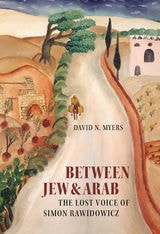
Between Jew and Arab
The Lost Voice of Simon RawidowiczDavid N. Myers
Brandeis University Press, 2009

Beyond Boundaries
C.L.R. James and Postnational StudiesEdited by Christopher Gair
Pluto Press, 2006
Invaluable for students of post-colonial studies, the book examines points where James crosses with other theorists, such as Lacan and Gramsci. Racial identity and cultural politics are key themes in his work, not to mention his unique writings on cricket. Contributors including Donald E Pease, Nicole King, Christopher Gair and Anthony Bogues illuminate the key themes in James's writing, and put forward the idea that the breath of James's thinking can be identified as the beginning of 'post-national' studies.
Christopher Gair is a lecturer in the Department of American and Canadian Studies, University of Birmingham. He is the author of Complicity and Resistance in Jack London¹ s Novels (Edwin Mullen Press, 1997), of The American Counterculture (forthcoming, Edinburgh University Press, 2006), and of numerous essays on American literature and culture. He is the editor of the journal Symbiosis.
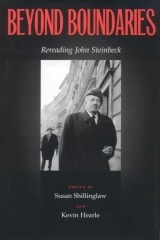
Beyond Boundaries
Rereading John SteinbeckSusan Shillinglaw
University of Alabama Press, 2002
As a writer who, beginning in the 1930s, illuminated the lives of ordinary people, Steinbeck came to be the conscience of America. He witnessed and recorded with clarity much of the political and social upheaval of the 20th century: The Great Depression, World War II, the Cold War, and Vietnam. Yet his place in the literary canon of American literature has been much debated and often dismissed by academics. Beyond Boundaries argues persuasively for Steinbeck's relevance, offering a fuller, more nuanced and international appreciation of the popular Nobel laureate and his works.
Topics treated in these wide-ranging essays include the historical and literary contexts and the artistic influence of the eminent novelist; the reception and translation of Steinbeck works outside the United States; Steinbeck’s worldview, his social vision, and his treatment of poverty, of self, and of patriotism; influence on Native American writers; the centrality of the archetypal feminine throughout his fiction; and the author's lifelong interest in science and philosophy.
International in scope, this timely study reevaluates the enduring and evolving legacy of one of America's most significant writers.
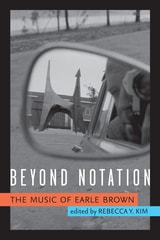
Beyond Notation
The Music of Earle BrownRebecca Y. Kim, Editor
University of Michigan Press, 2017
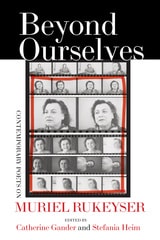
Beyond Ourselves
Contemporary Poets on Muriel RukeyserCatherine Gander
West Virginia University Press, 2026
Muriel Rukeyser has many faces: poet, biographer, theorist, playwright, novelist, story-writer, filmmaker, translator, ethnographer, and innovator of social, documentary poetics; feminist, queer, Jewish, single mother, and social justice activist. Yet above all, she was a poet. Threaded through her work, politics, and life was the conviction that poetry is an animating force that connects people and disciplines. Recent years have seen a surge of renewed interest in Rukeyser’s work, bringing her back into public consciousness as a crucial voice on the relations between poetry and social life in America and beyond.
Beyond Ourselves is the first volume of its kind to comprehensively consider the continued urgency and lasting legacy of Rukeyser’s work as a key source and inspiration for poets working today. Volume editors Catherine Gander and Stefania Heim—both scholars and poets—have gathered critical and creative contributions from some of the most innovative, exciting, and socially engaged poets writing today. In lyric and braided essays, scholarly critique, hybrid investigations, documentary collages, and collaborative poetry, these poets dive deeply into Muriel Rukeyser’s work and life to interrogate, explore, and challenge the models she provides for thinking and writing in our own social, political, and poetic moment. These essays address a range of themes, from the transhistorical politics of motherhood and contemporary relational and feminist poetics of war to communal history via documentary film and the possibilities of coalition-building beyond borders. As in Rukeyser’s own work, the forms of these texts animate their inquiries.
Beyond Ourselves is a volume at the intersections of creative and critical thought, reflecting on how Rukeyser’s expansive body of work offers a vision for, as she writes, “a kind of imagination with which to meet the world.”
Contributors: Daniel Borzutzky, Susan Briante, Catherine Gander, Stacy Hardy, Stefania Heim, Erika Meitner, Philip Metres, Jena Osman, Deborah Paredez, Khadijah Queen, Solmaz Sharif, and Nomi Stone.
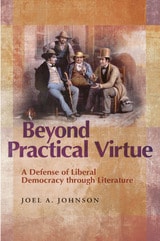
Beyond Practical Virtue
A Defense of Liberal Democracy through LiteratureJoel A. Johnson
University of Missouri Press, 2007
Why hasn’t democracy been embraced worldwide as the best form of government?
Aesthetic critics of democracy such as Carlyle and Nietzsche have argued that modern democracy, by removing the hierarchical institutions that once elevated society’s character, turns citizens into bland, mediocre souls. Joel A. Johnson now offers a rebuttal to these critics, drawing surprising inspiration from American literary classics.
Addressing the question from a new perspective, Johnson takes a fresh look at the worth of liberal democracy in these uncertain times and tackles head-on the thorny question of cultural development. Examining the novels of James Fenimore Cooper, Mark Twain, and William Dean Howells, he shows that through their fiction we can gain a better appreciation of the rich detail of everyday life, making the debate relevant to contemporary discussions of liberal democracy.
Johnson focuses on an issue that liberals have inadequately addressed: whether people tend to develop fully as individuals under liberal democracy when such a regime does little formally to encourage their development. He argues that, though the liberal fear of state-guided culture is well founded, it should not prevent us from evaluating liberalism’s effect on individual flourishing. By extending the debate over the worthiness of liberal democracy to include democracy’s effect on individual development, he contends that the democratic experience is much fuller than the aristocratic one and thus expands the faculties of its citizens.
Critics of American democracy such as John Rawls have sought to transform it into a social or egalitarian democracy in the European style. Johnson shows that neither the debate between Rawls and his communitarian critics nor the ongoing discussion of the globalization of American values adequately addresses the fundamental critique of democratic culture advanced by the aesthetic critics. Johnson’s cogent analysis reaches out to those readers who are ready for a more comprehensive evaluation of liberal democracy, offering new insight into the relationship between the state and the individual while blazing new trails in the intersection of politics and literature.
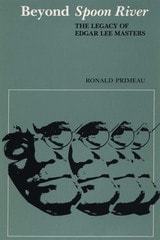
Beyond Spoon River
The Legacy of Edgar Lee MastersBy Ronald Primeau
University of Texas Press, 1981
As the first full-length critical study of Edgar Lee Masters, Beyond Spoon River is important not only for its reevaluation of this American poet and his work but also for its valuable insights into central questions of aesthetics, regionalism, and the nature and meaning of literary influence.
The inordinate popularity of Spoon River Anthology has for many years unfairly restricted Masters' reputation as a "one-book phenomenon," although between 1911 and 1942 he wrote over fifty other books—most of which were neglected or misinterpreted precisely because they attempted a large-scale rewriting of what he felt had been obscured or distorted in the Anglo-American tradition. Masters' wide reading in the whole of western literature shaped his own attitudes, themes, and style, and his detailed accounts of that reading and its effect on his work form the basis for this reinterpretation of his place in American poetry in this century.
After reviewing Masters' own statements on literary influence and his role as a critic, Primeau devotes the main body of his study to the major influences on Masters' work—the Greeks, Goethe, Emerson, Whitman, Shelley, and Browning. For Masters, the composite of all these influences provided a corrective to the poetry and criticism of his time, which he little admired. Primeau concludes by exploring Masters' midwestern heritage in the light of recent reinterpretations of regionalism.
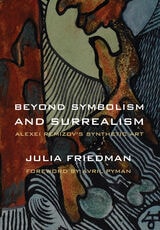
Beyond Symbolism and Surrealism
Alexei Remizov's Synthetic ArtJulia Friedman, Foreword by Avril Pyman
Northwestern University Press, 2011
The great modernist eccentric Alexei Remizov was a “writers’ writer” whose innovative poetic prose has long since entered the Russian literary canon. Gradually expanding his working methods to make drawing an integral part of the writing process, during the 1930s and 1940s, Remizov created hundreds of albums that combined texts with collages and india ink and watercolor illustrations. In Beyond Symbolism and Surrealism, Julia Friedman provides the first extensive examination of the dynamic interplay between text and image in Remizov’s albums, revealing their coequal roles in his oneiric and synaesthetic brand of storytelling. A participant in the Russian symbolist movement, an intellectual ally of many futurists, and during his émigré years, a collaborator of the surrealists, Remizov had unique insight into artistic cultures of the European avant-garde. His reinterpretation of the medieval illuminated manuscripts carries forward the traditions of symbolist mysticism and
This long-overdue examination of Remizov’s visual art addresses modernism’s key theoretical questions surrounding the relationships between image and text. Beyond Symbolism and Surrealism introduces a generous sampling of Remizov’s graphic work, much of which is currently held in private collections.
Beyond The Good Earth
Transnational Perspectives on Pearl S. BuckJay Cole
West Virginia University Press, 2019
How well do we really know Pearl S. Buck? Many think of Buck solely as the Nobel laureate and Pulitzer Prize–winning author of The Good Earth, the novel that explained China to Americans in the 1930s. But Buck was more than a novelist and interpreter of China. As the essays in Beyond The Good Earth show, she possessed other passions and projects, some of which are just now coming into focus.
Who knew, for example, that Buck imagined and helped define multiculturalism long before it became a widely known concept? Or that she founded an adoption agency to locate homes for biracial children from Asia? Indeed, few are aware that she advocated successfully for a genocide convention after World War II and was ahead of her time in envisioning a place for human rights in American foreign policy. Buck’s literary works, often dismissed as simple portrayals of Chinese life, carried a surprising degree of innovation as she experimented with the styles and strategies of modernist artists.
In Beyond The Good Earth, scholars and writers from the United States and China explore these and other often overlooked topics from the life of Pearl S. Buck, positioning her career in the context of recent scholarship on transnational humanitarian activism, women’s rights activism, and civil rights activism.
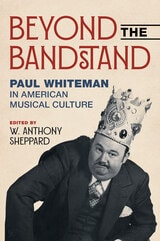
Beyond the Bandstand
Paul Whiteman in American Musical CultureEdited by W. Anthony Sheppard
University of Illinois Press, 2024
The most successful bandleader of the 1920s, Paul Whiteman was an entertainment icon who played a major role in the mainstreaming of jazz. Whiteman and his band premiered Gershwin’s Rhapsody in Blue. Duke Ellington acknowledged his achievements. His astonishing ear for talent vaulted a who’s who of artists toward prominence. But Whiteman’s oversized presence eclipsed Black jazz musicians while his middlebrow music prompted later generations to jettison him from jazz history.
W. Anthony Sheppard’s collection of essays confronts the racial implications of Whiteman’s career. The contributors explore Whiteman’s broad impact on popular culture, tracking his work and influence in American marketing, animated films, the Black press, Hollywood, and the music publication industry, and following him behind the scenes with arrangers, into grand concert halls, across the Atlantic, into the courtroom, and on television.
Multifaceted and cutting-edge, Beyond the Bandstand explores the racial politics and artistic questions surrounding a controversial figure in popular music.
Contributors: Ryan Raul Bañagale, Stephanie Doktor, John Howland, Katherine M. Leo, Sarah Caissie Provost, W. Anthony Sheppard, Catherine Tackley, Elijah Wald, and Christi Jay Wells
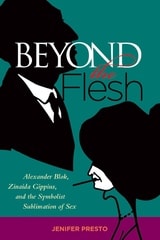
Beyond the Flesh
Alexander Blok, Zinaida Gippius, and the Symbolist Sublimation of SexJenifer Presto
University of Wisconsin Press, 2008
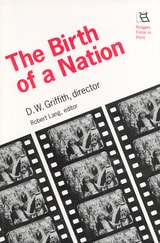
Birth of a Nation
D.W. Griffith, DirectorRobert Lang
Rutgers University Press, 1993
Robert Lang's introduction to this volume explores in fascinating detail the warped view of history that this great film presents. Griffith, a Southerner, was intent on resurrecting, idealizing, and justifying the South. In The Birth of a Nation, it is racism that unites the white North and South; the protection or abolition of slavery is not the divisive issue. In a powerful synthesis of spectacle and narrative, Griffith seeks to give the Southern cause a sense of glamour and high purpose. Lang considers the film as a historical melodrama, and by examining Griffith's "historiography as ideological practice," he traces the way in which the bloody, traumatic reality of the Civil War and Reconstruction becomes melodramatic myth. This unparalleled guide to The Birth of a Nation offers a shot-by-shot continuity script; a biographical sketch of the director; a sampling of contemporary reviews; a series of essays by distinguished critics including James Chandler, Michael Rogin, Janet Staiger, and Mimi White; and a filmography and bibliography.
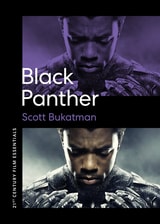
Black Panther
Scott Bukatman
University of Texas Press, 2022
Black Panther was the first Black superhero in mainstream American comics. Black Panther was a cultural phenomenon that broke box office records. Yet it wasn’t just a movie led by and starring Black artists. It grappled with ideas and conflicts central to Black life in America and helped redress the racial dynamics of the Hollywood blockbuster.
Scott Bukatman, one of the foremost scholars of superheroes and cinematic spectacle, brings his impeccable pedigree to this lively and accessible study, finding in the utopianism of Black Panther a way of re-envisioning what a superhero movie can and should be while centering the Black creators, performers, and issues behind it. He considers the superheroic Black body; the Pan-African fantasy, feminism, and Afrofuturism of Wakanda; the African American relationship to Africa; the political influence of director Ryan Coogler’s earlier movies; and the entwined performances of Chadwick Boseman’s T’Challa and Michael B. Jordan’s Killmonger. Bukatman argues that Black Panther is escapism of the best kind, offering a fantasy of liberation and social justice while demonstrating the power of popular culture to articulate ideals and raise vital questions.

Black Space
Imagining Race in Science Fiction FilmBy Adilifu Nama
University of Texas Press, 2008
Winner, Rollins Book Award, Southwest Texas Popular Culture Association/American Culture Association, 2008
Science fiction film offers its viewers many pleasures, not least of which is the possibility of imagining other worlds in which very different forms of society exist. Not surprisingly, however, these alternative worlds often become spaces in which filmmakers and film audiences can explore issues of concern in our own society. Through an analysis of over thirty canonic science fiction (SF) films, including Logan's Run, Star Wars, Blade Runner, Back to the Future, Gattaca, and Minority Report, Black Space offers a thorough-going investigation of how SF film since the 1950s has dealt with the issue of race and specifically with the representation of blackness.
Setting his study against the backdrop of America's ongoing racial struggles and complex socioeconomic histories, Adilifu Nama pursues a number of themes in Black Space. They include the structured absence/token presence of blacks in SF film; racial contamination and racial paranoia; the traumatized black body as the ultimate signifier of difference, alienness, and "otherness"; the use of class and economic issues to subsume race as an issue; the racially subversive pleasures and allegories encoded in some mainstream SF films; and the ways in which independent and extra-filmic productions are subverting the SF genre of Hollywood filmmaking.
The first book-length study of African American representation in science fiction film, Black Space demonstrates that SF cinema has become an important field of racial analysis, a site where definitions of race can be contested and post-civil rights race relations (re)imagined.

Black Women’s Health in the Age of Hip Hop and HIV/AIDS
A Narrative RemixNghana tamu Lewis
The Ohio State University Press, 2025
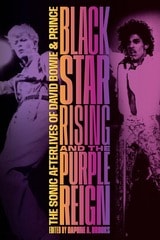
Blackstar Rising and the Purple Reign
The Sonic Afterlives of David Bowie and PrinceDaphne A. Brooks, editor
Duke University Press, 2026
Contributors: Christine Bacareza Balance, Emma Balázs, Victoria Broackes, Daphne A. Brooks, Daphne Carr, Andreana Clay, Ashon Crawley, Jonathan Flatley, Nicole R. Fleetwood, Lynell George, Farah Jasmine Griffin, Michelle Habell-Pallán, Jack Halberstam, Matthew Frye Jacobson, Kara Keeling, Jason King, Josh Kun, Kathryn Lofton, Emily J. Lordi, Eric Lott, Maureen Mahon, Greil Marcus, Geoffrey Marsh, Michaelangelo Matos, Tiffany Naiman, Tavia Nyong'o, Ann Powers, Sonnet Retman, Morgan Rhodes, Francesca T. Royster, Gustavus Stadler, Jacqueline Stewart, Greg Tate, Karen Tongson, Van My Truong, Alexandra T. Vazquez, Michael E. Veal, Shane Vogel, Gayle Wald, Oliver Wang, Alexander G. Weheliye, Richard Yarborough, Kristen Zschomler
Blood Lines
Myth, Indigenism, and Chicana/o LiteratureBy Sheila Marie Contreras
University of Texas Press, 2008
2009 — Runner-up, Modern Language Association Prize in United States Latina and Latino and Chicana and Chicano Literary and Cultural Studies
Blood Lines: Myth, Indigenism, and Chicana/o Literature examines a broad array of texts that have contributed to the formation of an indigenous strand of Chicano cultural politics. In particular, this book exposes the ethnographic and poetic discourses that shaped the aesthetics and stylistics of Chicano nationalism and Chicana feminism. Contreras offers original perspectives on writers ranging from Alurista and Gloria Anzaldúa to Lorna Dee Cervantes and Alma Luz Villanueva, effectively marking the invocation of a Chicano indigeneity whose foundations and formulations can be linked to U.S. and British modernist writing.
By highlighting intertextualities such as those between Anzaldúa and D. H. Lawrence, Contreras critiques the resilience of primitivism in the Mexican borderlands. She questions established cultural perspectives on "the native," which paradoxically challenge and reaffirm racialized representations of Indians in the Americas. In doing so, Blood Lines brings a new understanding to the contradictory and richly textured literary relationship that links the projects of European modernism and Anglo-American authors, on the one hand, and the imaginary of the post-revolutionary Mexican state and Chicano/a writers, on the other hand.
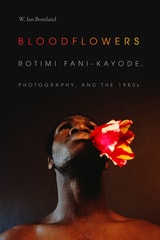
Bloodflowers
Rotimi Fani-Kayode, Photography, and the 1980sW. Ian Bourland
Duke University Press, 2019

Bloody Tyrants and Little Pickles
Stage Roles of Anglo-American Girls in the Nineteenth CenturyMarles Schweitzer
University of Iowa Press, 2020
Bloody Tyrants and Little Pickles traces the theatrical repertoire of a small group of white Anglo-American actresses as they reshaped the meanings of girlhood in Britain, North America, and the British West Indies during the first half of the nineteenth century. It is a study of the possibilities and the problems girl performers presented as they adopted the manners and clothing of boys, entered spaces intended for adults, and assumed characters written for men. It asks why masculine roles like Young Norval, Richard III, Little Pickle, and Shylock came to seem “normal” and “natural” for young white girls to play, and it considers how playwrights, managers, critics, and audiences sought to contain or fix the at-times dangerous plasticity they exhibited both on and off the stage.
Schweitzer analyzes the formation of a distinct repertoire for girls in the first half of the nineteenth century, which delighted in precocity and playfulness and offered up a model of girlhood that was similarly joyful and fluid. This evolving repertoire reflected shifting perspectives on girls’ place within Anglo-American society, including where and how they should behave, and which girls had the right to appear at all.