Results by title
160 books match the query 'Cross-cultural studies' and 7 start with b
BODIES OF TECHNOLOGY
Women’s Involvement with Reproductive MedicineEdited by Ann R. Saetnan, Nelly Oudshoorn, and Marta Kirejczyk
The Ohio State University Press, 2000
Bodies of Technology is based on the premise that technology and society mutually shape one another, and on a concern for women’s health and autonomy. A basic question is one of cultural appropriation: Do technologies take on different shapes, different practices, and have different impacts as they spread from one place to another? By juxtaposing a number of culturally and historically contextualized studies of similar technologies, the editors demonstrate that although technologies globalize by spreading among cultures, they are also localized by the cultures they encounter.
The first part of the book investigates how potential users of hormone-based contraceptives are represented as these technologies are developed in laboratories and field tests. The next section explores the political and economic processes that regulate access to and practices of assisted fertilization. The final section focuses on individual users engaging with fetal diagnostic technologies in clinical practice. Taken as a whole, the book points out the need and the possibilities for women to become directly involved in the shaping of technologies that so strongly affect their health and their daily lives.
Beliefs, Behaviors, and Alcoholic Beverages
A Cross-Cultural SurveyMac Marshall, Editor
University of Michigan Press, 1979
Between Military Rule and Democracy
Regime Consolidation in Greece, Turkey, and BeyondYaprak Gürsoy
University of Michigan Press, 2017
Based on more than 150 interviews with Greek and Turkish elites, Gürsoy offers a detailed analysis of both countries from the interwar period to recent regime crises. She argues that officers, politicians, and businesspeople prefer democracy, authoritarianism, or short-lived coups depending on the degree of threat they perceive to their interests from each other and the lower classes. The power of elites relative to the opposition, determined in part by the coalitions they establish with each other, affects the success of military interventions and the consolidation of regimes.
With historical and theoretical depth, Between Military Rule and Democracy will interest students of regime change and civil-military relations in Greece, Turkey, Thailand, and Egypt, as well as in countries facing similar challenges to democratization.
Bodies in Contact
Rethinking Colonial Encounters in World HistoryTony Ballantyne and Antoinette Burton, eds.
Duke University Press, 2005
Bodies in Contact brings together important scholarship on colonial gender studies gathered from journals around the world. Breaking with approaches to world history as the history of “the West and the rest,” the contributors offer a panoramic perspective. They examine aspects of imperial regimes including the Ottoman, Mughal, Soviet, British, Han, and Spanish, over a span of six hundred years—from the fifteenth century through the mid-twentieth. Discussing subjects as diverse as slavery and travel, ecclesiastical colonialism and military occupation, marriage and property, nationalism and football, immigration and temperance, Bodies in Contact puts women, gender, and sexuality at the center of the “master narratives” of imperialism and world history.
Contributors. Joseph S. Alter, Tony Ballantyne, Antoinette Burton, Elisa Camiscioli, Mary Ann Fay, Carter Vaughn Findley, Heidi Gengenbach, Shoshana Keller, Hyun Sook Kim, Mire Koikari, Siobhan Lambert-Hurley, Melani McAlister, Patrick McDevitt, Jennifer L. Morgan, Lucy Eldersveld Murphy, Rosalind O’Hanlon, Rebecca Overmyer-Velázquez, Fiona Paisley, Adele Perry, Sean Quinlan, Mrinalini Sinha, Emma Jinhua Teng, Julia C. Wells
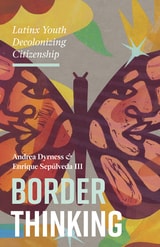
Border Thinking
Latinx Youth Decolonizing CitizenshipAndrea Dyrness
University of Minnesota Press, 2020
Rich accounts of how Latinx migrant youth experience belonging across borders
As anti-immigrant nationalist discourses escalate globally, Border Thinking offers critical insights into how young people in the Latinx diaspora experience belonging, make sense of racism, and long for change. Every year thousands of youth leave Latin America for the United States and Europe, and often the young migrants are portrayed as invaders and, if able to stay, told to integrate into their new society. Border Thinking asks not how to help the diaspora youth assimilate but what the United States and Europe can learn about citizenship from these diasporic youth.
Working in the United States, Spain, and El Salvador, Andrea Dyrness and Enrique Sepúlveda III use participatory action research to collaborate with these young people to analyze how they make sense of their experiences in the borderlands. Dyrness and Sepúlveda engage them in reflecting on their feelings of belonging in multiple places—including some places that treat them as outsiders and criminals. Because of their transnational existence and connections to both home and host countries, diaspora youth have a critical perspective on national citizenship and yearn for new forms of belonging not restricted to national borders. The authors demonstrate how acompañamiento—spaces for solidarity and community-building among migrants—allow youth to critically reflect on their experiences and create support among one another.
Even as national borders grow more restricted and the subject of immigration becomes ever more politically fraught, young people’s identities are increasingly diasporic. As the so-called migrant crisis continues, change in how citizenship and belonging are constructed is necessary, and urgent, to create inclusive and sustainable futures. In Border Thinking, Dyrness and Sepúlveda decouple citizenship from the nation-state, calling for new understandings of civic engagement and belonging.
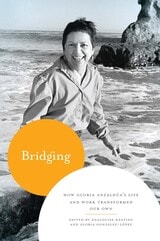
Bridging
How Gloria Anzaldúa's Life and Work Transformed Our OwnEdited by AnaLouise Keating and Gloria González-López
University of Texas Press, 2011
The inspirational writings of cultural theorist and social justice activist Gloria Anzaldúa have empowered generations of women and men throughout the world. Charting the multiplicity of Anzaldúa's impact within and beyond academic disciplines, community trenches, and international borders, Bridging presents more than thirty reflections on her work and her life, examining vibrant facets in surprising new ways and inviting readers to engage with these intimate, heartfelt contributions.
Bridging is divided into five sections: The New Mestizas: "transitions and transformations"; Exposing the Wounds: "You gave me permission to fly in the dark"; Border Crossings: Inner Struggles, Outer Change; Bridging Theories: Intellectual Activism with/in Borders; and "Todas somos nos/otras": Toward a "politics of openness." Contributors, who include Norma Elia Cantú, Elisa Facio, Shelley Fisher Fishkin, Aída Hurtado, Andrea Lunsford, Denise Segura, Gloria Steinem, and Mohammad Tamdgidi, represent a broad range of generations, professions, academic disciplines, and national backgrounds. Critically engaging with Anzaldúa's theories and building on her work, they use virtual diaries, transformational theory, poetry, empirical research, autobiographical narrative, and other genres to creatively explore and boldly enact future directions for Anzaldúan studies.
A book whose form and content reflect Anzaldúa's diverse audience, Bridging perpetuates Anzaldúa's spirit through groundbreaking praxis and visionary insights into culture, gender, sexuality, religion, aesthetics, and politics. This is a collection whose span is as broad and dazzling as Anzaldúa herself.
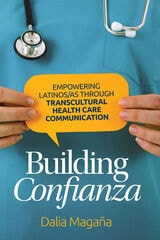
Building Confianza
Empowering Latinos/as Through Transcultural Health Care CommunicationDalia Magaña
The Ohio State University Press, 2021