Results by title
161 books match the query 'Cuba' and 12 start with b
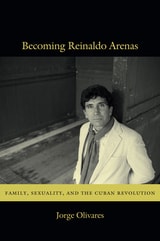
Becoming Reinaldo Arenas
Family, Sexuality, and The Cuban RevolutionJorge Olivares
Duke University Press, 2013
Through insightful close readings of a selection of Arenas's works, including unpublished manuscripts and correspondence, Olivares examines the writer's personal, political, and artistic trajectory, focusing on his portrayals of family, sexuality, exile, and nostalgia. He documents Arenas's critical engagement with cultural and political developments in revolutionary Cuba and investigates the ways in which Arenas challenged literary and national norms. Olivares's analysis shows how Arenas drew on his life experiences to offer revealing perspectives on the Cuban Revolution, the struggles of Cuban exiles, and the politics of sexuality.
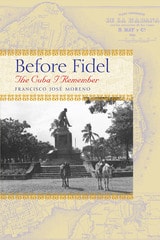
Before Fidel
The Cuba I RememberBy Francisco José Moreno
University of Texas Press, 2007
Before Fidel Castro seized power, Cuba was an ebullient and chaotic society in a permanent state of turmoil, combining a raucous tropical nature with the evils of arbitrary and corrupt government. Yet this fascinating period in Cuban history has been largely forgotten or misrepresented, even though it set the stage for Castro's dramatic takeover in 1959. To reclaim the Cuba that he knew—and add color and detail to the historical record—distinguished political scientist Francisco José Moreno here offers his recollections of the Cuba in which he came of age personally and politically.
Moreno takes us into the little-known world of privileged, upper-middle-class, white Cubans of the 1930s through the 1950s. His vivid depictions of life in the family and on the streets capture the distinctive rhythms of Cuban society and the dynamics between parents and children, men and women, and people of different races and classes. The heart of the book describes Moreno's political awakening, which culminated during his student years at the University of Havana. Moreno gives a detailed, insider's account of the anti-Batista movement, including the Ortodoxos and the Triple A. He recaptures the idealism and naiveté of the movement, as well as its ultimate ineffectiveness as it fell before the juggernaut of the Castro Revolution. His own disillusionment and wrenching decision to leave Cuba rather than accept a commission in Castro's army poignantly closes the book.
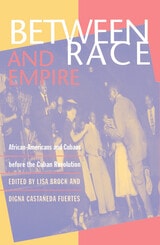
Between Race and Empire
African-Americans and Cubans before the Cuban RevolutionLisa Brock
Temple University Press, 1998
The eleven essays gathered here, written by scholars from both countries, heighten our appreciation of African-Americans as international actors and challenge the notion that Cubans had little or no race consciousness. This is the first study of the world capitalist system to track the international consciousness of working peoples, peoples of color, and women. With a focus on two sets of peoples not in state power, Between Race and Empire expands our understanding of "history from below," and reflects current trends in PanAfricanist and African Diaspora studies by tracing a little-studied linkage between two peoples of African descent.
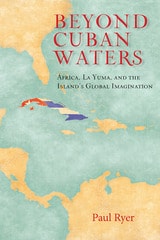
Beyond Cuban Waters
Africa, La Yuma, and the Island's Global ImaginationPaul Ryer
Vanderbilt University Press, 2016
This pursuit of Western status symbols represents a uniquely Cuban experience, set apart from other cultures pursuing the same things. In the Cuban case, this represents neither an acceptance nor rejection of the American cultural influence, but rather a co-opting or "Yumanizing" of these influences.
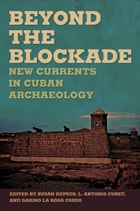
Beyond the Blockade
New Currents in Cuban ArchaeologyEdited by Susan Kepecs, L. Antonio Curet, and Gabino La Rosa Corzo
University of Alabama Press, 2011
An important collection of essays and scholarship by Cuban archaeologists about precontact human settlement on the island.
An important and timely collection of essays that greatly expands knowledge of the human settlement of Cuba and the activities of its indigenous peoples. The collection is a testament to the tenacity of Cuban and US scholars determined to dismantle the political and economic barriers that have impeded collaborative archaeological scholarship in Cuba. Despite economic and political challenges that have limited the pursuit of archaeological research in Cuba, these essays show that Cuban archaeology has made valuable contributions to understanding the cultural processes that have shaped life in the Caribbean in both prehispanic and historic periods and added significantly to our understanding of past Cuban peoples.
The collection, one of only a few studies of Cuban archaeology published in English in the United States, includes essays by both Cuban and US scholars that highlight trends in Cuban archaeology. It recognizes the past pioneers of joint Cuban-US archaeological projects and pays homage to those researchers, including Betty Meggers and Lourdes Dominguez, who sustained scholarly contact across the Florida Straits despite geopolitical roadblocks.
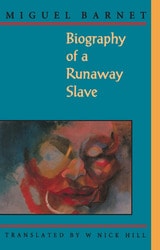
Biography of a Runaway Slave
Miguel Barnet
Northwestern University Press, 2002
In this remarkable testimony, Cuban novelist and anthropologist Miguel Barnet presents the narrative of 105-year-old Esteban Montejo, who lived as a slave, as fugitive in the wilderness, and as a soldier in the Cuban War of Independence. Honest, blunt, compassionate, shrewd, and engaging, his voice provides an extraordinary insight into the African culture that took root in the Caribbean.
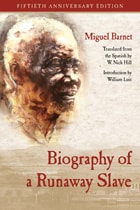
Biography of a Runaway Slave
Fiftieth Anniversary EditionMiguel Barnet; Translated from the Spanish by W. Nick Hill; Introduction by William Luis
Northwestern University Press, 2016
Fiftieth Anniversary Edition
Originally published in 1966, Miguel Barnet’s Biography of a Runaway Slave provides the written history of the life of Esteban Montejo, who lived as a slave, as a fugitive in the wilderness, and as a soldier fighting against Spain in the Cuban War of Independence. A new introduction by one of the most preeminent Afro-Hispanic scholars, William Luis, situates Barnet’s ethnographic strategy and lyrical narrative style as foundational for the tradition of testimonial fiction in Latin American literature. Barnet recorded his interviews with the 103-year-old Montejo at the onset of the Cuban Revolution. This insurgent’s history allows the reader into the folklore and cultural history of Afro-Cubans before and after the abolition of slavery. The book serves as an important contribution to the archive of black experience in Cuba and as a reminder of the many ways that the present continues to echo the past.
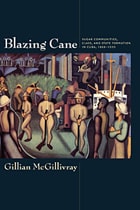
Blazing Cane
Sugar Communities, Class, and State Formation in Cuba, 1868–1959Gillian McGillivray
Duke University Press, 2009
Focusing on sugar communities in eastern and central Cuba, McGillivray recounts how farmers and workers pushed the Cuban government to move from exclusive to inclusive politics and back again. The revolutionary caudillo networks that formed between 1895 and 1898, the farmer alliances that coalesced in the 1920s, and the working-class groups of the 1930s affected both day-to-day local politics and larger state-building efforts. Not limiting her analysis to the island, McGillivray shows that twentieth-century Cuban history reflected broader trends in the Western Hemisphere, from modernity to popular nationalism to Cold War repression.

Bridging Enigma
Cubans on Cuba, Volume 96Ambrosio Fornet
Duke University Press, 0
Fostered by both caution and audacity, in a climate of both trust and tension, and in the face of sustained North American hostility through nearly four decades, Cuban artists and writers have succeeded in building bridges between domestic and foreign cultural institutions, partly offsetting the profound material deprivations under which they have labored. The work collected in this volume introduces a group of writers, artists, and filmmakers who provide a window on Cuban life, illuminating this enigmatic island and bridging the troubled waters it shares with its continental neighbor to the north.
Contributors. Arturo Arango, Emilio Bejel, Rosa Ileana Boudet, Roberto Fernández Retamar, Ambrosio Fornet, Rafael Hernández, Francisco López Sacha, Humberto Manduley López, Vivian Martínez Tabares, Margarita Mateo Palmer, Miguel Mejides, Reinaldo Montero, Lisandro Otero, Graziella Pogolotti, Magda Resik, Cintio Vitier
Broadcasting Modernity
Cuban Commercial Television, 1950-1960Yeidy M. Rivero
Duke University Press, 2015
Buena Vista in the Club
Rap, Reggaetón, and Revolution in HavanaGeoffrey Baker
Duke University Press, 2011
By Heart De Memoria
Cuban Women'S Journeys In/Out Of ExileMaria De Los Angeles Torre
Temple University Press, 2003