Results by title
50 books match the query 'Culture in motion pictures' and 3 start with b
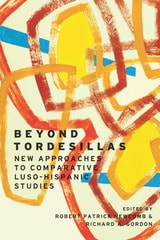
Beyond Tordesillas
New Approaches to Comparative Luso-Hispanic StudiesEdited by Robert Patrick Newcomb and Richard A. Gordon
The Ohio State University Press, 2017
The jumping-off point for Beyond Tordesillas is the critic Jorge Schwartz’s evocative call to arms, “Down with Tordesillas!” In this groundbreaking essay, Schwartz looks to the imaginary line created by the Treaty of Tordesillas (1494), which divided the known world into Spanish and Portuguese spheres of influence, to stand in for generations of literary and cultural noncommunication between the Spanish- and Portuguese-speaking spheres, and their attendant academic disciplines. This volume’s contributions range topically across continents, from the Iberian Peninsula to Latin American countries. They also range across genres, with studies that analyze fictional narrative, music, performance, and visual culture. Beyond Tordesillas forcefully challenges the disciplinary—and indeed, arbitrary—boundaries that for too long have separated Hispanic and Luso-Brazilian studies.
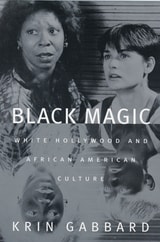
Black Magic
White Hollywood and African American CultureKrin Gabbard
Rutgers University Press, 2004
As Krin Gabbard brilliantly reveals in Black Magic, we duly recognize the cultural heritage of African Americans in literature, music, and art, but there is a disturbing pattern in the roles that blacks are asked to play-particularly in the movies. Many recent films, including The Matrix, Fargo, The Green Mile, Ghost, The Talented Mr. Ripley, Pleasantville, The Bridges of Madison County, and Crumb, reveal a fascination with black music and sexuality even as they preserve the old racial hierarchies. Quite often the dependence on African American culture remains hidden-although it is almost perversely pervasive. In the final chapters of Black Magic, Gabbard looks at films by Robert Altman and Spike Lee that attempt to reverse many of these widespread trends.
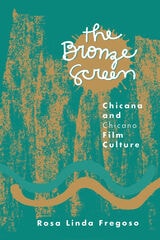
Bronze Screen
Chicana and Chicano Film CultureRosa Linda Fregoso
University of Minnesota Press, 1993
Rosa Linda Fregoso’s The Bronze Screen opens the way for international debate on the new critical field of Chicano/a cinema. Fregoso provides an incisive articulation of the ways in which narrative codes in film can telescope complex versions of Mexican and American culture and history. The often violent impact of ‘first’ (U.S.) and ‘third’ (Mexico) world cultures and geographies is channeled through the very term Chicano/a as well as its cinematic representation. Fregoso’s masterful critique brings out with great clarity the irony, paradox, and contradictions of such historical collisions. --Norma Alarcón, University of California, Berkeley