Results by title
65 books match the query 'Cultures' and 3 start with b

Ball Don't Lie
Myth, Genealogy, and Invention in the Cultures of BasketballYago Colás
Temple University Press, 2016
Pro basketball player Rasheed Wallace often exclaimed the pragmatic truth “Ball don’t lie!” during a game. It is a protest against a referee’s bad calls. But the slogan, which originated in pickup games, brings the reality of a racialized urban playground into mainstream American popular culture.
In Ball Don’t Lie!, Yago Colás traces the various forms of power at work in the intersections between basketball and language from the game’s invention to the present day. He critiques existing popular myths concerning the history of basketball, contextualizes them, and presents an alternative history of the sport inspired by innovations. Colás emphasizes the creative prerogative of players and the ways in which their innovations shape—and are shaped by—broader cultural and social phenomena.
Ball Don't Lie! shows that basketball cannot be reduced to a single, fixed or timeless essence but instead is a continually evolving exhibition of physical culture that flexibly adapts to and sparks changes in American society.

Border Watch
Cultures of Immigration, Detention and ControlAlexandra Hall
Pluto Press, 2012
Questions over immigration and asylum face almost all Western countries. Should only economically useful immigrants be allowed? What should be done with unwanted or 'illegal' immigrants? In this bold and original intervention, Alexandra Hall shows that immigration detention centres offer a window onto society's broader attitudes towards immigrants.
Despite periodic media scandals, remarkably little has been written about the everyday workings of the grassroots immigration system, or about the people charged with enacting immigration policy at local levels. Detention, particularly, is a hidden side of border politics, despite its growing international importance as a tool of control and security. This book fills the gap admirably, analysing the everyday encounters between officers and immigrants in detention to explore broad social trends and theoretical concerns.
This highly topical book provides rare insights into the treatment of the 'other' and will be essential for policy makers and students studying anthropology and sociology.
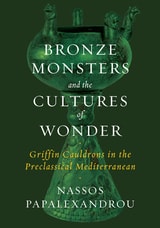
Bronze Monsters and the Cultures of Wonder
Griffin Cauldrons in the Preclassical MediterraneanNassos Papalexandrou
University of Texas Press, 2021
The eighth and seventh centuries BCE were a time of flourishing exchange between the Mediterranean and the Near East. One of the period’s key imports to the Hellenic and Italic worlds was the image of the griffin, a mythical monster that usually possesses the body of a lion and the head of an eagle. In particular, bronze cauldrons bore griffin protomes—figurative attachments showing the neck and head of the beast. Crafted in fine detail, the protomes were made to appear full of vigor, transfixing viewers.
Bronze Monsters and the Cultures of Wonder takes griffin cauldrons as case studies in the shifting material and visual universes of preclassical antiquity, arguing that they were perceived as lifelike monsters that introduced the illusion of verisimilitude to Mediterranean arts. The objects were placed in the tombs of the wealthy (Italy, Cyprus) and in sanctuaries (Greece), creating fantastical environments akin to later cabinets of curiosities. Yet griffin cauldrons were accessible only to elites, ensuring that the new experience of visuality they fostered was itself a symbol of status. Focusing on the sensory encounter of this new visuality, Nassos Papalexandrou shows how spaces made wondrous fostered novel subjectivities and social distinctions.