289 books match the query 'Dance' and 16 start with b
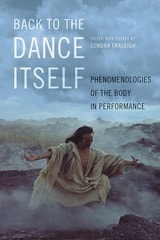
cover of Back to the Dance Itself: Phenomenologies of the Body in Performance

Back to the Dance Itself

Phenomenologies of the Body in Performance

Edited with Essays by Sondra Fraleigh

University of Illinois Press, 2018

In Back to the Dance Itself, Sondra Fraleigh edits essays that illuminate how scholars apply a range of phenomenologies to explore questions of dance and the world; performing life and language; body and place; and self-knowing in performance. Some authors delve into theoretical perspectives, while others relate personal experiences and reflections that reveal fascinating insights arising from practice. Collectively, authors give particular consideration to the interactive lifeworld of making and doing that motivates performance. Their texts and photographs study body and the environing world through points of convergence, as correlates in elemental and constant interchange modeled vividly in dance. Selected essays on eco-phenomenology and feminism extend this view to the importance of connections with, and caring for, all life.

Contributors: Karen Barbour, Christine Bellerose, Robert Bingham, Kara Bond, Hillel Braude, Sondra Fraleigh, Kimerer LaMothe, Joanna McNamara, Vida Midgelow, Ami Shulman, and Amanda Williamson.
[more]
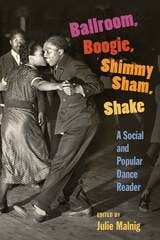
cover of Ballroom, Boogie, Shimmy Sham, Shake: A Social and Popular Dance Reader

Ballroom, Boogie, Shimmy Sham, Shake

A Social and Popular Dance Reader

Edited by Julie Malnig

University of Illinois Press, 2008

This dynamic collection documents the rich and varied history of social dance and the multiple styles it has generated, while drawing on some of the most current forms of critical and theoretical inquiry. The essays cover different historical periods and styles; encompass regional influences from North and South America, Britain, Europe, and Africa; and emphasize a variety of methodological approaches, including ethnography, anthropology, gender studies, and critical race theory. While social dance is defined primarily as dance performed by the public in ballrooms, clubs, dance halls, and other meeting spots, contributors also examine social dance’s symbiotic relationship with popular, theatrical stage dance forms.

Contributors are Elizabeth Aldrich, Barbara Cohen-Stratyner, Yvonne Daniel, Sherril Dodds, Lisa Doolittle, David F. García, Nadine George-Graves, Jurretta Jordan Heckscher, Constance Valis Hill, Karen W. Hubbard, Tim Lawrence, Julie Malnig, Carol Martin, Juliet McMains, Terry Monaghan, Halifu Osumare, Sally R. Sommer, May Gwin Waggoner, Tim Wall, and Christina Zanfagna.
[more]
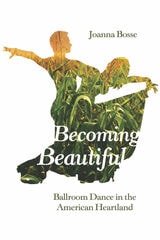
cover of Becoming Beautiful: Ballroom Dance in the American Heartland

Becoming Beautiful

Ballroom Dance in the American Heartland

Joanna Bosse

University of Illinois Press, 2015

In Becoming Beautiful, Joanna Bosse explores the transformations undergone by the residents of a Midwestern town when they step out on the dance floor for the very first time.
 
Bosse uses sensitive fieldwork as well as her own immersion in ballroom culture to lead readers into a community that springs up around ballroom dance. The result is a portrait of the real people who connect with others, change themselves, and join a world that foxtrots to its own rules, conventions, and rewards. Bosse's eye for revealing, humorous detail adds warmth and depth to discussions around critical perspectives on the experiences the dance hall provides, the nature of partnership and connection, and the notion of how dancing allows anyone to become beautiful.
[more]
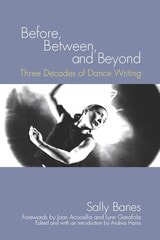
cover of Before, Between, and Beyond: Three Decades of Dance Writing

Before, Between, and Beyond

Three Decades of Dance Writing

Sally Banes; Edited and with an introduction by Andrea Harris

University of Wisconsin Press, 2007
     Sally Banes has been a preeminent critic and scholar of American contemporary dance, and Before, Between, Beyond spans more than thirty years of her prolific work. Beginning with her first published review and including previously unpublished papers, this collection presents some of her finest works on dance and other artistic forms. It concludes with her most recent research on Geroge Balanchine's dancing elephants. In each piece, Banes's detailed eye and sensual prose strike a rare balance between description, context, and opinion, delineating the American artistic scene with remarkable grace. With contextualizing essays by dance scholars Andrea Harris, Joan Acocella, and Lynn Garafola, this is a compelling, insightful indispensable summation of Banes's critical career.
[more]
cover of Bells of Change: Kathak Dance, Women and Modernity In India

Bells of Change

Kathak Dance, Women and Modernity In India

Pallabi Chakravorty

Seagull Books, 2008

This is the first critical study of Kathak dance. Bells of Change traces two centuries of Kathak, from the colonial nautch dance to classical Kathak under nationalism and post-colonialism to transnationalism and globalization. Reorienting dance to focus on the lived experiences of dancers from a wide cross-section of society, the book narrates the history of Kathak from baijis and tawaifs to the global stage.
[more]
cover of Bhangra and Asian Underground: South Asian Music and the Politics of Belonging in Britain

Bhangra and Asian Underground

South Asian Music and the Politics of Belonging in Britain

Falu Bakrania

Duke University Press, 2013
Asian Underground music—a fusion of South Asian genres with western breakbeats created for the dance club scene by DJs and musicians of Indian, Pakistani, and Bangladeshi descent—went mainstream in the U.K. in the late 1990s. Its success was unprecedented: British bhangra, a blend of Punjabi folk music with hip-hop musical elements, was enormously popular among South Asian communities but had yet to become mainstream. For many, the widespread attention to Asian Underground music signaled the emergence of a supposedly new, tolerant, and multicultural Britain that could finally accept South Asians. Interweaving ethnography and theory, Falu Bakrania examines the social life of British Asian musical culture to reveal a more complex and contradictory story of South Asian belonging in Britain. Analyzing the production of bhangra and Asian Underground music by male artists and its consumption by female club-goers, Bakrania shows that gender, sexuality, and class intersected in ways that profoundly shaped how young people interpreted “British” and “Asian” identity and negotiated, sometimes violently, contests about ethnic authenticity, sexual morality, individual expression, and political empowerment.


[more]
cover of Black Performance Theory

Black Performance Theory

Thomas F. DeFrantz and Anita Gonzalez, eds.

Duke University Press, 2014

Black performance theory is a rich interdisciplinary area of study and critical method. This collection of new essays by some of its pioneering thinkers—many of whom are performers—demonstrates the breadth, depth, innovation, and critical value of black performance theory. Considering how blackness is imagined in and through performance, the contributors address topics including flight as a persistent theme in African American aesthetics, the circulation of minstrel tropes in Liverpool and in Afro-Mexican settlements in Oaxaca, and the reach of hip-hop politics as people around the world embrace the music and dance. They examine the work of contemporary choreographers Ronald K. Brown and Reggie Wilson, the ways that African American playwrights translated the theatricality of lynching to the stage, the ecstatic music of Little Richard, and Michael Jackson's performance in the documentary This Is It. The collection includes several essays that exemplify the performative capacity of writing, as well as discussion of a project that re-creates seminal hip-hop album covers through tableaux vivants. Whether deliberating on the tragic mulatta, the trickster figure Anansi, or the sonic futurism of Nina Simone and Adrienne Kennedy, the essays in this collection signal the vast untapped critical and creative resources of black performance theory.

Contributors. Melissa Blanco Borelli, Daphne A. Brooks, Soyica Diggs Colbert, Thomas F. DeFrantz, Nadine George-Graves, Anita Gonzalez, Rickerby Hinds, Jason King, D. Soyini Madison, Koritha Mitchell, Tavia Nyong'o, Carl Paris, Anna B. Scott, Wendy S. Walters, Hershini Bhana Young
[more]
cover of Black Theater Is Black Life: An Oral History of Chicago Theater and Dance, 1970-2010

Black Theater Is Black Life

An Oral History of Chicago Theater and Dance, 1970-2010

Harvey Young and Queen Meccasia Zabriskie

Northwestern University Press, 2013
Black Theater Is Black Life fills a critical gap in the history of African American culture in Chicago. Through interviews with prominent producers, directors, choreographers, designers, dancers, and actors, Young and Zabriskie create a portrait of a diverse, dynamic artistic community between 1970 and 2010. They frame this history with helpful guides, including a chronology of key events, a glossary of names, and an appendix of leading performing arts institutions in Chicago.
[more]
cover of Bodies of the Text: Dance as Theory, Literature as Dance

Bodies of the Text

Dance as Theory, Literature as Dance

Edited by Ellen W Goellner

Rutgers University Press, 1995

Dance and literary studies have traditionally been at odds: dancers and dance critics have understood academic analysis to be overly invested in the mind at the expense of body signification; literary critics and theorists have seen dance studies as anti-theoretical, even anti-intellectual. Bodies of the Text is the first book-length study of the interconnections between the two arts and the body of writing about them. The essays, by scholar-critics of dance and literature, explore dances actual and fictional to offer powerful new insights into issues of gender, race, ethnicity, popular culture, feminist aesthetics, historical "embodiment," identity politics, and narrativity. The general introduction traces the genealogy of dance studies in the academy to suggest why critical and theoretical attention to dance--and dance's challenges to writing--is both compelling and overdue. A milestone in interdisciplinary studies, Bodies of the Text opens both its fields to new inquiry, new theoretical precision, and to new readers and writers. 
[more]
cover of Body and Mind in Motion: Dance and Neuroscience in Conversation

Body and Mind in Motion

Dance and Neuroscience in Conversation

Glenna Batson with Margaret Wilson

Intellect Books, 2014

Western contemporary dance and body-mind education have engaged in a pas de deux for more than four decades. The rich interchange of somatics and dance has altered both fields, but scholarship that substantiates these ideas through the findings of twentieth-century scientific advances has been missing. This book fills that gap and brings to light contemporary discoveries of neuroscience and somatic education as they relate to dance. Drawing from the burgeoning field of “embodiment”—itself an idea at the intersection of the sciences, humanities, arts, and technologies—Body and Mind in Motion highlights the relevance of somatic education within dance education, dance science, and body-mind studies.
[more]
cover of Books Do Furnish a Room: Book 10 of A Dance to the Music of Time

Books Do Furnish a Room

Book 10 of A Dance to the Music of Time

Anthony Powell

University of Chicago Press, 1995

Anthony Powell’s universally acclaimed epic A Dance to the Music of Time offers a matchless panorama of twentieth-century London. Now, for the first time in decades, readers in the United States can read the books of Dance as they were originally published—as twelve individual novels—but with a twenty-first-century twist: they’re available only as e-books.

The tenth volume, Books Do Furnish a Room (1971), finds Nick Jenkins and his circle beginning to re-establish their lives and careers in the wake of the war. Nick dives into work on a study of Robert Burton; Widmerpool grapples with the increasingly difficult and cruel Pamela Flitton—now his wife; and we are introduced to the series’ next great character, the dissolute Bohemian novelist X. Trapnel, a man who exudes in equal measure mystery, talent, and an air of self-destruction.

"Anthony Powell is the best living English novelist by far. His admirers are addicts, let us face it, held in thrall by a magician."--Chicago Tribune

"A book which creates a world and explores it in depth, which ponders changing relationships and values, which creates brilliantly living and diverse characters and then watches them grow and change in their milieu. . . . Powell's world is as large and as complex as Proust's."--Elizabeth Janeway, New York Times

"One of the most important works of fiction since the Second World War. . . . The novel looked, as it began, something like a comedy of manners; then, for a while, like a tragedy of manners; now like a vastly entertaining, deeply melancholy, yet somehow courageous statement about human experience."--Naomi Bliven, New Yorker

“The most brilliant and penetrating novelist we have.”--Kingsley Amis
[more]
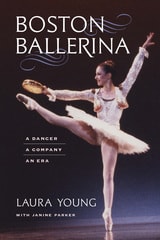
cover of Boston Ballerina: A Dancer, a Company, an Era

Boston Ballerina

A Dancer, a Company, an Era

Laura Young and Janine Parker

University Press of New England, 2017
As a charter member of Boston Ballet and its predecessor, New England Civic Ballet, Laura Young has been affiliated with the company longer than any other dancer in its history. This book is both a memoir of her personal journey and a fascinating account of Boston Ballet’s rise from a regional troupe to the internationally recognized company that it is today. It is interspersed with ruminations on the history of ballet, stories from the company’s Balanchine-influenced early years under founder E. Virginia Williams, and recollections from noteworthy tours, including those featuring the legendary Rudolf Nureyev, with whom Young was frequently paired. After retiring from the stage, Young has continued her affiliation with Boston Ballet, both as an administrator and a teacher. Working in collaboration with Janine Parker, Young has written a lively, informed, and entertaining memoir.
[more]
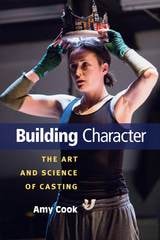
cover of Building Character: The Art and Science of Casting

Building Character

The Art and Science of Casting

Amy Cook

University of Michigan Press, 2018

What can we learn about how we understand each other and ourselves by examining the casting we find on stage and film—the casting we find perfect and the casting we find wrong? Building Character examines how the process of “casting” an actor in a part creates a character and how this can be usefully understood through deploying theories from the cognitive sciences. A casting director may match the perceived qualities of an actor with the perceived qualities of the character, but the combination is also synergistic; casting a character creates qualities. While casting directors do this professionally, all of us do this when we make sense of the people around us. This book argues that we build the characters of others from a sea of stimuli and that the process of watching actors take on roles improves our ability to “cast” those roles in our daily lives. Amy Cook examines the visible celebrity casting, such as Robert Downey Jr. as Ironman or Judi Dench as Bond’s M, the political casting of one candidate as “presidential” and another as “weak,” the miscasting of racial profiling and sexual assault, and the counter casting that results when actors and characters are not where or who we expect.
[more]
cover of Bulldaggers, Pansies, and Chocolate Babies: Performance, Race, and Sexuality in the Harlem Renaissance

Bulldaggers, Pansies, and Chocolate Babies

Performance, Race, and Sexuality in the Harlem Renaissance

James F. Wilson

University of Michigan Press, 2011

Bulldaggers, Pansies, and Chocolate Babies shines the spotlight on historically neglected plays and performances that challenged early twentieth-century notions of the stratification of race, gender, class, and sexual orientation. On Broadway stages, in Harlem nightclubs and dance halls, and within private homes sponsoring rent parties, African American performers of the 1920s and early 1930s teased the limits of white middle-class morality. Blues-singing lesbians, popularly known as "bulldaggers," performed bawdy songs; cross-dressing men vied for the top prizes in lavish drag balls; and black and white women flaunted their sexuality in scandalous melodramas and musical revues. Race leaders, preachers, and theater critics spoke out against these performances that threatened to undermine social and political progress, but to no avail: mainstream audiences could not get enough of the riotous entertainment.James F. Wilson has based his rich cultural history on a wide range of documents from the period, including eyewitness accounts, newspaper reports, songs, and play scripts, combining archival research with an analysis grounded in a cultural studies framework that incorporates both queer theory and critical race theory. Throughout, he argues against the widely held belief that the stereotypical forms of black, lesbian, and gay show business of the 1920s prohibited the emergence of distinctive new voices. Figuring prominently in the book are African American performers including Gladys Bentley, Ethel Waters, and Florence Mills, among others, and prominent writers, artists, and leaders of the era, including Langston Hughes, Wallace Thurman, Zora Neale Hurston, and W. E. B. Du Bois. The study also engages with contemporary literary critics, including Henry Louis Gates and Houston Baker. "James F. Wilson uncovers fascinating new material on the Harlem Renaissance, shedding light on the oft-forgotten gay and lesbian contributions to the era's creativity and Civil Rights. Extremely well researched, compellingly written, and highly informative."
—David Krasner, author of A Beautiful Pageant: African American Theatre, Drama, and Performance in the Harlem Renaissance, 1910-1927
[more]
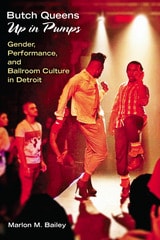
cover of Butch Queens Up in Pumps: Gender, Performance, and Ballroom Culture in Detroit

Butch Queens Up in Pumps

Gender, Performance, and Ballroom Culture in Detroit

Marlon M. Bailey

University of Michigan Press, 2013

Butch Queens Up in Pumpsexamines Ballroom culture, in which inner-city LGBT individuals dress, dance, and vogue to compete for prizes and trophies. Participants are affiliated with a house, an alternative family structure typically named after haute couture designers and providing support to this diverse community. Marlon M. Bailey’s rich first-person performance ethnography of the Ballroom scene in Detroit examines Ballroom as a queer cultural formation that upsets dominant notions of gender, sexuality, kinship, and community.
[more]
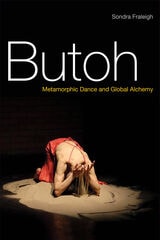
cover of Butoh: Metamorphic Dance and Global Alchemy

Butoh

Metamorphic Dance and Global Alchemy

Sondra Fraleigh

University of Illinois Press, 2010

Both a refraction of the bombings of Hiroshima and Nagasaki and a protest against Western values, butoh is a form of Japanese dance theater that emerged in the aftermath of World War II. Sondra Fraleigh chronicles the growth of this provocative art form from its mid-century founding under a sign of darkness to its assimilation in the twenty-first century as a poignant performance medium with philosophical and political implications.
 
Through highly descriptive, thoughtful, and emotional prose, Fraleigh traces the transformative alchemy of this metaphoric dance form by studying the international movement inspired by its aesthetic mixtures. While butoh has retained a special identity related to its Japanese background, it also has blossomed into a borderless art with a tolerant and inclusive morphology gaining prominence in a borderless century.
 
Employing intellectual and aesthetic perspectives to reveal the origins, major figures, and international development of the dance, Fraleigh documents the range and variety of butoh artists around the world with first-hand knowledge of butoh performances from 1973 to 2008. Her definitions of butoh's morphology, alchemy, and philosophy set a theoretical framework for poetic and engaging articulations of twenty butoh performances in Japan, Europe, India, and the West. With a blend of scholarly research and direct experience, she also signifies the unfinished nature of butoh and emphasizes its capacity to effect spiritual transformation and bridge cultural differences.
[more]