126 books match the query 'Decolonization' and 5 start with b
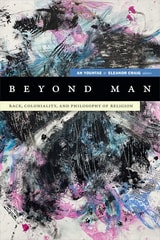
cover of Beyond Man: Race, Coloniality, and Philosophy of Religion

Beyond Man

Race, Coloniality, and Philosophy of Religion

Yountae An and Eleanor Craig, editors

Duke University Press, 2021

Beyond Man reimagines the meaning and potential of a philosophy of religion that better attends to the inextricable links among religion, racism, and colonialism. An Yountae, Eleanor Craig, and the contributors reckon with the colonial and racial implications of the field's history by staging a conversation with Black, Indigenous, and decolonial studies. In their introduction, An and Craig point out that European-descended Christianity has historically defined itself by its relation to the other while paradoxically claiming to represent and speak to humanity in its totality. The topics include secularism, the Eucharist's relation to Blackness, and sixteenth-century Brazilian cannibalism rituals as well as an analysis of how Mircea Eliade's conception of the sacred underwrites settler colonial projects and imaginaries. Throughout, the contributors also highlight the theorizing of Afro-Caribbean thinkers such as Sylvia Wynter, C. L. R. James, Frantz Fanon, and Aimé Césaire whose work disrupts the normative Western categories of religion and philosophy.

Contributors. An Yountae, Ellen Armour, J. Kameron Carter, Eleanor Craig, Amy Hollywood, Vincent Lloyd, Filipe Maia, Mayra Rivera, Devin Singh, Joseph R. Winters
[more]
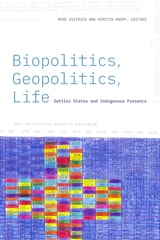
cover of Biopolitics, Geopolitics, Life: Settler States and Indigenous Presence

Biopolitics, Geopolitics, Life

Settler States and Indigenous Presence

René Dietrich and Kerstin Knopf, editors

Duke University Press, 2023

The contributors to Biopolitics, Geopolitics, Life investigate biopolitics and geopolitics as two distinct yet entangled techniques of settler-colonial states across the globe, from the Americas and Hawai‘i to Australia and Aotearoa/New Zealand. Drawing on literary and cultural studies, social sciences, political theory, visual culture, and film studies, they show how biopolitics and geopolitics produce norms of social life and land use that delegitimize and target Indigenous bodies, lives, lands, and political formations. Among other topics, the contributors explore the representations of sexual violence against Native women in literature, Indigenous critiques of the carceral state in North America, Indigenous elders’ refusal of dominant formulations of aging, the governance of Indigenous peoples in Guyana, the displacement of Guaraní in Brazil, and the 2016 rule to formally acknowledge a government-to-government relationship between the US federal government and the Native Hawaiian community. Throughout, the contributors contend that Indigenous life and practices cannot be contained and defined by the racialization and dispossession of settler colonialism, thereby pointing to the transformative potential of an Indigenous-centered decolonization. 

Contributors René Dietrich, Jacqueline Fear-Segal, Mishuana Goeman, Alyosha Goldstein, Sandy Grande, Michael R. Griffiths, Shona N. Jackson, Kerstin Knopf, Sabine N. Meyer, Robert Nichols, Mark Rifkin, David Uahikeaikaleiʻohu Maile
[more]
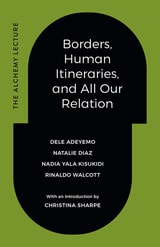
cover of Borders, Human Itineraries, and All Our Relation

Borders, Human Itineraries, and All Our Relation

Dele Adeyemo, Natalie Diaz, Nadia Yala Kisukidi, and Rinaldo Walcott. With a Foreword by Christina Sharpe

Duke University Press, 2024

The first annual Alchemy Lecture brings four deep and agile writers from different geographies and disciplines into vibrant conversation on a topic of urgent relevance: humans and borders. Borders, Human Itineraries, and All Our Relation captures and expands those conversations in insightful, passionate ways. Architect, artist, and urban theorist Dele Adeyemo (UK/Nigeria) calls attention to the complexity of Black infrastructures, questioning how “the environments that surround us condition the possibility of our being.” Poet Natalie Diaz (US/Mojave/Akimel O’otham) writes, “Like story, migration is the sensual movement of knowledge,” and asks, “What is the language we need to live right now?” Philosopher Nadia Yala Kisukidi (France) suggests there is no diasporic life “without the dynamics of fabulation, where we pass down, from generation to generation, the stories of our ancestors who walked barefoot for many months.” And cultural theorist Rinaldo Walcott (Canada) asks us to consider inheritances beyond white supremacist logics: “What might it mean to live a life, if we can’t risk desiring and working towards utopia?” As each alchemist considers the legacies of anticolonial struggle, the future of the planet, and the textures of Black and Indigenous life, their essays speak to each other in multiple ways, creating something startling and revelatory: a vision of the world as it is, and as it could be.
[more]
cover of Britain, France and the Decolonization of Africa: Future Imperfect?

Britain, France and the Decolonization of Africa

Future Imperfect?

Edited by Andrew W.M. Smith and Chris Jeppesen

University College London, 2017

Looking at decolonization in the conditional tense, this volume teases out the complex and uncertain ends of British and French empire in Africa during the period of ‘late colonial shift’ after 1945. Rather than view decolonization as an inevitable process, the contributors together explore the crucial historical moments in which change was negotiated, compromises were made, and debates were staged. Three core themes guide the analysis: development, contingency and entanglement. The chapters consider the ways in which decolonization was governed and moderated by concerns about development and profit. A complementary focus on contingency allows deeper consideration of how colonial powers planned for ‘colonial futures’, and how divergent voices greeted the end of empire. Thinking about entanglements likewise stresses both the connections that existed between the British and French empires in Africa, and those that endured beyond the formal transfer of power.
[more]
cover of Bundle: Life, Stories, and Hope Across Díne Worlds

Bundle

Life, Stories, and Hope Across Díne Worlds

J. Jeffery Clark

University of Arizona Press, 2027

The stories colonizers tell about Diné people represent them as adaptors, uncontrollable, and unruly. These wounding narratives justify the displacement and dispossession of Diné people, masking the ongoing violence of settler colonialism. 

Bundle: Life, Stories, and Hope Across Diné Worlds challenges and dismantles these harmful depictions. By shifting the paradigm away from anthropological lenses, this book offers an exploration of bundling: the active, physical, spiritual, and ideological practice through which Diné people assemble stories, tools, and knowledge. From world shifts detailed in oral narratives to the present deadly structures of colonization, Diné people have long relied on their bundled knowledge systems to sustain their presence across worlds and time. 

Bundle is a must-read for anyone seeking to understand Diné resistance, hope, and worlding. Rather than studying Diné life from the outside, it prioritizes Diné ways of knowing and being to develop bundling as a theory of continuance. For readers invested in decolonization, place-making, and storytelling, Bundle provides an indispensable roadmap for how Diné people continue even in the face of domination.

[more]