Results by title
628 books match the query 'Democracy' and 13 start with b
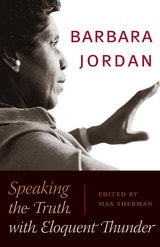
Barbara Jordan
Speaking the Truth with Eloquent ThunderEdited by Max Sherman
University of Texas Press, 2007
Revered by Americans across the political spectrum, Barbara Jordan was "the most outspoken moral voice of the American political system," in the words of former President Bill Clinton, who awarded her the Presidential Medal of Freedom in 1994. Throughout her career as a Texas senator, U.S. congresswoman, and distinguished professor at the Lyndon B. Johnson School of Public Affairs, Barbara Jordan lived by a simple creed: "Ethical behavior means being honest, telling the truth, and doing what you said you were going to do." Her strong stand for ethics in government, civil liberties, and democratic values still provides a standard around which the nation can unite in the twenty-first century.
This volume brings together several major political speeches that articulate Barbara Jordan's most deeply held values. They include:
- "Erosion of Civil Liberties," a commencement address delivered at Howard University on May 12, 1974, in which Jordan warned that "tyranny in America is possible"
- "The Constitutional Basis for Impeachment," Jordan's ringing defense of the U.S. Constitution before the House Judiciary Committee investigating the Watergate break-in
- Keynote addresses to the Democratic National Conventions of 1976 and 1992, in which Jordan set forth her vision of the Democratic Party as an advocate for the common good and a catalyst of change
- Testimony in the U.S. Congress on the confirmation of Supreme Court nominee Robert Bork and on immigration reform
- Meditations on faith and politics from two National Prayer Breakfasts
- Acceptance speech for the 1995 Sylvanus Thayer Award presented by the Association of Graduates of the United States Military Academy, in which Jordan challenged the military to uphold the values of "duty, honor, country"
Accompanying the speeches are context-setting introductions by volume editor Max Sherman. The book concludes with the eloquent eulogy that Bill Moyers delivered at Barbara Jordan's memorial service in 1996, in which he summed up Jordan's remarkable life and career by saying, "Just when we despaired of finding a hero, she showed up, to give the sign of democracy.... This is no small thing. This, my friends, this is grace. And for it we are thankful."
Beautiful Democracy
Aesthetics and Anarchy in a Global EraRuss Castronovo
University of Chicago Press, 2007
Between Military Rule and Democracy
Regime Consolidation in Greece, Turkey, and BeyondYaprak Gürsoy
University of Michigan Press, 2017
Based on more than 150 interviews with Greek and Turkish elites, Gürsoy offers a detailed analysis of both countries from the interwar period to recent regime crises. She argues that officers, politicians, and businesspeople prefer democracy, authoritarianism, or short-lived coups depending on the degree of threat they perceive to their interests from each other and the lower classes. The power of elites relative to the opposition, determined in part by the coalitions they establish with each other, affects the success of military interventions and the consolidation of regimes.
With historical and theoretical depth, Between Military Rule and Democracy will interest students of regime change and civil-military relations in Greece, Turkey, Thailand, and Egypt, as well as in countries facing similar challenges to democratization.
Beyond Adversary Democracy
Jane J. Mansbridge
University of Chicago Press, 1983
"Sociologists recurrently complain about how seldom it is that we produce books that combine serious theorizing about important issues of public policy with original and sensitive field research. Several rounds of enthusiastic applause, then, are due Jane Mansbridge . . . for having produced a dense and well written book whose subject is nothing less ambitious than the theory of democracy and its problems of equality, solidarity, and consensus. Beyond Adversary Democracy, however, is not simply a work of political theory; Mansbridge explores her abstract subject matter by close studies (using ethnographic, documentary, and questionnaire methods) of two small actual democracies operating at their most elemental American levels (1) a New England town meeting ("Selby," Vermont) and (2) an urban crisis center ("Helpline"), whose 41 employees shared a New Left-Counterculture belief in participatory democracy and consensual decision-making. [Mansbridge] is a force to contend with. It is in our common interest that she be widely read."—Bennett M. Berger, Contemporary Sociology
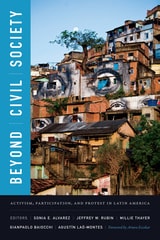
Beyond Civil Society
Activism, Participation, and Protest in Latin AmericaSonia E. Alvarez, Jeffrey W. Rubin, Millie Thayer, Gianpaolo Baiocchi, and Agustín Laó-Montes, editors
Duke University Press, 2017
Contributors. Sonia E. Alvarez, Kiran Asher, Leonardo Avritzer, Gianpaolo Baiocchi, Andrea Cornwall, Graciela DiMarco, Arturo Escobar, Raphael Hoetmer, Benjamin Junge, Luis E. Lander, Agustín Laó-Montes, Margarita López Maya, José Antonio Lucero, Graciela Monteagudo, Amalia Pallares, Jeffrey W. Rubin, Ana Claudia Teixeira, Millie Thayer
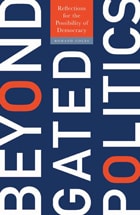
Beyond Gated Politics
Reflections for the Possibility of DemocracyRomand Coles
University of Minnesota Press, 2005
In Beyond Gated Politics, political theorist and grassroots activist Romand Coles argues that the survival of democracy depends on recognizing the failings of disengaged liberal democracy—the exclusions and subjugations that accompany every democratic “we,” for example—and experimenting with more radical modes of democratic theory and action. Among those brought into the conversation are John Howard Yoder, John Rawls, Alisdair MacIntyre, Jacques Derrida, Jean-Luc Nancy, Gloria Anzaldúa, and Audre Lorde.
Coles, whose work is deeply informed by his own experiences as an activist, pays close attention to the actual practice of democracy with particular interest in emerging social movements. In doing so, he not only moves beyond the paradigms of political liberalism, deliberative democracy, and communitarian republicanism, but also cultivates multidimensional modes of public discourse that reflect and sustain the creative tension at the heart of democratic life and responsibility.
Romand Coles is professor of political theory at Duke University. His previous books include Rethinking Generosity: Critical Theory and the Politics of Caritas and Self/Power/Other: Political Theory and Dialogical Ethics.
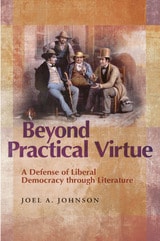
Beyond Practical Virtue
A Defense of Liberal Democracy through LiteratureJoel A. Johnson
University of Missouri Press, 2007
Why hasn’t democracy been embraced worldwide as the best form of government?
Aesthetic critics of democracy such as Carlyle and Nietzsche have argued that modern democracy, by removing the hierarchical institutions that once elevated society’s character, turns citizens into bland, mediocre souls. Joel A. Johnson now offers a rebuttal to these critics, drawing surprising inspiration from American literary classics.
Addressing the question from a new perspective, Johnson takes a fresh look at the worth of liberal democracy in these uncertain times and tackles head-on the thorny question of cultural development. Examining the novels of James Fenimore Cooper, Mark Twain, and William Dean Howells, he shows that through their fiction we can gain a better appreciation of the rich detail of everyday life, making the debate relevant to contemporary discussions of liberal democracy.
Johnson focuses on an issue that liberals have inadequately addressed: whether people tend to develop fully as individuals under liberal democracy when such a regime does little formally to encourage their development. He argues that, though the liberal fear of state-guided culture is well founded, it should not prevent us from evaluating liberalism’s effect on individual flourishing. By extending the debate over the worthiness of liberal democracy to include democracy’s effect on individual development, he contends that the democratic experience is much fuller than the aristocratic one and thus expands the faculties of its citizens.
Critics of American democracy such as John Rawls have sought to transform it into a social or egalitarian democracy in the European style. Johnson shows that neither the debate between Rawls and his communitarian critics nor the ongoing discussion of the globalization of American values adequately addresses the fundamental critique of democratic culture advanced by the aesthetic critics. Johnson’s cogent analysis reaches out to those readers who are ready for a more comprehensive evaluation of liberal democracy, offering new insight into the relationship between the state and the individual while blazing new trails in the intersection of politics and literature.
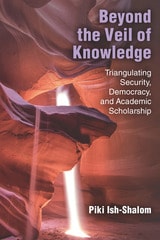
Beyond the Veil of Knowledge
Triangulating Security, Democracy, and Academic ScholarshipPiki Ish-Shalom
University of Michigan Press, 2019

Brazil Since 1985
Economy, Polity and SocietyEdited by Maria D'Alva G. Kinzo and James Dunkerley
University of London Press, 2003
Contributors include Edmund Amann (School of Economic Studies, University of Manchester, UK), Maria Celi Scalon (Insituto Universitario de Pesquisas do Rio de Janeiro, Brazil), Carlos Antonio Costa Ribeiro (Universidade Federal de Minas Gerais, Brazil), Mauricio Coutinho (Universidade Estadual de Campinas, Brazil), Argelina Cheibub Figueiredo (Universidade de Sao Paulo, Brazil), James Dunkerley (Institute of Latin American Studies and Queen Mary, University of London, UK), Antonio Sergio A. Guimaraes (Universidade de Sao Paulo, Brazil), Anthony Hall (London School of Economics and Political Science, UK), Fernando Limongi (Universidade de Sao Paulo, Brazil), Fiona Macaulay (Centre for Brazilian Studies, University of Oxford and Institute of Latin American Studies, University of London, UK), Celso Martone (Universidade de Sao Paulo, Brazil), Leandro Piquet Carneiro (Universidade de Sao Paulo, Brazil), Mauro Porto (Universidade de Brasilia, Brazil), and Brasilio Sallum Jr. (Universidade de Sao Paulo, Brazil).
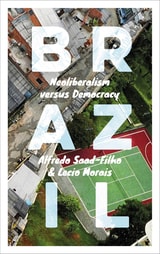
Brazil
Neoliberalism versus DemocracyAlfredo Saad-Filho and Lecio Morais
Pluto Press, 2017
In Brazil: Neoliberalism Versus Democracy, Alfredo Saad-Filho and Lecio Morais review the complex paradox that is modern Brazil. Focusing on 1980 to the present, they analyze the tensions between the two dominant systemic political transitions from military rule to first democracy, then neoliberalism. A groundbreaking interpretation of this intricate relationship, Brazil examines how the contradictory dynamics of these transitions eventually became symbiotic as they unfolded and intertwined.
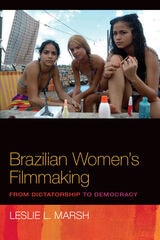
Brazilian Women's Filmmaking
From Dictatorship to DemocracyLeslie Marsh
University of Illinois Press, 2012
At most recent count, there are no fewer than forty-five women in Brazil directing or codirecting feature-length fiction or documentary films. In the early 1990s, women filmmakers in Brazil were credited for being at the forefront of the rebirth of filmmaking, or retomada, after the abolition of the state film agency and subsequent standstill of film production. Despite their numbers and success, films by Brazilian women directors are generally absent from discussions of Latin American film and published scholarly works.

Bribes, People, and Politics
How Everyday Corruption Shapes Governance in EurasiaWilliam M. Reisinger & Marina Zaloznaya
University of Michigan Press, 2027
Everyday bureaucratic corruption is not the domain of oligarchs or powerful elites, but of informal exchanges between bureaucrats and ordinary citizens seeking to move paperwork, secure benefits, or avoid penalties. Despite extensive research on the economic, legal, and social consequences of corruption, this mundane form has rarely been treated as a political phenomenon.
Drawing on original, nationally representative surveys conducted in Russia, Ukraine, Georgia, and China, Bribes, People, and Politics analyzes how citizens’ encounters with corrupt bureaucratic practices influence popular political trust, perceptions of elite corruption, legal attitudes, voting behavior, and political activism. After each interaction with public bureaucracy, citizens subtly revise their views about what role people like themselves play within the political system. As a result, corrupt bureaucratic encounters can significantly shape popular attitudes and behavior toward the political order. By linking the microdynamics of bureaucratic encounters to macro-level questions of political legitimacy and regime durability, this book bridges the literature on corruption, political sociology, and comparative politics, offering a new framework for understanding the persistent phenomenon of public sector corruption in Eurasia.
Bureaucracy in America
The Administrative State's Challenge to Constitutional GovernmentJoseph Postell
University of Missouri Press, 2023