Results by title
102 books match the query 'Demography' and 4 start with b
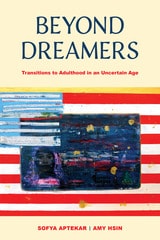
Beyond Dreamers
Transitions to Adulthood in an Uncertain AgeSofya Aptekar
Russell Sage Foundation, 2026
The typical image of a Dreamer is an undocumented Latinx youth—brought to the U.S. through no choice of their own—who excels academically and aspires to contribute to the U.S. economy. This image has engendered political good will and helped push through an executive order that created Deferred Action for Childhood Arrivals, but it is limited. It fails to account for the full spectrum of diversity among undocumented youth. It also leaves the Dreamer figure stuck in a stage of youth and innocence waiting for immigration reform to allow them to finally transition to adulthood. There is little room in the Dreamer narrative for navigating complex family obligations, employment, entering adult relationships, or other markers of adulthood. In Beyond Dreamers, sociologists Sofya Aptekar and Amy Hsin examine how undocumented young adults navigate the transition to adulthood.
Drawing on more than one hundred interviews with a racially and ethnically diverse group of undocumented college students in New York City, with and without DACA authorization, Aptekar and Hsin show that there is no single undocumented experience. They find that while legal status matters enormously, its impacts are influenced by race, national origin, gender, class, sexuality, family resources, educational institutions, neighborhood contexts, and access to local and transnational co-ethnic communities and labor markets. These forces not only shape the kinds of opportunities available to undocumented young adults, but how they choose to approach disclosing their undocumented status and interact with family, peers, employers, professors, and police.
Aptekar and Hsin pay particular attention to the effect of one’s mode of entry into the United States, highlighting the distinction between visa overstayers and those who entered the country without inspection. This highly consequential divide shapes early experiences of illegality, labor market options, exposure to surveillance and precarity, and the possibility of adjusting status. Individuals who overstay their visas have more avenues to adjust their undocumented status, including family sponsorship and marriage to U.S. citizens. Opportunities for legalization are much more restricted for those who made unauthorized border crossings. If these immigrant youth want to adjust their status, they are required to leave the country and remain abroad for at least ten years to do so. Other methods of adjusting their status, such as claiming extreme hardship on their American families or trying to obtain visas for victims of crime or parental abuse or neglect, are extremely difficult to obtain, costly, and can lead to division in families, making legalization all but impossible and, therefore, limiting youths’ opportunities. Thus, mode of entry strongly influences how some young adults imagine their future lives in the U.S. and beyond.
Beyond Dreamers deftly underscores how deeply legal uncertainty continues to structure the lives of undocumented young adults.
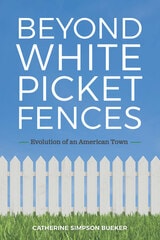
Beyond White Picket Fences
Evolution of an American TownCatherine Simpson Bueker
Russell Sage Foundation, 2025
Drawing on interviews, archival data, and participant observations, Bueker examines how Italian, Jewish, and Chinese newcomers influenced and were influenced by the established Wellesley community. She examines the ways in which immigrant and ethnic groups assimilate, retain their cultural backgrounds, and respond to discrimination, sometimes simultaneously, and, in doing so, alter the mainstream. Some new residents responded to Wellesley by assimilating to it. They developed relationships with long-term resident neighbors, volunteered in their children’s schools, and ran for elected positions. In adapting themselves to their new community, however, they also influenced it by virtue of their distinct cultural backgrounds.
Other new residents worked to preserve their cultures by establishing ethnic-specific organizations, lobbying to have new holidays incorporated into the calendar, and hewing to their own ethnic culinary traditions. Their efforts also influenced the established community. When newcomers attempted to retain their culture by requesting ethnic-specific food items be stocked at the local grocery store, opening ethic restaurants, or renting space for a new organization, for example, they impacted the established community. New individuals and groups also responded to experiences of hostility and discrimination. Italian residents fought against attempts at school redistricting targeting them in the 1930s, Jewish residents pushed back against housing discrimination in the 1950s and 1960s, and Chinese residents responded to anti-Asian incidents in the wake of the COVID-19 pandemic in 2020. These groups had to engage with the larger community to rectify these injustices. Some of the changes in Wellesley have come about with little recognition or response, others have been met with resistance and anger. Whether the changes are subtle or obvious and whether new groups are embraced or resisted, the whole town is altered in an ongoing process as new groups continue to move to and settle in Wellesley.
Beyond White Picket Fences is a timely and compelling examination of the ways newcomers become part of and shape American communities.
Birth Quake
The Baby Boom and Its AftershocksDiane J. Macunovich
University of Chicago Press, 2002
Macunovich focuses on the pervasive effects of changes in "relative cohort size," the ratio of young to middle-aged adults, as masses of young people tried to achieve the standard of living to which they had become accustomed in their parents' homes despite dramatic reductions in their earning potential relative to that of their parents. Macunovich presents the results of detailed empirical analyses that illustrate how varied and important cohort effects can be on a wide range of economic indicators, social factors, and even on more tumultuous events including the stock market crash of 1929, the "oil shock" of 1973, and the "Asian flu" of the 1990s. Birth Quake demonstrates that no discussion of business or economic trends can afford to ignore the effects of population.
Birth and Fortune
The Impact of Numbers on Personal WelfareRichard A. Easterlin
University of Chicago Press, 1987
"[Easterlin] has made clear, I think unambiguously, that the baby-boom generation is economically underprivileged merely because of its size. And in showing this, he demonstrates that population size can be as restrictive as a factor as sex, race, or class on equality of opportunity in the U.S."—Jeffrey Madrick, Business Week