Results by title
240 books match the query 'Diaries' and 7 start with b

Between Tedium and Terror
A Soldier's World War II Diary, 1943-45Sy M. KahnForeword by Ronald Spector
University of Illinois Press, 1993
Often writing in tents by candlelight, in foxholes, or on board ships, Kahn documents life during four campaigns and over three hundred air attacks. He describes the 244th Port Company's backbreaking work of loading and unloading ships, the suffocating heat, the debilitating tropical diseases, and the relentless, sometimes terrifying bombings, accidents, casualties, and deaths.
His wartime odyssey also includes encounters with civilians in Australia, in the Philippines, and, as among the earliest occupation troops, in Japan. A detailed record of the daily cost of war, Kahn's journal reflects his increasing maturity and his personal coming of age, representative of thousands of young Americans who served in World War II.
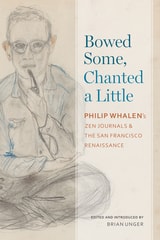
Bowed Some, Chanted a Little
Philip Whalen's Zen Journals and the San Francisco RenaissanceEdited and Introduced by Brian Unger
University of Alabama Press, 2023
The literary journals of a key figure in both the Beat and San Francisco Renaissance movements of the New American Poetry, and an ordained Zen Buddhist priest
Philip Whalen (1923–2002) authored twenty collections of verse, more than twenty broadsides, two novels, a huge assemblage of autobiographical literary journals, nine or ten experimental prose works, and dozens of critical essays, lectures, commentaries, introductions, prefaces, and interviews. But he came to regard his literary journals as his most important prose legacy.
Whalen’s literary work represents a significant turn in American letters, as he and his closest colleagues immersed themselves in East Asian literature and religion, reinvigorating strikingly new linguistic and aesthetic paths for North American writers and artists. However, until now Whalen’s forty-plus years of journals—sixty small eight-by-six-inch notebooks—have been largely inaccessible, archived in the rare book and manuscript library at the University of California, Berkeley, undigitized and unavailable online. Thus, the publication of a critical scholarly edition of Whalen’s journals and notebooks constitutes an important literary event and an invaluable resource for scholars, teachers, poets, and lay readers who follow twentieth-century North American poetry.
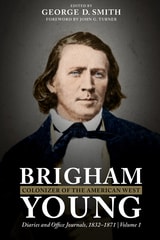
Brigham Young, Colonizer of the American West
Diaries and Office Journals, 1832–1871George D. Smith
Signature Books, 2019
Thus, by 1877, some 400 Mormon settlements spanned the western frontier from Salt Lake City to outposts in Idaho, Nevada, Arizona, Wyoming, and California. As prophet of the LDS Church and governor of the proposed State of Deseret, Young led several campaigns for Utah statehood while defending polygamy and local sovereignty. His skillful and authoritarian leadership led historian Bernard de Voto to classify him as an “American genius,” responsible for turning Joseph Smith’s visions “into the seed of life.”
Young’s diaries and journals reveal a man dedicated to his church, defensive of his spiritual and temporal claims to authority, and determined to create a modern Zion within the Utah desert. Editor George D. Smith’s careful organization and annotation of Young’s personal writings provide insights into the mind of Mormonism’s dynamic church leader and frontier statesman.
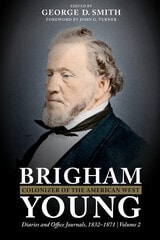
Brigham Young, Colonizer of the American West
Diaries and Office Journals, 1832–1871: Volume 2George D. Smith
Signature Books, 2021
Thus, by 1877, some 400 Mormon settlements spanned the western frontier from Salt Lake City to outposts in Idaho, Nevada, Arizona, Wyoming, and California. As prophet of the LDS Church and governor of the proposed State of Deseret, Young led several campaigns for Utah statehood while defending polygamy and local sovereignty. His skillful and authoritarian leadership led historian Bernard de Voto to classify him as an “American genius,” responsible for turning Joseph Smith’s visions “into the seed of life.”
Young’s diaries and journals reveal a man dedicated to his church, defensive of his spiritual and temporal claims to authority, and determined to create a modern Zion within the Utah desert. Editor George D. Smith’s careful organization and annotation of Young’s personal writings provide insights into the mind of Mormonism’s dynamic church leader and frontier statesman.
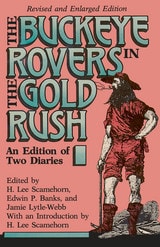
Buckeye Rovers in the Gold Rush
An Edition of Two DiariesH. Lee Scamehorn
Ohio University Press, 1989
When “California Fever” raced through southeastern Ohio in the spring of 1849, a number of residents of Athens County organized a cooperative venture for traveling overland to the mines. Known as the “Buckeye Rovers,” the company began its trip westward in early April. The Buckeye Rovers, along with thousands who traveled the overland route to California, endured numerous hardships and the seemingly constant threat of attacks from hostile Indians. On reaching their destination, the Ohioans discovered that rich deposits of gold were extremely rare, and that except for a few lucky fortune–seekers, mining required hard physical labor and yielded small rewards. They persisted nonetheless and most of the company returned to Athens in late 1851 or early 1852 with modest fortunes.
The arduous experiences of the overland trek were recorded by two Buckeye Rover diarists. The more compete account was compiled by John Banks. He wrote effusively while on the trail and throughout his stay of more than two years in the gold regions. J. Elza Armstrong, by contrast, was brief, even laconic, and his journal ended upon reaching California. The contrast between the two brings into focus the divergent personalities who were drawn to California by the lure of gold.
A nine–month segment of Bank’s diary, from February to November, 1851, had been missing at the time the story of the Buckeye Rovers was first published in 1965. This revised and enlarged edition contains the complete diaries. They offer valuable record of the Buckeyes’ adventures from the time they left home until the time they departed California for the return trip to Ohio.

Buckeye Schoolmaster
A Chronicle of Midwestern Rural Life, 1853–1865J. Merton England
University of Wisconsin Press, 1996
The journals and diaries of John M. Roberts provide an intimate view of the life and dthoughts of a young schoolmaster, miller, itenerant bookseller, and farmer in centreal Ohio in a time of rising sectional crisis and Civil War.
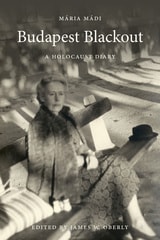
Budapest Blackout
A Holocaust Diaryby Máriá Mádi, edited by James W. Oberly
University of Wisconsin Press, 2023
Mádi’s family donated the entire collection of her diaries to the US Holocaust Memorial Museum. This edition transcribes a selection of Mádi’s writings focusing on the period of March 1944 to November 1945, from the Nazi invasion and occupation of Hungary, through the Battle of Budapest, to the ensuing Soviet occupation. While bearing witness to the catastrophe in Hungary, Mádi hid a Jewish family in her small flat from October 1944 to February 1945. She received a posthumous Righteous among Nations Medal from Yad Vashem, the World Holocaust Remembrance Center.
Editorial commentary by James W. Oberly situates Mádi’s observations, and a critical introduction by the Holocaust scholar András Lénárt outlines the wider sociopolitical context in which her diaries gain meaning.