Results by title
78 books match the query 'Diseases' and 4 start with b
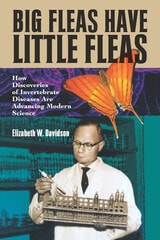
Big Fleas Have Little Fleas
How Discoveries of Invertebrate Diseases Are Advancing Modern ScienceElizabeth W. Davidson
University of Arizona Press, 2006
In this book, Elizabeth Davidson shares amazing stories about diseases of insects and other invertebrates important to people—and about the scientists who learned to use those diseases to control pests and create products beneficial to humans. Focusing on insect-microbial interactions crucial to public health, she tells detective stories ranging across global history, from the silkworm farms of nineteenth-century Japan to the research labs of modern America. In these fascinating accounts, Davidson shows us how human health often comes down to a contest of bug against bug. Even habitats seething with bacteria, such as the runoff from cattle farms or sewage treatment plants, are also teeming with invertebrate life—animals that, like ourselves, have ways of fighting infection.
Scientific curiosity about what allows creatures as simple as water fleas to survive in such polluted environments has led to the discovery of chemicals with remarkable properties and potential usefulness to humankind. From diseases of shellfish to parasites of bees, Davidson opens a window on a world most of us never stop to consider—but which matters to all of us more than we might ever imagine. In our present era of pandemic scares, Big Fleas Have Little Fleas is a sweeping historical review that’s as timely as tomorrow’s headlines, showing us that the most exciting discoveries can emerge from the smallest sources.
Biofeedback for the Brain
How Neurotherapy Effectively Treats Depression, ADHD, Autism, and MorePaul G. Swingle, PhD
Rutgers University Press, 2008
Neurofeedback is a cutting-edge, drug-free therapeutic technique used by over a thousand licensed therapists in North America to treat a range of conditions from attention deficit and hyperactivity disorders to epilepsy, stroke, anxiety, migraine, and depression. First popularized in the 1970s, this naturalistic method is based on the idea that we can control our brain activity and that, through training, the brain can learn to modify its own electrical patterns for more efficient processing or to overcome various states of dysfunction.
In Biofeedback for the Brain, Dr. Paul G. Swingle describes in clear and coherent language how these procedures work. With numerous actual case examples, readers follow the progress of clients from the initial “brain map” that shows the location and severity of the neurological abnormalities to the various stages of treatment. Conditions often considered untreatable by conventional health practitioners respond positively to neurotherapeutic treatment and Swingle describes many of these remarkable recoveries. Other chapters describe the use of neurotherapy for a variety of surprising purposes, including performance training for elite athletes, of which the most famous example is the Italian soccer team who considered the technique to be their “secret weapon” in attaining a World Cup victory.
Despite wide-ranging success stories and the endorsement of the American Psychological Association, many health care practitioners remain skeptical of neurofeedback and the procedures are still not well-known by the public or conventional health care providers. This book provides a thorough, definitive, and highly readable presentation of this remarkable health care alternative that offers millions of individuals a chance for healing.
Black Women’s Health in the Age of Hip Hop and HIV/AIDS
A Narrative RemixNghana tamu Lewis
The Ohio State University Press, 2025

Breathe Easy
Relieving the Symptoms of Chronic Lung DiseaseDonald A. Mahler
University Press of New England, 2017