230 books match the query 'Doctrines' and 4 start with b
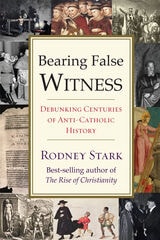
cover of Bearing False Witness: Debunking Centuries of Anti-Catholic History

Bearing False Witness

Debunking Centuries of Anti-Catholic History

Rodney Stark

Templeton Press, 2016

As we all know and as many of our well-established textbooks have argued for decades, the Inquisition was one of the most frightening and bloody chapters in Western history; Pope Pius XII was anti-Semitic and rightfully called “Hitler’s Pope,” the Dark Ages were stunting the progress of knowledge to be redeemed only by the secular spirit of the Enlightenment. The religious Crusades were an early example of the rapacious Western thirst for riches and power. But what if these long held beliefs were all wrong?

In this stunning, powerful, and ultimately persuasive book, Rodney Stark, one of the most highly regarded sociologists of religion and bestselling author of The Rise of Christianity (HarperSanFrancisco 1997), argues that some of our most firmly held ideas about history, ideas that paint the Catholic Church in the least favorable light are, in fact, fiction. Why have we held these wrongheaded ideas so firmly and for so long? And if our beliefs are wrong, what is the truth?

In each chapter, Stark takes on a well-established anti-Catholic myth, gives a fascinating history of how each myth became conventional wisdom and presents a startling picture of the real truth. For example, instead of the Spanish Inquisition being an anomaly of torture and murder of innocent people persecuted for “imaginary” crimes such as witchcraft and blasphemy, Stark argues that not only did the Spanish Inquisition spill very little blood, but it was a major force in support of moderation and justice.

Stark dispels the myth of Pope Pius XII being apathetic or even helpful to the Nazi movement, such as to merit the title “Hitler’s Pope,” and instead shows that the campaign to link Pope Pius XII to Hitler was initiated by the Soviet Union, presumably in hopes of neutralizing the Vatican in post-World War II affairs. Many praised Pope Pius XIIs vigorous and devoted efforts to saving Jewish lives during the war.

Instead of understanding the Dark Ages as a millennium of ignorance and backwardness inspired by the Catholic Church’s power, Stark argues that the whole notion of the “Dark Ages” was an act of pride perpetuated by anti-religious intellectuals who were determined to claim that theirs was the era of “Enlightenment.”

In the end, readers of Bearing False Witness will have a more accurate history of the Catholic Church and will also understand why it became unfairly maligned for so long. Bearing False Witness is a compelling and sobering account of how egotism and ideology often work together to give us a false truth.
[more]
cover of Before Amoris Laetitia: The Sources of the Controversy

Before Amoris Laetitia

The Sources of the Controversy

Jaroslaw Kupczak

Catholic University of America Press, 2021
The publication of Pope Francis’ post-synodal apostolic exhortation, Amoris Laetitia started the most important theological debate in the Catholic Church since the end of the Second Vatican Council. The cardinals, bishops, theologians, priests, lay Catholics found themselves on the opposite sides of this crucial and complicated discussion. This book attempts to shed some light on this debate by tracing its genealogy. Since Amoris Laetitia is a post-synodal document, the large part of the book is devoted to the theological analysis of the two Synods of Bishops convoked by Pope Francis in the first years of his pontificate: the extraordinary in October 2014 and the ordinary that took place a year later. The main topics for the two synods were determined, however, in the speech given by Cardinal Walter Kasper during the cardinals consistory in February 2014 whose main aim was to prepare the possibility of admitting divorced persons who live in second unions to Holy Communion. The arguments of Cardinal Kasper are presented in the first chapter of the book and confronted with the most significant statements of the Magisterium of the Church on the issue of admittance to the Holy Communion. This book is a study at the intersection of Church history, the history of theology, and systematic theology: dogmatic and moral. Kupczak is interested in the chronology of the events connected to the two synods on the family but in the context of theological problems discussed therein: the theological significance of contemporary cultural changes; the relation of the Church to the world; the understanding of the indissolubility of the sacramental marriage and the Eucharist; the methods of ethically assessing human acts, particularly the concept of so-called intrinsically evil acts (intrinsece malum); and the relation of conscience to the general moral norm. The non-partisan ambition of this book is to serve as a “road map”— a help in navigation for the reader in the complicated discussions leading to publication of Amoris Laetitia. The uniqueness of this book consists in combining the historical analysis of the events leading to the publication of Amoris Laetitia with research of the theological discussion that ensued. Since Amoris Laetitia is a post-synodal exhortation, this book rests on the assumption that crucial for its understanding is a thorough analysis of its genealogy. Only in the light of this historical and theological perspective the debates surrounding Amoris Laetitia may be understood.
[more]
cover of Biblical and Theological Foundation of the Family

Biblical and Theological Foundation of the Family

Joseph C. Atkinson

Catholic University of America Press, 2014
This ground-breaking work establishes a solid biblical and theological foundation on which a theology of the family can be constructed. It thus fills a critical lack in the current literature on the family. The wide range of sources, including Jewish, Catholic, Orthodox, and Protestant, give this work a genuine ecumenical dimension. Biblical and Theological Foundations of the Family will become indispensable for anyone wanting to engage in serious study of the structure and meaning of the family and its place in the salvific will of God.
[more]
cover of Black Fire:  African American Quakers on Spirituality and Human Rights

Black Fire

African American Quakers on Spirituality and Human Rights

Harold D. Weaver, Jr.

QuakerPress, 2011

[more]