Results by title
218 books match the query 'Education, Higher' and 6 start with b

Bankers in the Ivory Tower
The Troubling Rise of Financiers in US Higher EducationCharlie Eaton
University of Chicago Press, 2022
Exposes the intimate relationship between big finance and higher education inequality in America.
Elite colleges have long played a crucial role in maintaining social and class status in America, while public universities have offered a major stepping stone to new economic opportunities. However, as Charlie Eaton reveals in Bankers in the Ivory Tower, finance has played a central role in the widening inequality in recent decades, both in American higher education and in American society at large.
With federal and state funding falling short, the US higher education system has become increasingly dependent on financial markets and the financiers that mediate them. Beginning in the 1980s, the government, colleges, students, and their families took on multiple new roles as financial investors, borrowers, and brokers. The turn to finance, however, has yielded wildly unequal results. At the top, ties to Wall Street help the most elite private schools achieve the greatest endowment growth through hedge fund investments and the support of wealthy donors. At the bottom, takeovers by private equity transform for-profit colleges into predatory organizations that leave disadvantaged students with massive loan debt and few educational benefits. And in the middle, public universities are squeezed between incentives to increase tuition and pressures to maintain access and affordability. Eaton chronicles these transformations, making clear for the first time just how tight the links are between powerful financiers and America’s unequal system of higher education.
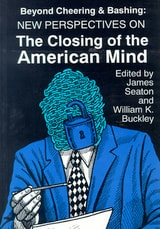
Beyond Cheering and Bashing
New Perspectives on The Closing of the American MindWilliam K. Buckley
University of Wisconsin Press, 1992
The debate over the central issue confronted in The Closing of the American Mind—the role of the university and the liberal arts in the United States—has become increasingly urgent and contentious. The goal of this collection of essays is to see what we can learn about the dilemmas confronting American culture through consideration of both The Closing of the American Mind and the debate it aroused.

Beyond Education
Radical Studying for Another WorldEli Meyerhoff
University of Minnesota Press, 2019
A bold call to deromanticize education and reframe universities as terrains of struggle between alternative modes of studying and world-making
Higher education is at an impasse. Black Lives Matter and #MeToo show that racism and sexism remain pervasive on campus, while student and faculty movements fight to reverse increased tuition, student debt, corporatization, and adjunctification. Commentators typically frame these issues as crises for an otherwise optimal mode of intellectual and professional development. In Beyond Education, Eli Meyerhoff instead sees this impasse as inherent to universities, as sites of intersecting political struggles over resources for studying.
Meyerhoff argues that the predominant mode of study, education, is only one among many alternatives and that it must be deromanticized in order to recognize it as a colonial-capitalist institution. He traces how key elements of education—the vertical trajectory of individualized development, its role in preparing people to participate in governance through a pedagogical mode of accounting, and dichotomous figures of educational waste (the “dropout”) and value (the “graduate”)—emerged from histories of struggles in opposition to alternative modes of study bound up with different modes of world-making.
Through interviews with participants in contemporary university struggles and embedded research with an anarchist free university, Beyond Education paves new avenues for achieving the aims of an “alter-university” movement to put novel modes of study into practice. Taking inspiration from Black Lives Matter, Occupy Wall Street, and Indigenous resurgence projects, it charts a new course for movements within, against, and beyond the university as we know it.

Beyond the Veil of Knowledge
Triangulating Security, Democracy, and Academic ScholarshipPiki Ish-Shalom
University of Michigan Press, 2019
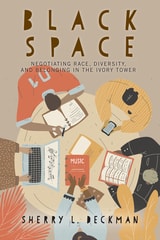
Black Space
Negotiating Race, Diversity, and Belonging in the Ivory TowerSherry L. Deckman
Rutgers University Press, 2022

Buying In or Selling Out?
The Commercialization of the American Research UniversityStein, Donald G.
Rutgers University Press, 2004
Universities were once ivory towers where scholarship and teaching reigned supreme, or so we tell ourselves. Whether they were ever as pure as we think, it is certainly the case that they are pure no longer. Administrators look to patents as they seek money by commercializing faculty discoveries; they pour money into sports with the expectation that these spectacles will somehow bring in revenue; they sign contracts with soda and fast-food companies, legitimizing the dominance of a single brand on campus; and they charge for distance learning courses that they market widely. In this volume, edited by Donald G. Stein, university presidents and others in higher education leadership positions comment on the many connections between business and scholarship when intellectual property and learning is treated as a marketable commodity. Some contributors write about the benefits of these connections in providing much needed resources. Others emphasize that the thirst for profits may bias the type of research that is carried out and the quality of that research. They fear for the future of basic research if faculty are in search of immediate payoffs.
The majority of the contributors acknowledge that commercialization is the current reality and has progressed too far to return to the “good old days.” They propose guidelines for students and professors to govern commercial activities. Such guidelines can increase the likelihood that quality, openness, and collegiality will remain core academic values.