Results by title
130 books match the query 'Educators' and 3 start with b
Becoming Historians
Edited by James M. Banner, Jr. and John R. Gillis
University of Chicago Press, 2009
In this unique collection, the memoirs of eleven historians provide a fascinating portrait of a formative generation of scholars. Born around the time of World War II, these influential historians came of age just before the upheavals of the 1960s and ’70s and helped to transform both their discipline and the broader world of American higher education. The self-inventions they thoughtfully chronicle led, in many cases, to the invention of new fields—including women’s and gender history, social history, and public history—that cleared paths in the academy and made the study of the past more capacious and broadly relevant. In these stories—skillfully compiled and introduced by James Banner and John Gillis—aspiring historians will find inspiration and guidance, experienced scholars will see reflections of their own dilemmas and struggles, and all readers will discover a rare account of how today’s seasoned historians embarked on their intellectual journeys.
Beyond the Frontier
The Midwestern Voice in American Historical WritingDavid S. Brown
University of Chicago Press, 2009
As the world went to war in 1941, Time magazine founder Henry Luce coined a term for what was rapidly becoming the establishment view of America’s role in the world: the twentieth century, he argued, was the American Century. Many of the nation’s most eminent historians—nearly all of them from the East Coast—agreed with this vision and its endorsement of the vigorous use of power and persuasion to direct world affairs. But an important concentration of midwestern historians actively dissented. With Beyond the Frontier, David S. Brown tells their little-known story of opposition.
Raised in a cultural landscape that combined agrarian provincialism with reform-minded progressivism, these historians—among them Charles Beard, William Appleman Williams, and Christopher Lasch—argued strenuously against the imperial presidencies, interventionist foreign policies, and Keynesian capitalism that swiftly shaped cold war America. Casting a skeptical eye on the burgeoning military-industrial complex and its domestic counterpart, the welfare state, they warned that both components of the liberal internationalist vision jeopardized the individualistic, republican ethos that had long lain at the heart of American democracy.
Drawing on interviews, personal papers, and correspondence of the imoprtant players in the debate, Brown has written a fascinating follow-up to his critically acclaimed biography of Richard Hofstadter. Illuminating key ideas that link midwestern writers from Frederick Jackson Turner all the way to William Cronon and Thomas Frank, Beyond the Frontier is intellectual history at its best: grounded in real lives and focused on issues that remain salient—and unresolved—even today.
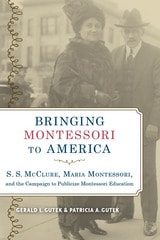
Bringing Montessori to America
S. S. McClure, Maria Montessori, and the Campaign to Publicize Montessori EducationGerald L. Gutek and Patricia A. Gutek
University of Alabama Press, 2016
2016 CHOICE OUTSTANDING ACADEMIC TITLE
The remarkable story of how Montessori education crossed the Atlantic and transformed American educational thought.
Born on the Adriatic, Montessori first entered the world stage in 1906 as the innovator of a revolutionary teaching method that creates an environment where children learn at their own pace and initiate skills like reading and writing in a spontaneous way. As her school in Rome swiftly attracted attention, curiosity, and followers, Montessori recruited disciples whom she immersed in a rigorous and detailed teacher-training regimen of her own creation.
McClure was an Irish-born media baron of America’s Gilded Age, best known as the founder and publisher of McClure’s Magazine. Against the backdrop of Theodore Roosevelt’s Bull Moose insurgency, the brilliant and mercurial McClure used his flagship publication as a vehicle to advance Progressive Party causes. After meeting in 1910, McClure and Montessori embarked on a five-year collaboration to introduce Montessori’s innovative teaching style in the United States.
Gerald and Patricia Gutek trace the dramatic arc of the partnership between the Italian teacher and American publisher united by a vision of educational change in the United States. After her triumphal lecture tour in 1913, Montessori, secure in her trust of her American partner, gave McClure her power of attorney and returned to Italy. The surge in popularity of Montessori education in America, however, deeply concerned Montessori, who had heretofore exerted total control over her method, apparatus, schools, and teacher training. The American entrepreneurial spirit, along with a desire to disseminate the Montessori method quickly, led to major conflicts between the Italian educator and American businesspeople, particularly McClure. Feeling betrayed, Montessori ended her relationship with her erstwhile collaborator.
Gutek and Gutek describe the fascinating story of this first wave of Montessori education in the United States, which did not sustain itself during Montessori’s lifetime. It would not be until the 1950s that Montessori education was revived with the successful establishment of Montessori academies throughout the United States.