Results by title
153 books match the query 'Egypt' and 8 start with b

Bedouin Life in the Egyptian Wilderness
By Joseph J. Hobbs
University of Texas Press, 1992
Between the Nile River and the Red Sea, in the northern half of Egypt's Eastern Desert, live the Bedouins of the Ma'aza tribe. Joseph Hobbs lived with the Khushmaan Ma'aza clan for almost two years, gathering information for a study of traditional Bedouin life and culture. The resulting work, Bedouin Life in the Egyptian Wilderness, is the first modern ethnographic portrait of the Ma'aza Bedouins.
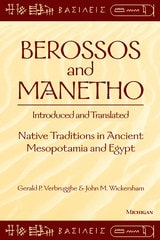
Berossos and Manetho, Introduced and Translated
Native Traditions in Ancient Mesopotamia and EgyptGerald P. Verbrugghe and John M. Wickersham
University of Michigan Press, 2001
Berossos and Manetho offers particular emphasis on and discussion of the languages and scripts used to preserve the glorious past of these lands. Each author receives his own special introduction, which describes his life, the sources of his History, the nature and content of his writings, and his goals and accomplishments. There follows a translation of all the surviving ancient information about each author, and of all that can be recovered of his writings. For the first time, Berossos and Manetho--priests and contemporaries who write just when their lands had been pushed into Hellenization--have been translated in one volume.
This volume will appeal to all people interested in ancient Israel, Greek history, and ancient history in general.
Gerald P. Verbrugghe is Associate Professor of History, Rutgers University. John M. Wickersham is Professor of Classics and Classics Department Chairperson, Ursinus College.
Biographical Texts from Ramessid Egypt
Elizabeth Frood
SBL Press, 2007
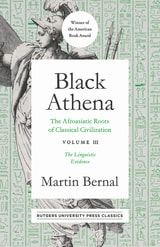
Black Athena
The Afroasiatic Roots of Classical Civilation Volume III: The Linguistic EvidenceMartin Bernal
Rutgers University Press, 2020
What is classical about Classical civilization? In one of the most audacious works of scholarship ever written, Martin Bernal challenges the foundation of our thinking about this question. Classical civilization, he argues, has deep roots in Afroasiatic cultures. But these Afroasiatic influences have been systematically ignored, denied or suppressed since the eighteenth century—chiefly for racist reasons.
The popular view is that Greek civilization was the result of the conquest of a sophisticated but weak native population by vigorous Indo-European speakers—Aryans—from the North. But the Classical Greeks, Bernal argues, knew nothing of this “Aryan model.” They did not see their institutions as original, but as derived from the East and from Egypt in particular.
This long-awaited third and final volume of the series is concerned with the linguistic evidence that contradicts the Aryan Model of ancient Greece. Bernal shows how nearly 40 percent of the Greek vocabulary has been plausibly derived from two Afroasiatic languages – Ancient Egyptian and West Semitic. He also reveals how these derivations are not limited to matters of trade, but extended to the sophisticated language of politics, religion, and philosophy. This evidence, according to Bernal, greatly strengthens the hypothesis that in Greece an Indo-European-speaking population was culturally dominated by Ancient Egyptian and West Semitic speakers.
Provocative, passionate, and colossal in scope, this volume caps a thoughtful rewriting of history that has been stirring academic and political controversy since the publication of the first volume.
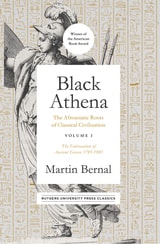
Black Athena
The Afroasiatic Roots of Classical Civilization Volume I: The Fabrication of Ancient Greece 1785-1985Martin Bernal
Rutgers University Press, 2020
What is classical about Classical civilization? In one of the most audacious works of scholarship ever written, Martin Bernal challenges the foundation of our thinking about this question. Classical civilization, he argues, has deep roots in Afroasiatic cultures. But these Afroasiatic influences have been systematically ignored, denied or suppressed since the eighteenth century—chiefly for racist reasons.
The popular view is that Greek civilization was the result of the conquest of a sophisticated but weak native population by vigorous Indo-European speakers—Aryans—from the North. But the Classical Greeks, Bernal argues, knew nothing of this “Aryan model.” They did not see their institutions as original, but as derived from the East and from Egypt in particular.
In an unprecedented tour de force, Bernal links a wide range of areas and disciplines—drama, poetry, myth, theological controversy, esoteric religion, philosophy, biography, language, historical narrative, and the emergence of “modern scholarship.”
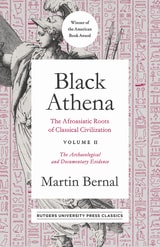
Black Athena
The Afroasiatic Roots of Classical Civilization Volume II: The Archaeological and Documentary EvidenceMartin Bernal
Rutgers University Press, 2020
What is classical about Classical civilization? In one of the most audacious works of scholarship ever written, Martin Bernal challenges the foundation of our thinking about this question. Classical civilization, he argues, has deep roots in Afroasiatic cultures. But these Afroasiatic influences have been systematically ignored, denied or suppressed since the eighteenth century—chiefly for racist reasons.
The popular view is that Greek civilization was the result of the conquest of a sophisticated but weak native population by vigorous Indo-European speakers—Aryans—from the North. But the Classical Greeks, Bernal argues, knew nothing of this “Aryan model.” They did not see their institutions as original, but as derived from the East and from Egypt in particular.
In an unprecedented tour de force, Bernal links a wide range of areas and disciplines—drama, poetry, myth, theological controversy, esoteric religion, philosophy, biography, language, historical narrative, and the emergence of “modern scholarship.”
This volume is the second in a three-part series concerned with the competition between two historical models for the origins of Greek civilization. Volume II is concerned with the archaeological and documentary evidence for contacts between Egypt and the Levant on the one hand, and the Aegean on the other, during the Bronze Age from c. 34000 BC to c. 1100 BC. These approaches are supplemented by information from later Greek myths, legends, religious cults, and language. The author concludes that contact between the two regions was far more extensive and influential than is generally believed. In the introduction to this volume, Bernal also responds to some reviews and criticism of Volume I of Black Athena.

Bound by Struggle
The Strategic Evolution of Enduring International RivalriesZeev Maoz and Ben D. Mor
University of Michigan Press, 2002
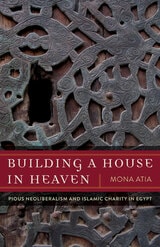
Building a House in Heaven
Pious Neoliberalism and Islamic Charity in EgyptMona Atia
University of Minnesota Press, 2013
Charity is an economic act. This premise underlies a societal transformation—the merging of religious and capitalist impulses that Mona Atia calls “pious neoliberalism.” Though the phenomenon spans religious lines, Atia makes the connection between Islam and capitalism to examine the surprising relations between charity and the economy, the state, and religion in the transition from Mubarak-era Egypt.
Mapping the landscape of charity and development in Egypt, Building a House in Heaven reveals the factors that changed the nature of Egyptian charitable practices—the state’s intervention in social care and religion, an Islamic revival, intensified economic pressures on the poor, and the subsequent emergence of the private sector as a critical actor in development. She shows how, when individuals from Egypt’s private sector felt it necessary to address poverty, they sought to make Islamic charities work as engines of development, a practice that changed the function of charity from distributing goods to empowering the poor. Drawing on interviews with key players, Atia explores the geography of Islamic charities through multiple neighborhoods, ideologies, sources of funding, projects, and wide social networks. Her work shifts between absorbing ethnographic stories of specific organizations and reflections on the patterns that appear across the sector.
An enlightening look at the simultaneous neoliberalization of Islamic charity work and Islamization of neoliberal development, the book also offers an insightful analysis of the political and socioeconomic movements leading up to the uprisings that ended Mubarak’s rule and that amplified the importance of not only the Muslim Brotherhood but also the broader forces of Islamic piety and charity.