Results by title
201 books match the query 'English fiction' and 6 start with b
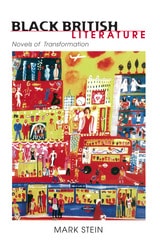
BLACK BRITISH LITERATURE
NOVELS OF TRANSFORMATIONMark Stein
The Ohio State University Press, 2004
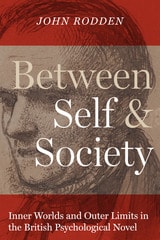
Between Self and Society
Inner Worlds and Outer Limits in the British Psychological NovelBy John Rodden
University of Texas Press, 2016
Between Self and Society explores the psychosocial dramas that galvanize six major British novels written between the eighteenth and twentieth centuries. The book challenges an influential misconception that has for too long hindered appreciation of the psychological novel. John Rodden argues that there should be no simplifying antithesis between psychological, “inner” conflicts (within the mind or “soul”) and institutional, “outer” conflicts (within family, class, community). Instead, it is the overarching, dramatic—yet often tortuous—relations between self and society that demand our attention. Rodden presents fresh interpretations of an eclectic group of prose fiction classics, including Tobias Smollett’s The Adventures of Roderick Random, William Godwin’s Caleb Williams, Thomas Hardy’s The Mayor of Casterbridge, Ford Madox Ford’s The Good Soldier, Wyndham Lewis’s Tarr, and D. H. Lawrence’s Women in Love.
Far from being merely admirable experiments, let alone daring though interesting failures, these fictions are shown to possess aesthetic unity, stylistic consistency, and psychic force. Between Self and Society thus impels our careful reconsideration of novels that represent major artistic achievements, yet have been either unjustly neglected or appreciated in limiting ways that do injustice to their psychological aspects. Rodden’s vibrant discussion invites an upward revaluation of these works and encourages the full recognition of their value and significance in British literary history.
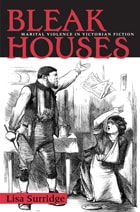
Bleak Houses
Marital Violence in Victorian FictionLisa Surridge
Ohio University Press, 2005
The Offenses Against the Person Act of 1828 opened magistrates' courts to abused working-class wives. Newspapers in turn reported on these proceedings, and in this way the Victorian scrutiny of domestic conduct began. But how did popular fiction treat “private” family violence? Bleak Houses: Marital Violence in Victorian Fiction traces novelists' engagement with the wife-assault debates in the public press between 1828 and the turn of the century.
Lisa Surridge examines the early works of Charles Dickens and reads Dombey and Son and Anne Brontë's The Tenant of Wildfell Hall in the context of the intense debates on wife assault and manliness in the late 1840s and early 1850s. Surridge explores George Eliot's Janet's Repentance in light of the parliamentary debates on the 1857 Divorce Act. Marital cruelty trials provide the structure for both Wilkie Collins's The Woman in White and Anthony Trollope's He Knew He Was Right.
Locating the New Woman fiction of Mona Caird and the reassuring detective investigations of Sherlock Holmes in the context of late-Victorian feminism and the great marriage debate in the Daily Telegraph, Surridge illustrates how fin-de-siècle fiction brought male sexual violence and the viability of marriage itself under public scrutiny. Bleak Houses thus demonstrates how Victorian fiction was concerned about the wife-assault debates of the nineteenth century, debates which both constructed and invaded the privacy of the middle-class home.
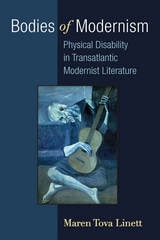
Bodies of Modernism
Physical Disability in Transatlantic Modernist LiteratureMaren Tova Linett
University of Michigan Press, 2016
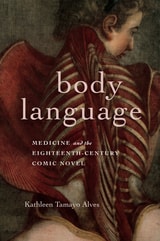
Body Language
Medicine and the Eighteenth-Century Comic NovelKathleen Tamayo Alves
Bucknell University Press, 2026
Body Language examines the complex intersections of British eighteenth-century comic fiction and medical discourse. By engaging medical writings of renowned and widely-read physicians of the Enlightenment such as John Freind, Thomas Sydenham, Albrecht von Haller, John Whytt, and William Cullen, with novels of humor by Henry Fielding, Tobias Smollett, Laurence Sterne, and Charlotte Lennox, Alves explains how medicine shaped comic language by dramatizing female-specific phenomena like menstruation, hysteria, nervous disorders, and pregnancy. In these novels, the medical belief that women are incapable of bodily self-regulation becomes an imperative for policing women’s bodies and highlights the enduring shortcomings of patriarchal systems. Ultimately, these comic representations offer a counternarrative of women’s bodies, agency, and selfhood, exposing masculine anxieties about the effectiveness of marriage to regulate women’s sexuality.
Published by Bucknell University Press. Distributed worldwide by Rutgers University Press.
British Women Writing Fiction
Abby H.P. Werlock
University of Alabama Press, 2000
British women in the second half of the 20th century have produced a body of work that is as diverse as it is entertaining. This book offers an informal, jargon-free introduction to the fiction of sixteen contemporary writers either brought up or now living in England, from Muriel Spark to Jeanette Winterson.
British Women Writing Fiction presents a balanced view comprising women writing since the 1950s and 1960s, those who attracted critical attention during the 1970s and 1980s, and those who have burst upon the literary scene more recently, including African-Caribbean and African women. The essays show how all of these writers treat British subjects and themes, sometimes from radically different perspectives, and how those who are daughters of immigrants see themselves as women writing on the margins of society.
Abby Werlock's introduction explores the historical and aesthetic factors that have contributed to the genre, showing how even those writers who began in a traditional vein have created experimental work. The contributors provide complete bibliographies of each writer's works and selected bibliographies of criticism. Exceptional both in its breadth of subjects covered and critical approaches taken, this book provides essential background that will enable readers to appreciate the singular merits of each writer. It offers an approach toward better understanding favorite authors and provides a way to become acquainted with new ones.