114 books match the query 'Enslaved persons' and 10 start with b
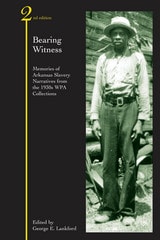
cover of Bearing Witness: Memories of Arkansas Slavery

Bearing Witness

Memories of Arkansas Slavery

George E. Lankford

University of Arkansas Press, 2006
The first edition of Bearing Witness brought together for the first time 176 slave narratives from the state of Arkansas. Now, this new edition adds ten previously undiscovered accounts. No one knew the truths of slavery better than the slaves themselves, but no one consulted them until the 1930s. Then, recognizing that this generation of unique witnesses would soon be lost to history, the Works Progress Administration's Federal Writers' Project acted to interview as many former slaves as possible. In a continuation of the project's interest in the life histories of ordinary people, writers interviewed over two thousand former slaves, more than a third of them in Arkansas. These oral histories were first published in the 1970s in a thirty-nine-volume series organized by state, and they transformed America's understanding of slavery. They have offered crucial evidence on a variety of other topics as well: the Civil War, Reconstruction, agricultural practices, everyday life, and oral history itself. But some former Arkansas slaves were interviewed in Texas, Oklahoma, and other states, so their narratives were published in those other collections. And more than half of the testimonies in the Arkansas volume were interviews with people who had moved to Arkansas after freedom. Folklorist George Lankford combed all of the state collections for the testimonies properly belonging to Arkansas and deleted from this state's collection the testimony of later migrants
[more]
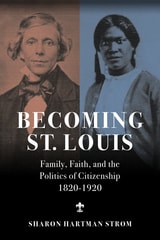
cover of Becoming St. Louis: Family, Faith, and the Politics of Citizenship, 1820-1920

Becoming St. Louis

Family, Faith, and the Politics of Citizenship, 1820-1920

Sharon Hartman Strom

University of Illinois Press, 2025
St. Louis was the pivot of the free states and slave states and the border of the settled East and frontier West. Sharon Hartman Strom draws on disparate and previously untapped sources to weave the personal and public lives of women and both free and enslaved African Americans into city history. Strom’s analysis shows how the embrace of Protestantism by people of color sparked a vigorous antislavery movement. During the Civil War, several prominent citizens served in the Lincoln cabinet and Congress while Missouri’s decision to remain in the Union allowed the city to find its own ways to end slavery and grant citizenship to African Americans. Years later, biracial movements to advance equality collapsed when the East St. Louis race riot of 1917 affirmed that racist attitudes and structures still dominated the region. Illuminating and nuanced, Becoming St. Louis offers a diverse social and political history of the city during a transformative era.
[more]
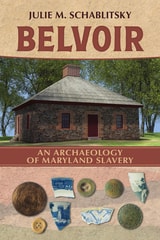
cover of Belvoir: An Archaeology of Maryland Slavery

Belvoir

An Archaeology of Maryland Slavery

Julie M. Schablitsky

University of Alabama Press, 2025

Unearthed truths, buried lives: Belvoir reveals the pain, resilience, and reckoning found beneath the soil of a Maryland plantation.

Near Annapolis, Maryland, a former tobacco plantation dating to the 1730s holds centuries of untold history. In Belvoir: An Archaeology of Maryland Slavery, Julie M. Schablitsky leads readers on an archaeological narrative to unearth the lives and stories still buried there.The book begins with an introduction to the estate’s history, detailing its ownership by prominent families such as the Rosses, Scotts, Worthingtons, and Welshes. Schablitsky highlights the landscape of the estate, including the unique thirty-two-square-foot stone quarter built for enslaved people.

With sensitivity and scientific rigor, Schablitsky shifts focus to the enslaved people who lived and labored at Belvoir for more than eighty years. Through detailed excavation of the stone quarter and analysis of everyday artifacts—buttons, tobacco pipes, food remains, ceramics—she reconstructs the daily life, acts of resistance, and the cultural endurance of a community forced to navigate brutality.

Yet what makes Belvoir especially vital is its ethical compass. Schablitsky centers the voices of descendants, allowing their questions, memories, and presence to shape the narrative. The result is a groundbreaking archaeological case study and a blueprint for restorative justice at sites of enslavement. Scholars, archaeologists, and general readers alike will find Belvoir a deeply human, profoundly necessary book, one that confronts the past with clarity, care, and the hope of reconciliation.
[more]
cover of Between Fitness and Death: Disability and Slavery in the Caribbean

Between Fitness and Death

Disability and Slavery in the Caribbean

Stefanie Hunt-Kennedy

University of Illinois Press, 2020

Long before the English became involved in the African slave trade, they imagined Africans as monstrous and deformed beings. The English drew on pre-existing European ideas about monstrosity and deformity to argue that Africans were a monstrous race, suspended between human and animal, and as such only fit for servitude. Joining blackness to disability transformed English ideas about defective bodies and minds. It also influenced understandings of race and ability even as it shaped the embodied reality of people enslaved in the British Caribbean.

Stefanie Hunt-Kennedy provides a three-pronged analysis of disability in the context of Atlantic slavery. First, she examines the connections of enslavement and representations of disability and the parallel development of English anti-black racism. From there, she moves from realms of representation to reality in order to illuminate the physical, emotional, and psychological impairments inflicted by slavery and endured by the enslaved. Finally, she looks at slave law as a system of enforced disablement.

Audacious and powerful, Between Fitness and Death is a groundbreaking journey into the entwined histories of racism and ableism.
[more]
cover of Black Lives, Native Lands, White Worlds: A History of Slavery in New England

Black Lives, Native Lands, White Worlds

A History of Slavery in New England

Jared Ross Hardesty

University of Massachusetts Press, 2019

Shortly after the first Europeans arrived in seventeenth-century New England, they began to import Africans and capture the area's indigenous peoples as slaves. By the eve of the American Revolution, enslaved people comprised only about 4 percent of the population, but slavery had become instrumental to the region's economy and had shaped its cultural traditions. This story of slavery in New England has been little told.

In this concise yet comprehensive history, Jared Ross Hardesty focuses on the individual stories of enslaved people, bringing their experiences to life. He also explores larger issues such as the importance of slavery to the colonization of the region and to agriculture and industry, New England's deep connections to Caribbean plantation societies, and the significance of emancipation movements in the era of the American Revolution. Thoroughly researched and engagingly written, Black Lives, Native Lands, White Worlds is a must-read for anyone interested in the history of New England.
[more]
cover of Black Women Writing Autobiography: A Tradition Within a Tradition

Black Women Writing Autobiography

A Tradition Within a Tradition

Joanne Braxton

Temple University Press, 1990
"In this illuminating study Joanne Braxton shows the continuity and tradition in the writing of Afra-American women. An important work for teachers and students of Literature, History, and Women's Studies." --Gerda Lerner "As black American women, we are born into a mystic sisterhood, and we live our lives within a magic circle, a realm of shared language, reference, and allusion within the veil of our blackness and our femaleness. We have been as invisible to the dominant culture as rain; we have been knowers, but we have not been known." Joanne Braxton argues for a redefinition of the genre of black American autobiography to include the images of women as well as their memoirs, reminiscences, diaries, and journals--as a corrective to both black and feminist literary criticism. Beginning with slave narratives and concluding with modern autobiography, she deals with individual works as representing stages in a continuum and situates these works in the context of other writings by both black and white writers. Braxton demonstrates that the criteria used to define the slave narrative genre are inadequate for analyzing Harriet "Linda Brent" Jacobs's pseudonymously published Incidents in the Life of a Slave Girl: Written by Herself (1861). She examines "sass" as a mode of women's discourse and a weapon of self-defense, and she introduces the "outraged mother" as a parallel to the articulate hero archetype. Not even emancipation authorized black women to define themselves or address an audience. Late-nineteenth-century accounts in the form of confessional spiritual autobiographies, travelogue/adventure stories, and slave memoirs enabled such women as Jarena Lee, Rebecca Cox Jackson, Elizabeth Keckley, Susie King Taylor, as well as Harriet Tubman and Sojourner Truth to tell their own extraordinary stories and to shed light on the thousands of lives obscured by illiteracy and sexual and racial oppression. In her diaries, Charlotte Forten Grimké, the gifted poet, epitomizes the problems faced by a well-educated, extremely articulate black woman attempting to find a public voice in America. Moving into the twentieth century, Braxton analyzes the memoir of Ida B. Wells, journalist and anti-lynching activist, and the work of Zora Neale Hurston and Era Bell Thompson. They represent the first generation of black female autobiographers who did not continually come into contact with former slaves and who transcended the essential struggle for survival that occupied earlier writings. For the contemporary black woman autobiographer, the quest for personal fulfillment is the central theme. Braxton concludes with Maya Angelou's I Know Why the Caged Bird Sings (1996), which represents the black woman of the 1960s who has found the place to recreate the self in her own image--the place all the others had been searching for. "Braxton's book is scrupulously researched. She has been creative in finding resources and courageous in analyzing and interpreting her finds. This is the word of a diligent mind. The material is mountainous, yet the book sings. Braxton is a poet. Thank goodness." --Maya Angelou "Joanne Braxton's essays on black women's autobiographies delineate and illuminate the personal and historical dimension of an important literary tradition. Emphasizing the distinct character of Afra-American women's experience and relations with each other, she ground their writing of their lives in the struggles and triumphs of the lives they actually led." --Elizabeth Fox-Genovese "In this compelling and lucid study examining the content, context, and continuum of black women autobiographers, Braxton clears the place for it in the curriculum: at the center of black and feminist studies." --Paula Giddings "This is the fullest and most sympathetic study of black American autobiographers I know. By paying close attention to private and public history, to social networks and literary kinships, to narrative structures and patterns of imagery, Braxton leads her readers to see the black woman 'at the center of her own [written] experiences.' At once scholarly and passionate, Braxton's critique will immediately secure her a place among the leading analysts of black American autobiography." --Albert E. Stone "A highly readable and original contribution to the important fields of Afro-American studies, feminist criticism, and autobiographical narrative." --Elaine Showalter "Rich in empathy and insight, Joanne M. Braxton's trailblazing study attends to both the textual and historical dimensions of a powerful literary inheritance. She brings to bear a keen sense of the departures and continuities of which any tradition consists; and an appreciation of the distinctive Afro-American dynamic between literary convention and a vernacular substrate. Braxton doesn't just read--she listens." --Henry Louis Gates, Jr. "Joanne Braxton makes a unique contribution to the scholarship of American autobiography. Her focus on the outraged mother as a figure of rebellion is a significant challenge to our conventional understanding of autobiographical acts." --Hazel Carby "This is the most inclusive and thoughtful literary history of black American women's autobiography in existence…It is not just a collection of essays; it is well knit together and displays multiple traditions as they evolved and are in the process of evolving still." --William L. Andrews "This book marks another milestone in the critical appraisal of American autobiographical writings. In tracing the evolution of a tradition of black women in autobiography in America, Braxton takes us on the first journey of this kind: the black American woman's search for a dignified, self-defining identity through the rejection of traditional female roles. This book sets the tone for future studies of black women's autobiographies." --Nellie McKay
[more]
cover of Blacks on the Border: The Black Refugees in British North America, 1815–1860

Blacks on the Border

The Black Refugees in British North America, 1815–1860

Harvey Whitfield

University Press of New England, 2006
Following the American Revolution, free black communities and enslaved African Americans increasingly struggled to reconcile their African heritage with their American home. This struggle resulted in tens of thousands of African Americans seeking new homes in areas as diverse as Haiti and Nova Scotia. Black refugees arrived in Nova Scotia after the War of 1812 with little in common but their desire for freedom. By 1860, they had formed families, communities, and traditions. Harvey Amani Whitfield’s study reconstructs the lives and history of a sizeable but neglected group of African Americans by placing their history within the framework of free black communities in New England and Nova Scotia during the nineteenth century. It examines which aspects of American and African American culture black expatriates used or discarded in an area that forced them to negotiate the overlapping worlds of Great Britain, the United States, Afro–New England, and the African American Diaspora, while considering how former American slaves understood freedom long before the Civil War.
[more]
cover of Bloody Numbers: The Early Atlantic Slave Trade and the Invention of Modern Corporeality

Bloody Numbers

The Early Atlantic Slave Trade and the Invention of Modern Corporeality

Pablo F. Gómez

University of Chicago Press, 2026

Upends current thinking about how early modern people started to conceptualize human beings in terms of populations.
 
Bloody Numbers is a provocative account of the violent world of the sixteenth- and seventeenth-century South Atlantic slave-trading societies, where traders, financiers, officials, surgeons, notaries, ship captains, and others began thinking about human bodies as aggregate populations understood through numbers: measurements, averages, and calculations of risk and value assessed through the tabulation of heights, weights, tumors, scars, and other characteristics. Pablo F. Gómez explores how figures within the world of slave trading used this model for understanding human bodies to generalize about behavior and disease in ways that foreshadowed the work of modern epidemiologists and public health officials—though they employed their calculations with the aim of protecting their financial interests rather than of caring for enslaved people. The ruthlessness inherent in these practices became ingrained in the modern corporeal mathematics that emerged from the early slave trade and diffused through its vast political, financial, logistical, and intellectual networks.

A pathbreaking work, Bloody Numbers reveals the historical actions that rendered populations quantifiable. In doing so, it shows that confronting these origins is essential to understanding the violent political, legal, economic, and scientific practices that ascribe numbers to our own bodies.
[more]
cover of Breaking Chains: Slavery on Trial in the Oregon Territory

Breaking Chains

Slavery on Trial in the Oregon Territory

R. Gregory Nokes

Oregon State University Press, 2013

When they were brought to Oregon in 1844, Missouri slaves Robin and Polly Holmes and their children were promised freedom in exchange for helping develop their owner’s Willamette Valley farm. However, Nathaniel Ford, an influential settler and legislator, kept them in bondage until 1850, even then refusing to free their children. Holmes took his former master to court and, in the face of enormous odds, won the case in 1853.

In Breaking Chains, R. Gregory Nokes tells the story of the only slavery case adjudicated in Oregon’s pre-Civil War courts—Holmes v. Ford. Through the lens of this landmark case, Nokes explores the historical context of racism in Oregon and the West, reminding readers that there actually were slaves in Oregon, though relatively few in number.

Drawing on the court record, Nokes offers an intimate account of the relationship between a slave and his master from the slave’s point of view. He also explores the experiences of other slaves in early Oregon, examining attitudes toward race and revealing contradictions in the state’s history. Oregon was the only free state admitted to the union with a voter-approved constitutional clause banning African Americans and, despite the prohibition of slavery in the state, many in Oregon tolerated it and supported politicians who advocated for slavery, including Oregon’s first territorial governor.

Breaking Chains sheds light on a somber part of Oregon’s history, bringing the story of slavery in Oregon to a broader audience. The book will appeal to readers interested in Pacific Northwest history and in the history of slavery in the United States.
[more]
cover of Breaking the Chains: Slavery, Bondage, and Emancipation in Modern Africa and Asia

Breaking the Chains

Slavery, Bondage, and Emancipation in Modern Africa and Asia

Martin A. Klein

University of Wisconsin Press, 1993

“Martin Klein has brought together recent work on the abolition of slavery, from Ottoman Turkey to Thailand and from South India to West Africa.  This anthology builds on the recent scholarship on both slavery in Asia and Africa and the end of slavery as a world-wide historical phenomenon.  Whereas other anthologies have tended to focus on either Africa or Asia, this project brings together in one volume case studies and methodological approaches concerning both regions.  Breaking the Chains will be an important part of the relatively sparse literature on emancipation in comparative and global context.”—Richard Roberts, Stanford University

Because the American history of slavery and emancipation tends to be foremost in Western minds, few realize that traditional forms of servitude still exist in a variety of places around the world: children are sold on the streets of Bangkok, bondage persists in India despite official efforts to abolish it, and until 1980 slavery was legal in Mauritania.
    Breaking the Chains  deals with emancipation in African and Asian societies which were either colonized or came under the domination of European powers in the nineteenth century.  In these societies, emancipation involved the imposition on non-European societies of an explicitly European discourse on slavery, and, in most cases, a free labor ideology.  Most of the slave masters described in these essays were not European and found European ideas on emancipation difficult to accept. 
    Against this backdrop, the essayists (many of whom contribute their own non-Western perspective) focus on the transition from slavery (or other forms of bondage) to emancipation.  They show that in each case the process involved pressure from European abolition movements, the extension of capitalist relations of production, the concerns and perceptions of the colonial state, and the efforts of non-Western elites to modernize their cultures.
    Martin A. Klein argues that the Asian and African experience has much in common with the American experience, particularly in efforts to control labor and family life.  The struggle to control the labor of former slaves has often been intense and, he suggests, has had a continuing impact on the social order in former slave societies.

[more]