Results by title
313 books match the query 'Environmental policy' and 16 start with b
Back to Earth
Tomorrow's EnvironmentalismAnthony Weston
Temple University Press, 1994
Bad Environmentalism
Irony and Irreverence in the Ecological AgeNicole Seymour
University of Minnesota Press, 2018
Traces a tradition of ironic and irreverent environmentalism, asking us to rethink the movement’s reputation for gloom and doom
Activists today strive to educate the public about climate change, but sociologists have found that the more we know about alarming issues, the less likely we are to act. Meanwhile, environmentalists have acquired a reputation as gloom-and-doom killjoys. Bad Environmentalism identifies contemporary texts that respond to these absurdities and ironies through absurdity and irony—as well as camp, frivolity, irreverence, perversity, and playfulness.
Nicole Seymour develops the concept of “bad environmentalism”: cultural thought that employs dissident affects and sensibilities to reflect critically on our current moment and on mainstream environmental activism. From the television show Wildboyz to the short film series Green Porno, Seymour shows that this tradition of thought is widespread—spanning animation, documentary, fiction film, performance art, poetry, prose fiction, social media, and stand-up comedy since at least 1975. Seymour argues that these texts reject self-righteousness and sentimentality, undercutting public negativity toward activism and questioning basic environmentalist assumptions: that love and reverence are required for ethical relationships with the nonhuman and that knowledge is key to addressing problems like climate change.
Funny and original, Bad Environmentalism champions the practice of alternative green politics. From drag performance to Indigenous comedy, Seymour expands our understanding of how environmental art and activism can be pleasurable, even in a time of undeniable crisis.
Beginning to End the Climate Crisis
A History of Our FutureLuisa Neubauer and Alexander Repenning
Brandeis University Press, 2023
“Act as though your house is on fire. Because it is.” Following Greta Thunberg, millions of young climate activists have been taking to the streets around the globe as part of the Fridays For Future movement. They demand that we “unite behind the science,” as, for too long, climate scientists have been ringing the alarm bells about rising temperatures, tipping points, and the devastating consequences of extreme weather—but politicians do nothing.
So how do you begin to end the climate crisis? Luisa Neubauer and Alexander Repenning begin by telling stories. Neubauer cofounded the youth climate activist group in Germany and has become its most prominent voice. In this book she and Repenning weave in personal accounts of their evolution as climate activists with a thorough analysis of how climate change impacts their generation, and what every one of us can and must do about it. The young and old in the United States and around the world can learn valuable lessons from their European counterparts.
Behavioral and Distributional Effects of Environmental Policy
Edited by Carlo Carraro and Gilbert E. Metcalf
University of Chicago Press, 2001

Betting the Earth
How We Can Still Win the Biggest Gamble of all TimeJohn Charles Kunich
Parkhurst Brothers, Inc., 2010
"Betting the Earth explores the uneasy parallels between our contemporary environmental challenges and our national fascination with gambling. How much should we bet on preserving biodiversity? Should we bet more on responding to climate change? where should we place each bet: on federal or state laws, on acquiring public or private preserves, on preventing environmental harms or saving places of special environmental significance? Like it or not, we must make such choices every day, and Betting the Earth helps us to understand how we do so."
Professor John Copeland Nagle, John N. Matthews Chair in Law, University of Notre Dame Law School
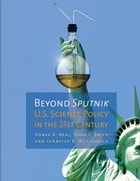
Beyond Sputnik
U.S. Science Policy in the Twenty-First CenturyHomer A. Neal, Tobin L. Smith, and Jennifer B. McCormick
University of Michigan Press, 2008
Science and technology are responsible for almost every advance in our modern quality of life. Yet science isn't just about laboratories, telescopes and particle accelerators. Public policy exerts a huge impact on how the scientific community conducts its work. Beyond Sputnik is a comprehensive survey of the field for use as an introductory textbook in courses and a reference guide for legislators, scientists, journalists, and advocates seeking to understand the science policy-making process. Detailed case studies---on topics from cloning and stem cell research to homeland security and science education---offer readers the opportunity to study real instances of policymaking at work. Authors and experts Homer A. Neal, Tobin L. Smith, and Jennifer B. McCormick propose practical ways to implement sound public policy in science and technology and highlight how these policies will guide the results of scientific discovery for years to come.
Homer A. Neal is the Samuel A. Goudsmit Distinguished University Professor of Physics, Interim President Emeritus, and Vice President for Research Emeritus at the University of Michigan, and is a former member of the U.S. National Science Board.
Tobin L. Smith is Associate Vice President for Federal Relations at the Association of American Universities. He was formerly Assistant Director of the University of Michigan and MIT Washington, DC, offices.
Jennifer B. McCormick is an Assistant Professor of Biomedical Ethics in the Division of General Internal Medicine at the Mayo College of Medicine in Rochester, Minnesota, and is the Associate Director of the Research Ethics Resource, part of the Mayo Clinic's NIH Clinical Translational Science Award research programs.
GO BEYOND SPUTNIK ONLINE--Visit www.science-policy.net for the latest news, teaching resources, learning guides, and internship opportunities in the 21st-Century field of science policy.
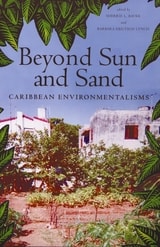
Beyond Sun and Sand
Caribbean EnvironmentalismsEdited by Sherrie L. Baver and Barbara Deutsch Lynch
Rutgers University Press, 2006
In both versions, the image of the exotic landscape overshadows the rich island cultures that are both linguistically and politically diverse, but trapped in a global economy that offers few options for development. Popular depictions also overlook the reality that the region is fraught with environmental problems, including water and air pollution, solid waste mismanagement, destruction of ecosystems, deforestation, and the transition from agriculture to ranching.
Bringing together ten essays by social scientists and activists, Beyond Sun and Sand provides the most comprehensive exploration to date of the range of environmental issues facing the region and the social movements that have developed to deal with them. The authors consider the role that global and regional political economies play in this process and provide valuable insight into Caribbean environmentalism. Many of the essays by prominent Caribbean analysts are made available for the first time in English.

Beyond Wolves
The Politics Of Wolf Recovery And ManagementMartin A. Nie
University of Minnesota Press, 2003
Looks at the next stages of the controversy over wolf recovery
Since 1995, when the U.S. Fish and Wildlife Service released Canadian gray wolves into Yellowstone National Park as part of its wolf recovery program, reintroduction has been widely challenged in public forums and sensationalized in the media. This conflict has pitted western ranchers and property rights activists against environmental groups, highlighting starkly contrasting political perspectives. In this informed account, Martin A. Nie examines not only the future of wolf recovery but also the issues that will define debates around the politics of wildlife management, animal rights issues, and other flash points. The result is a revelatory look at the way the democratic process works when the subject is an environmental hot-button issue.
Examining the wolf recovery program from a policy-making perspective, Nie looks at programs in Alaska, the Lake Superior region, the Northern Rockies, the Southwest, and New England and upstate New York. He analyzes the social, political, and cultural backdrop in the areas in which wolves have been reintroduced and explores such contentious issues as the role of science in public policy; the struggle between wilderness protection, resource management, and private property; and the use of stakeholders in environmental conflicts.For Nie, the debate over wolf recovery is above all a value-based political conflict that should take place in a more inclusive, participatory, and representative democratic arena. Wolves, Nie writes, are an important indicator species both biologically and politically, and in Beyond Wolves, he tells an important story of wolves and people, place and politics, that resonates far beyond the fate of America’s most misunderstood inhabitants.
Beyond the European Left
Ideology and Political Action in the Belgian EcologyHerbert Kitschelt and Staf Hellemans
Duke University Press, 1990
The authors employ a new research methodology—surveying party militants—that is better adapted to the study of micropolitics than are expert interviews. Herbert Kitschelt and Staf Hallemans show that European Green party activists express an egalitarian and libertarian vision of a desirable social order that builds on, but radically transforms, ideas of the traditional socialist European left. The authors then examine the debates and disagreements among militants on political objectives and the consequences of conflicting views for party organization and strategy. Their findings illuminate the unique dynamics of left-libertarian politics in a number of Western European countries with obvious relevance to current developments in Eastern Europe.

Bombs in the Backyard
Atomic Testing and American PoliticsA. Constandina Titus
University of Nevada Press, 2001

Border Air
A History of US-Mexico Environmental CooperationLaura M. Uribarri
University of Texas Press, 0
Tracing a century of pollution and transnational collaboration in the Paso del Norte air basin.
The air knows no borders, which makes atmospheric pollution a devilish legal and environmental challenge. The problem is especially dangerous in the Paso del Norte, where the industry and urbanization of Juárez-El Paso stretch across the international boundary, and surrounding mountains trap airborne pollutants. Laura Uribarri traces the nineteenth- and twentieth-century transformations of the region, uncovering the sources of pollution and analyzing transnational efforts to regulate and improve the air.
Border Air shows how a favorable location, rail expansion, and numerous trade and labor agreements made Juárez-El Paso a global manufacturing hub, leading to unfettered growth and declining air quality. By the mid-1990s, El Paso and Juárez ranked among the most polluted cities on the continent. Environmental treaties crafted in Washington and Mexico City made little difference. But fronterizos themselves had an impact. Uribarri focuses on the Paso del Norte Air Quality Task Force, a citizen group that pioneered successful mitigation projects such as working with emitters to design cleaner production methods without disrupting workers’ livelihoods. This history shows what can be accomplished at the grassroots and offers lessons on how border communities can collaborate to address complex environmental problems.
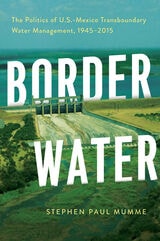
Border Water
The Politics of U.S.-Mexico Transboundary Water Management, 1945–2015Stephen Paul Mumme
University of Arizona Press, 2023
The international boundary between the United States and Mexico spans more than 1,900 miles. Along much of this international border, water is what separates one country from the other. Border Water provides a historical account of the development of governance related to transboundary and border water resources between the United States and Mexico in the last seventy years.
This work examines the phases and pivot points in the development of U.S.-Mexico border water resources and reviews the theoretical approaches and explanation that impart a better understanding of these events. Author Stephen Paul Mumme, a leading expert in water policy and border studies, describes three important periods in the chronology of transboundary water management. First, Mumme examines the 1944 Water Treaty, the establishment of the International Boundary and Water Commission (IBWC) in 1945, and early transborder politics between the two governments. Next, he describes the early 1970s and the rise of environmentalism. In this period, pollution and salinization of the Colorado River Delta come into focus. Mumme shows how new actors, now including environmentalists and municipalities, broadened and strengthened the treaty’s applications in transboundary water management. The third period of transborder interaction described covers the opening and restricting of borders due to NAFTA and then 9/11.
Border Water places transboundary water management in the frame of the larger binational relationship, offering a comprehensive history of transnational water management between the United States and Mexico. As we move into the next century of transnational water management, this important work offers critical insights into lessons learned and charts a path for the future.
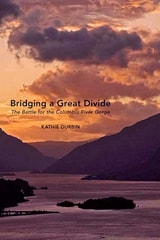
Bridging a Great Divide
The Battle for the Columbia River GorgeKathie Durbin
Oregon State University Press, 2013
In Bridging a Great Divide, award-winning environmental journalist Kathie Durbin draws on interviews, correspondence, and extensive research to tell the story of the major shifts in the Gorge since the Act’s passage. Sweeping change has altered the Gorge’s landscape: upscale tourism and outdoor recreation, gentrification, the end of logging in national forests, the closing of aluminum plants, wind farms, and a population explosion in the metropolitan area to its west. Yet, to the casual observer, the Gorge looks much the same as it did twenty-five years ago.
How can we measure the success of the Columbia River Gorge National Scenic Area Act? In this insightful and revealing history, Durbin suggests that the answer depends on who you are: a small business owner, an environmental watchdog group, a chamber of commerce. The story of the Columbia River Gorge National Scenic Area is the story of the Pacific Northwest in microcosm, as the region shifts from a natural-resource-based economy to one based on recreation, technology, and quality of life.
Building Something Better
Environmental Crises and the Promise of Community ChangeStephanie A. Malin
Rutgers University Press, 2022
Sociologists Stephanie A. Malin and Meghan Elizbeth Kallman offer a clear, accessible volume that demonstrates the ways that communities adapt in the face of crises and explains that sociology can help us understand how and why they do this challenging work. Tackling neoliberalism head-on, these communities are making big changes by crafting distributive and regenerative systems that depart from capitalist approaches. The vivid case studies presented range from activist water protectors to hemp farmers to renewable energy cooperatives led by Indigenous peoples and nations. Alongside these studies, Malin and Kallman present incisive critiques of colonialism, extractive capitalism, and neoliberalism, while demonstrating how sociology’s own disciplinary traditions have been complicit with those ideologies—and must expand beyond them.
Showing that it is possible to challenge social inequality and environmental degradation by refusing to continue business-as-usual, Building Something Better offers both a call to action and a dose of hope in a time of crises.
Building a Green Economy
Perspectives from Ecological EconomicsRobert B. Richardson
Michigan State University Press, 2013
The first decade of the twenty-first century has been characterized by a growing global awareness of the tremendous strains that human economic activity place on natural resources and the environment. As the world’s population increases, so does the demand for energy, food, and other resources, which adds to existing stresses on ecosystems, with potentially disastrous consequences. Humanity is at a crossroads in our pathway to future prosperity, and our next steps will impact our long-term sustainability immensely. In this timely volume, leading ecological economics scholars offer a variety of perspectives on building a green economy. Grounded in a critique of conventional thinking about unrestrained economic expansion and the costs of environmental degradation, this book presents a roadmap for an economy that prioritizes human welfare over consumerism and growth. As the authors represented here demonstrate, the objective of ecological economics is to address contemporary problems and achieve long-term socioeconomic well-being without undermining the capacity of the ecosphere. The volume is organized around three sections: “Perspectives on a Green Economy,” “Historical and Theoretical Perspectives,” and “Applications and Practice.” A rich resource in its own right, Building a Green Economy contains the most innovative thinking in ecological economics at a critical time in the reexamination of the human relationship with the natural world.
Bureaucracy vs. Environment
The Environmental Costs of Bureaucratic GovernanceJohn Baden and Richard L. Stroup, Editors
University of Michigan Press, 1981