Results by title
67 books match the query 'Environmental protection' and 3 start with b
Bad Water
Nature, Pollution, and Politics in Japan, 1870-1950Robert Stolz
Duke University Press, 2014
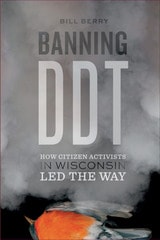
Banning DDT
How Citizen Activists in Wisconsin Led the WayBill Berry
Wisconsin Historical Society Press, 2014
On a December day in 1968, DDT went on trial in Madison, Wisconsin. In Banning DDT: How Citizen Activists in Wisconsin Led the Way, Bill Berry details how the citizens, scientists, reporters, and traditional conservationists drew attention to the harmful effects of “the miracle pesticide” DDT, which was being used to control Dutch elm disease.
Berry tells of the hunters and fishers, bird-watchers, and garden-club ladies like Lorrie Otto, who dropped off twenty-eight dead robins at the Bayside village offices. He tells of university professors and scientists like Joseph Hickey, a professor and researcher in the Department of Wildlife Management in at the University of Wisconsin–Madison, who, years after the fact, wept about the suppression of some of his early DDT research. And he tells of activists like Senator Gaylord Nelson and members of the state’s Citizens Natural Resources who rallied the cause.
The Madison trial was one of the first for the Environmental Defense Fund. The National Audubon Society helped secure the more than $52,000 in donations that offset the environmentalists’ costs associated with the hearing. Today, virtually every reference to the history of DDT mentions the impact of Wisconsin’s battles.
The six-month-long DDT hearing was one of the first chapters in citizen activism in the modern environmental era. Banning DDT is a compelling story of how citizen activism, science, and law merged in Wisconsin’s DDT battles to forge a new way to accomplish public policy. These citizen activists were motivated by the belief that we all deserve a voice on the health of the land and water that sustain us.
Being Together in Place
Indigenous Coexistence in a More Than Human WorldSoren C. Larsen
University of Minnesota Press, 2017
Being Together in Place explores the landscapes that convene Native and non-Native people into sustained and difficult negotiations over their radically different interests and concerns. Grounded in three sites—the Cheslatta-Carrier traditional territory in British Columbia; the Wakarusa Wetlands in northeastern Kansas; and the Waitangi Treaty Grounds in Aotearoa/New Zealand—this book highlights the challenging, tentative, and provisional work of coexistence around such contested spaces as wetlands, treaty grounds, fishing spots, recreation areas, cemeteries, heritage trails, and traditional village sites. At these sites, activists learn how to articulate and defend their intrinsic and life-supportive ways of being, particularly to those who are intent on damaging or destroying these places.
Using ethnographic research and a geographic perspective, Soren C. Larsen and Jay T. Johnson show how the communities in these regions challenge the power relations that structure the ongoing (post)colonial encounter in liberal democratic settler-states. Emerging from their conversations with activists was a distinctive sense that the places for which they cared had agency, a “call” that pulled them into dialogue, relationships, and action with human and nonhuman others. This being-together-in-place, they find, speaks in a powerful way to the vitalities of coexistence: where humans and nonhumans are working to decolonize their relationships; where reciprocal guardianship is being stitched back together in new and unanticipated ways; and where a new kind of “place thinking” is emerging on the borders of colonial power.