Results by title
81 books match the query 'Executive Branch' and 3 start with b
Barack Obama's America
How New Conceptions of Race, Family, and Religion Ended the Reagan EraJohn Kenneth White
University of Michigan Press, 2009
"White's Barack Obama's America eloquently captures both the important nuances of the current political scene and its long-term consequences."
---Richard Wirthlin, former pollster for Ronald Reagan
"This delightfully written and accessible book is the best available account of the changes in culture, society, and politics that have given us Barack Obama's America."
---Stan Greenberg, pollster for Bill Clinton and Chairman and CEO of Greenberg Quinlan Rosner Research
"From one of the nation's foremost experts on how values shape our politics, a clear and compelling account of the dramatic shifts in social attitudes that are transforming American political culture. White's masterful blend of narrative and data illuminates the arc of electoral history from Reagan to Obama, making a powerful case for why we are entering a new progressive political era."
---Matthew R. Kerbel, Professor of Political Science, Villanova University, and author of Netroots
"John Kenneth White is bold. He asks the big questions . . . Who are we? What do we claim to believe? How do we actually live? What are our politics? John Kenneth White writes compellingly about religion and the role it played in making Barack Obama president. White's keen insight into America's many faiths clarifies why Barack Obama succeeded against all odds. It is a fascinating description of religion and politics in twenty-first-century America---a must-read."
---Kathleen Kennedy Townsend, former Lieutenant Governor of Maryland and author of Failing America's Faithful
"In Barack Obama's America, John Kenneth White has written the political equivalent of Baedeker or Michelin, the definitive guide to and through the new, uncharted political landscape of our world. White captures and explains what America means---and what it means to be an American---in the twenty-first century."
---Mark Shields, nationally syndicated columnist and political commentator for PBS NewsHour
"John White has always caught important trends in American politics that others missed. With his shrewd analysis of why Barack Obama won, he's done it again."
---E. J. Dionne, Jr., Senior Fellow, Brookings Institution, and University Professor in the Foundations of Democracy and Culture at Georgetown University
The election of Barack Obama to the presidency marks a conclusive end to the Reagan era, writes John Kenneth White in Barack Obama's America. Reagan symbolized a 1950s and 1960s America, largely white and suburban, with married couples and kids at home, who attended church more often than not.
Obama's election marks a new era, the author writes. Whites will be a minority by 2042. Marriage is at an all-time low. Cohabitation has increased from a half-million couples in 1960 to more than 5 million in 2000 to even more this year. Gay marriages and civil unions are redefining what it means to be a family. And organized religions are suffering, even as Americans continue to think of themselves as a religious people. Obama's inauguration was a defining moment in the political destiny of this country, based largely on demographic shifts, as described in Barack Obama's America.
John Kenneth White is Professor of Politics at the Catholic University of America in Washington, D.C.
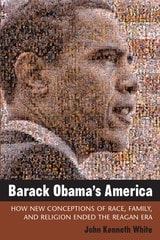
Cover image: "Out of many, we are one: Dare to Hope: Faces from 2008 Obama Rallies" by Anne C. Savage, view and buy full image at http://revolutionaryviews.com/obama_poster.html.
Bill Clinton on Stump, State, and Stage
The Rhetorical Road to the White HouseStephen A. Smith
University of Arkansas Press, 1994
Brother Bill
President Clinton and the Politics of Race and ClassDaryl A Carter
University of Arkansas Press, 2016
“This book is a fascinating analysis of race and class in the age of President Bill Clinton. It provides much-needed clarity in regards to the myth of the ‘First Black President.’ It contributes much to our understanding of the history that informs our present moment!”
—Cornel West
As President Barack Obama was sworn into office on January 20, 2009, the United States was abuzz with talk of the first African American president. At this historic moment, one man standing on the inaugural platform, seemingly a relic of the past, had actually been called by the moniker the “first black president” for years.
President William Jefferson Clinton had long enjoyed the support of African Americans during his political career, but the man from Hope also had a complex and tenuous relationship with this faction of his political base. Clinton stood at the nexus of intense political battles between conservatives’ demands for a return to the past and African Americans’ demands for change and fuller equality. He also struggled with the class dynamics dividing the American electorate, especially African Americans. Those with financial means seized newfound opportunities to go to college, enter the professions, pursue entrepreneurial ambitions, and engage in mainstream politics, while those without financial means were essentially left behind. The former became key to Clinton’s political success as he skillfully negotiated the African American class structure while at the same time maintaining the support of white Americans. The results were tremendously positive for some African Americans. For others, the Clinton presidency was devastating.
Brother Bill examines President Clinton’s political relationship with African Americans and illuminates the nuances of race and class at the end of the twentieth century, an era of technological, political, and social upheaval.