455 books match the query 'Feminism' and 27 start with b

cover of Bad Girls Dirty Pictures: The Challenge to Reclaim Feminism

Bad Girls Dirty Pictures

The Challenge to Reclaim Feminism

Alison Assiter and Avedon Carol

Pluto Press, 1993

For well over a decade, half-baked analysis and phony science have been used by some feminists to side-track the women's movement into puritanical campaigns against sexual material and imaginative sexual exploration.

Many feminists would say that this widely publicised version of feminism is itself sexist, and that the increasingly vocal anti-pornography campaigns are founded on theoretical dead-ends that have allowed feminists to deviate drastically from the basic goals of women's liberation.

Bad Girls & Dirty Pictures puts these anti-sex, anti-porn arguments under the microscope of a more thorough and considered feminist analysis. It examines the flaws in the research that purports to prove the harm of pornography and warns against the continuing use of censorship by politicians and the moral right, as well as exposing the dangers of anti-porn feminist arguments.

Contributions from a wide range of women, including sex workers and academics, remind us that pornography does not have a special place in our oppression, and that censorship must still be seen as dangerous enemy of women. Bad Girls & Dirty Pictures is a much-needed antidote to falsehoods, shabby thinking, and patronising sexism that have fuelled anti-pornography campaigns and misled the women's movement.

[more]
cover of Bad Girls of the Arab World

Bad Girls of the Arab World

Edited by Nadia Yaqub and Rula Quawas

University of Texas Press, 2017

Women’s transgressive behaviors and perspectives are challenging societal norms in the Arab world, giving rise to anxiety and public debate. Simultaneously, however, other Arab women are unwillingly finding themselves labeled “bad” as authority figures attempt to redirect scrutiny from serious social ills such as patriarchy and economic exploitation, or as they impose new restrictions on women’s behavior in response to uncertainty and change in society. Bad Girls of the Arab World elucidates how both intentional and unintentional transgressions make manifest the social and cultural constructs that define proper and improper behavior, as well as the social and political policing of gender, racial, and class divisions.

The works collected here address the experiences of women from a range of ages, classes, and educational backgrounds who live in the Arab world and beyond. They include short pieces in which the women themselves reflect on their experiences with transgression; academic articles about performance, representation, activism, history, and social conditions; an artistic intervention; and afterwords by the acclaimed novelists Laila al-Atrash and Miral al-Tahawy. The book demonstrates that women’s transgression is both an agent and a symptom of change, a site of both resistance and repression. Showing how transnational forces such as media discourses, mobility and confinement, globalization, and neoliberalism, as well as the legacy of colonialism, shape women’s badness, Bad Girls of the Arab World offers a rich portrait of women’s varied experiences at the boundaries of propriety in the twenty-first century.

[more]
cover of Badass Feminist Politics: Exploring Radical Edges of Feminist Theory, Communication, and Activism

Badass Feminist Politics

Exploring Radical Edges of Feminist Theory, Communication, and Activism

Sarah Jane Blithe

Rutgers University Press, 2022

In the late 2010s, the United States experienced a period of widespread silencing. Protests of unsafe drinking water have been met with tear gas; national park employees, environmentalists, and scientists have been ordered to stop communicating publicly. Advocates for gun control are silenced even as mass shootings continue. Expressed dissent to political power is labeled as “fake news.” DREAMers, Muslims, Trans military members, women, black bodies, the LGBTQI+ community, Latina/o/x communities, rape survivors, sex workers, and immigrants have all been systematically silenced. During this difficult time and despite such restrictions, advocates and allies persist and resist, forming dialogues that call to repel inequality in its many forms. Addressing the oppression of women of color, white women, women with (dis)abilities, and LBTQI+ individuals across cultures and contexts remains a central posit of feminist struggle and requires “a distinctly feminist politics of recognition.” However, as second wave debates about feminism have revealed, there is no single way to express a feminist politic. Rather, living feminist politics requires individual interpretation and struggle, collective discussion and disagreement, and recognizing difference among women as well as points of convergence in feminist struggle.
 
Badass Feminist Politics includes a diverse range of engaging feminist political projects to not only analyze the work being done on the ground but provide an overview for action that can be taken on by those seeking to engage in feminist activism in their own communities. Contributors included here are working for equality and equity and resisting violent, racist, homophobic, transphobic, xenophobic, and sexist language and action during this tension-filled political moment. Collectively, the book explores what it means to live and communicate feminist politics in everyday choices and actions, and how we can facilitate learning by analyzing these examples. Taking up current issues and new theoretical perspectives, the authors offer novel perspectives into what it means to live feminist politics. This book is a testament to resilience, resistance, communication, and forward thinking about what these themes all mean for new feminist agendas. Learning how to resist oppressive structures through words and actions is particularly important for students. Badass Feminist Politics features scholars from non-dominant groups taking up issues of marginalization and oppression, which can help people accomplish their social justice goals of inclusivity on the ground and in the classroom.

 
[more]
cover of Beauvoir and Her Sisters: The Politics of Women's Bodies in France

Beauvoir and Her Sisters

The Politics of Women's Bodies in France

Sandra Reineke

University of Illinois Press, 2011
Beauvoir and Her Sisters investigates how women's experiences, as represented in print culture, led to a political identity of an "imagined sisterhood" through which political activism developed and thrived in postwar France. Through the lens of women's political and popular writings, Sandra Reineke presents a unique interpretation of feminist and intellectual discourse on citizenship, identity, and reproductive rights.
 
Drawing on feminist writings by Simone de Beauvoir, feminist reviews from the women's liberation movement, and cultural reproductions from French women's fashion and beauty magazines, Reineke illustrates how print media created new spaces for political and social ideas. This sustained study extends from 1944, when women received the right to vote in France, to 1993, when the French government outlawed anti-abortion activities. Touching on the relationship between consumer culture and feminist practice, Reineke's analysis of a selection of women's writings underlines how these texts challenged traditional gender models and ideals.
 
In revealing that women collectively used texts to challenge the state to redress its abortion laws, Reineke renders the act of writing as a form of political action and highlights the act of reading as an essential but often overlooked space in which marginalized women could exercise dissent and create solidarity.
[more]
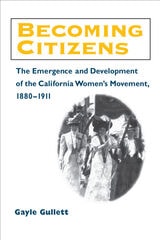
cover of Becoming Citizens: The Emergence and Development of the California Women's Movement, 1880-1911

Becoming Citizens

The Emergence and Development of the California Women's Movement, 1880-1911

Gayle Gullett

University of Illinois Press, 2000

In 1880, Californians believed a woman safeguarded the Republic by maintaining a morally sound home. Scarcely forty years later, women in the state won full-fledged citizenship and voting rights by stepping outside the home to engage in robust activism. 

Gayle Gullett reveals how this enormous transformation came about and the ways women's search for a larger public life led to a flourishing women's movement in California. Though voters rejected women's radical demand for citizenship in 1896, women rebuilt the movement in the early years of the twentieth century and forged critical bonds between activist women and the men involved in the urban Good Government movement. This alliance formed the basis of progressivism, with male Progressives helping to legitimize women's new public work by supporting their civic campaigns, appointing women to public office, and placing a suffrage referendum before the male electorate in 1911. 

Placing local developments in a national context, Becoming Citizens illuminates the links between women's reform movements and progressivism in the American West.

[more]
cover of Beginning to See the Light: Sex, Hope, and Rock-and-Roll

Beginning to See the Light

Sex, Hope, and Rock-and-Roll

Ellen Willis

University of Minnesota Press, 2012

From the New Yorker’s inimitable first pop music critic comes this pioneering collection of essays by a conscientious writer whose political realm is both radical and rational, and whose prime preoccupations are with rock ’n’ roll, sexuality, and above all, freedom. Here Ellen Willis assuredly captures the thrill of music, the disdain of authoritarian culture, and the rebellious spirit of the ’60s and ’70s.
[more]
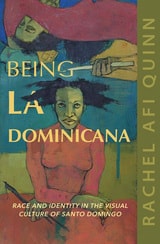
cover of Being La Dominicana: Race and Identity in the Visual Culture of Santo Domingo

Being La Dominicana

Race and Identity in the Visual Culture of Santo Domingo

Rachel Afi Quinn

University of Illinois Press, 2021

Rachel Afi Quinn investigates how visual media portray Dominican women and how women represent themselves in their own creative endeavors in response to existing stereotypes. Delving into the dynamic realities and uniquely racialized gendered experiences of women in Santo Domingo, Quinn reveals the way racial ambiguity and color hierarchy work to shape experiences of identity and subjectivity in the Dominican Republic. She merges analyses of context and interviews with young Dominican women to offer rare insights into a Caribbean society in which the tourist industry and popular media reward, and rely upon, the ability of Dominican women to transform themselves to perform gender, race, and class.

Engaging and astute, Being La Dominicana reveals the little-studied world of today's young Dominican women and what their personal stories and transnational experiences can tell us about the larger neoliberal world.

[more]
cover of Between Banat: Queer Arab Critique and Transnational Arab Archives

Between Banat

Queer Arab Critique and Transnational Arab Archives

Mejdulene Bernard Shomali

Duke University Press, 2023

In Between Banat Mejdulene Bernard Shomali examines homoeroticism and nonnormative sexualities between Arab women in transnational Arab literature, art, and film. Moving from The Thousand and One Nights and the Golden Era of Egyptian cinema to contemporary novels, autobiographical writing, and prints and graphic novels that imagine queer Arab futures, Shomali uses what she calls queer Arab critique to locate queer desire amid heteronormative imperatives. Showing how systems of heteropatriarchy and Arab nationalisms foreclose queer Arab women’s futures, she draws on the transliterated term “banat”—the Arabic word for girls—to refer to women, femmes, and nonbinary people who disrupt stereotypical and Orientalist representations of the “Arab woman.” By attending to Arab women’s narration of desire and identity, queer Arab critique substantiates queer Arab histories while challenging Orientalist and Arab national paradigms that erase queer subjects. In this way, Shomali frames queerness and Arabness as relational and transnational subject formations and contends that prioritizing transnational collectivity over politics of authenticity, respectability, and inclusion can help lead toward queer freedom.
[more]
cover of Between Feminism and Islam: Human Rights and Sharia Law in Morocco

Between Feminism and Islam

Human Rights and Sharia Law in Morocco

Zakia Salime

University of Minnesota Press, 2011

There are two major women’s movements in Morocco: the Islamists who hold shari’a as the platform for building a culture of women’s rights, and the feminists who use the United Nations’ framework to amend shari’a law. Between Feminism and Islam shows how the interactions of these movements over the past two decades have transformed the debates, the organization, and the strategies of each other.

In Between Feminism and Islam, Zakia Salime looks at three key movement moments: the 1992 feminist One Million Signature Campaign, the 2000 Islamist mass rally opposing the reform of family law, and the 2003 Casablanca attacks by a group of Islamist radicals. At the core of these moments are disputes over legitimacy, national identity, gender representations, and political negotiations for shaping state gender policies. Located at the intersection of feminism and Islam, these conflicts have led to the Islamization of feminists on the one hand and the feminization of Islamists on the other.

Documenting the synergistic relationship between these movements, Salime reveals how the boundaries of feminism and Islamism have been radically reconfigured. She offers a new conceptual framework for studying social movements, one that allows us to understand how Islamic feminism is influencing global debates on human rights.

[more]
cover of Between Woman and Nation: Nationalisms, Transnational Feminisms, and the State

Between Woman and Nation

Nationalisms, Transnational Feminisms, and the State

Caren Kaplan, Norma Alarcón, and Minoo Moallem, eds.

Duke University Press, 1999

In Between Woman and Nation constructions such as nationalism, homeland, country, region, and locality are for the first time examined in the context of gender. The contributors—leading scholars of ethnicity, transnationalism, globalization, and feminist theory—are united in their determination to locate and describe the performative space of interactions between woman and nation. These are interactions, claim the contributors, that cannot be essentialized.
This interdisciplinarily collection investigates women in diverse locales—ranging from Quebec to Beirut. The contributors consider such subjects as Yucatan feminism, Islamic fundamentalisms, Canadian gender formations, historic Chicana/o struggles, and Israeli/Palestinian conflicts. Divided into three parts, the collection first examines constructions of nationalism and communities whose practices complicate these constructions. The second section discusses regulations of particular nation-states and how they affect the lives of women, while the third presents studies of transnational identity formation, in which contributors critique ideas such as “multicultural nationalism” and “global feminism.” Arguing provocatively that such movements and concepts inadequately represent women’s interests, contributors examine how such beliefs and their attendant organizations may actually bolster the very formations they ought to subvert.
In its demonstration of the critical possibilities of feminist alliances across discrepant and distinct material conditions, Between Woman and Nation will make a unique contribution to women’s studies, feminist theory, studies of globalization and transnationalism, ethnic studies, and cultural studies.



[more]
cover of Beyond Machismo: Intersectional Latino Masculinities

Beyond Machismo

Intersectional Latino Masculinities

By Aída Hurtado and Mrinal Sinha

University of Texas Press, 2016

Long considered a pervasive value of Latino cultures both south and north of the US border, machismo—a hypermasculinity that obliterates any other possible influences on men’s attitudes and behavior—is still used to define Latino men and boys in the larger social narrative. Yet a closer look reveals young, educated Latino men who are going beyond machismo to a deeper understanding of women’s experiences and a commitment to ending gender oppression. This new Latino manhood is the subject of Beyond Machismo.

Applying and expanding the concept of intersectionality developed by Chicana feminists, Aída Hurtado and Mrinal Sinha explain how the influences of race, class, ethnicity, sexuality, and gender shape Latinos’ views of manhood, masculinity, and gender issues in Latino communities and their acceptance or rejection of feminism. In particular, the authors show how encountering Chicana feminist writings in college, as well as witnessing the horrors of sexist oppression in the United States and Latin America, propels young Latino men to a feminist consciousness. By focusing on young, high-achieving Latinos, Beyond Machismo elucidates this social group’s internal diversity, thereby providing a more nuanced understanding of the processes by which Latino men can overcome structural obstacles, form coalitions across lines of difference, and contribute to movements for social justice.

[more]
cover of Beyond the Gender Gap in Japan

Beyond the Gender Gap in Japan

Gill Steel, Editor

University of Michigan Press, 2019

Why do Japanese women enjoy a high sense of well-being in a context of high inequality? Beyond the Gender Gap in Japan brings together researchers from across the social sciences to investigate this question. The authors analyze women’s values and the lived experiences at home, in the family, at work, in their leisure time, as volunteers, and in politics and policy-making. Their research shows that the state and firms have blurred “the public” and “the private” in postwar Japan, constraining individuals’ lives, and reveals the uneven pace of change in women’s representation in politics. Yet, despite these constraints, the increasing diversification in how people live and how they manage their lives demonstrates that some people are crafting a variety of individual solutions to structural problems. Covering a significant breadth of material, the book presents comprehensive findings that use a variety of research methods—public opinion surveys, in-depth interviews, a life history, and participant observation—and, in doing so, look beyond Japan’s perennially low rankings in gender equality indices to demonstrate the diversity underneath, questioning some of the stereotypical assumptions about women in Japan.
[more]
cover of Big Sister: Feminism, Conservatism, and Conspiracy in the Heartland

Big Sister

Feminism, Conservatism, and Conspiracy in the Heartland

Erin M. Kempker

University of Illinois Press, 2018

The mid-Seventies represented a watershed era for feminism. A historic National Women's Conference convened in Houston in 1977. The Equal Rights Amendment inched toward passage. Conservative women in the Midwest, however, saw an event like the International Year of the Woman not as a celebration, but as part of a conspiracy that would lead to radicalism and one-world government. Erin M. Kempker delves into how conspiracy theories affected--and undermined--second wave feminism in the Midwest. Focusing on Indiana, Kempker views this phenomenon within the larger history of right-wing fears of subversion during the Cold War. Feminists and conservative women each believed they spoke in women's best interests. Though baffled by the conservative dread of "collectivism," feminists compromised by trimming radicals from their ranks. Conservative women, meanwhile, proved adept at applying old fears to new targets. Kemper's analysis places the women's opposing viewpoints side by side to unlock the differences that separated the groups, explain one to the other, and reveal feminism's fate in the Midwest.
[more]
cover of Black Female Sexualities

Black Female Sexualities

Melancon, Trimiko

Rutgers University Press, 2015

Western culture has long regarded black female sexuality with a strange mix of fascination and condemnation, associating it with everything from desirability, hypersexuality, and liberation to vulgarity, recklessness, and disease. Yet even as their bodies and sexualities have been the subject of countless public discourses, black women’s voices have been largely marginalized in these discussions. In this groundbreaking collection, feminist scholars from across the academy come together to correct this omission—illuminating black female sexual desires marked by agency and empowerment, as well as pleasure and pain, to reveal the ways black women regulate their sexual lives. 

The twelve original essays in Black Female Sexualities reveal the diverse ways black women perceive, experience, and represent sexuality. The contributors highlight the range of tactics that black women use to express their sexual desires and identities. Yet they do not shy away from exploring the complex ways in which black women negotiate the more traumatic aspects of sexuality and grapple with the legacy of negative stereotypes. 

Black Female Sexualities takes not only an interdisciplinary approach—drawing from critical race theory, sociology, and performance studies—but also an intergenerational one, in conversation with the foremothers of black feminist studies. In addition, it explores a diverse archive of representations, covering everything from blues to hip-hop, from Crash to Precious, from Sister Souljah to Edwidge Danticat. Revealing that black female sexuality is anything but a black-and-white issue, this collection demonstrates how to appreciate a whole spectrum of subjectivities, experiences, and desires.  
[more]
cover of Black Feminism Reimagined: After Intersectionality

Black Feminism Reimagined

After Intersectionality

Jennifer C. Nash

Duke University Press, 2019
In Black Feminism Reimagined Jennifer C. Nash reframes black feminism's engagement with intersectionality, often celebrated as its primary intellectual and political contribution to feminist theory. Charting the institutional history and contemporary uses of intersectionality in the academy, Nash outlines how women's studies has both elevated intersectionality to the discipline's primary program-building initiative and cast intersectionality as a threat to feminism's coherence. As intersectionality has become a central feminist preoccupation, Nash argues that black feminism has been marked by a single affect—defensiveness—manifested by efforts to police intersectionality's usages and circulations. Nash contends that only by letting go of this deeply alluring protectionist stance, the desire to make property of knowledge, can black feminists reimagine intellectual production in ways that unleash black feminist theory's visionary world-making possibilities.
[more]
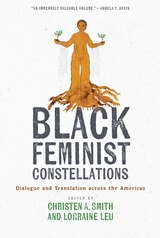
cover of Black Feminist Constellations: Dialogue and Translation across the Americas

Black Feminist Constellations

Dialogue and Translation across the Americas

Edited by Christen A. Smith and Lorraine Leu

University of Texas Press, 2023

A collection of essays, interviews, and conversations by and between scholars, activists, and artists from Latin America and the Caribbean that paints a portrait of Black women's experiences across the region.

Black women in Latin America and the Caribbean suffer a triple erasure: as Black people, as women, and as non-English speakers in a global environment dominated by the Anglophone North. Black Feminist Constellations is a passionate and necessary corrective. Focused on and written by Black women of the southern Americas, the original works composing this volume make legible the epistemologies that sustain radical scholarship, art, and political organizing by Black women everywhere.

In essays, poems, and dialogues, the writers in Black Feminist Constellations reimagine liberation from the perspectives of radical South American and Caribbean Black women thinkers. The volume’s methodologically innovative approach reflects how Black women come together to theorize the world and challenges the notion that the university is the only site where knowledge can emerge. A major work of intellectual history, Black Feminist Constellations amplifies rarely heard voices, centers the uncanonized, and celebrates the overlooked work of Black women.

[more]
cover of Black Girl Magic Beyond the Hashtag: Twenty-First-Century Acts of Self-Definition

Black Girl Magic Beyond the Hashtag

Twenty-First-Century Acts of Self-Definition

Edited by Julia S. Jordan-Zachery and Duchess Harris; Foreword by Janell Hobson; Afterword by Tammy Owens

University of Arizona Press, 2019

Hashtag or trademark, personal or collective expression, #BlackGirlMagic is an articulation of the resolve of Black women and girls to triumph in the face of structural oppressions. The online life of #BlackGirlMagic insists on the visibility of Black women and girls as aspirational figures. But while the notion of Black girl magic spreads in cyberspace, the question remains: how is Black girl magic experienced offline?

The essays in this volume move us beyond social media. They offer critical analyses and representations of the multiplicities of Black femmes’, girls’, and women’s lived experiences. Together the chapters demonstrate how Black girl magic is embodied by four elements enacted both on- and offline: building community, challenging dehumanizing representations, increasing visibility, and offering restorative justice for violence.

Black Girl Magic Beyond the Hashtag shows how Black girls and women foster community, counter invisibility, engage in restorative acts, and create spaces for freedom. Intersectional and interdisciplinary, the contributions in this volume bridge generations and collectively push the boundaries of Black feminist thought.

[more]
cover of Black Trans Feminism

Black Trans Feminism

Marquis Bey

Duke University Press, 2022

In Black Trans Feminism Marquis Bey offers a meditation on blackness and gender nonnormativity in ways that recalibrate traditional understandings of each. Theorizing black trans feminism from the vantages of abolition and gender radicality, Bey articulates blackness as a mutiny against racializing categorizations; transness as a nonpredetermined, wayward, and deregulated movement that works toward gender’s destruction; and black feminism as an epistemological method to fracture hegemonic modes of racialized gender. In readings of the essays, interviews, and poems of Alexis Pauline Gumbs, jayy dodd, and Venus Di’Khadijah Selenite, Bey turns black trans feminism away from a politics of gendered embodiment and toward a conception of it as a politics grounded in fugitivity and the subversion of power. Together, blackness and transness actualize themselves as on the run from gender. In this way, Bey presents black trans feminism as a mode of enacting the wholesale dismantling of the world we have been given.
[more]
cover of Black Visions: The Roots of Contemporary African-American Political Ideologies

Black Visions

The Roots of Contemporary African-American Political Ideologies

Michael C. Dawson

University of Chicago Press, 2001
This stunning book represents the most comprehensive analysis to date of the complex relationships between black political thought and black political identity and behavior. Ranging from Frederick Douglass to rap artist Ice Cube, Michael C. Dawson brilliantly illuminates the history and current role of black political thought in shaping political debate in America.
[more]
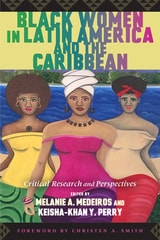
cover of Black Women in Latin America and the Caribbean: Critical Research and Perspectives

Black Women in Latin America and the Caribbean

Critical Research and Perspectives

Melanie A. Medeiros

Rutgers University Press, 2023

Black Women in Latin America and the Caribbean: Critical Research and Perspectives employs an intersectional and interdisciplinary approach to examine Black cisgender women’s social, cultural, economic, and political experiences in Latin America and the Caribbean. It presents critical empirical research emphasizing Black women’s innovative, theoretical, and methodological approaches to activism and class-based gendered racism and Black politics. While there are a few single-authored books focused on Black women in Latin American and Caribbean, the vast majority of the scholarship on Black women in Latin America and the Caribbean has been published as theses, dissertations, articles, and book chapters. This volume situates these social and political analyses as interrelated and dialogic and contributes a transnational perspective to contemporary conversations surrounding the continued relevance of Black women as a category of social science inquiry. Many of the contributing authors are from Latin American and Caribbean countries, reflecting a commitment to representing the valuable observations and lived experiences of scholars from this region. When read together, the chapters offer a hemispheric framework for understanding the lasting legacies of colonialism, transatlantic slavery, plantation life, and persistent socio-economic and cultural violence.
[more]
cover of Black Women’s Intellectual Traditions: Speaking Their Minds

Black Women’s Intellectual Traditions

Speaking Their Minds

Edited by Kristin B. Waters and Carol B. Conaway

University Press of New England, 2007

An astonishing wealth of literary and intellectual work by nineteenth-century black women is being rediscovered and restored to print in scholarly and popular editions. In Kristin Waters’s and Carol B. Conaway’s landmark edited collection, Black Women’s Intellectual Traditions: Speaking Their Minds, sophisticated commentary on this rich body of work chronicles a powerful and interwoven legacy of activism based in social and political theories that helped shape the history of North America. The book meticulously reclaims this American legacy, providing a collection of critical analyses of the primary sources and their vital traditions. Written by leading scholars, Black Women’s Intellectual Traditions is particularly powerful in its exploration of the pioneering thought and action of the nineteenth-century black woman lecturer and essayist Maria W. Stewart, abolitionist Sojourner Truth, novelist and poet Frances Ellen Watkins Harper, educator Anna Julia Cooper, newspaper editor Mary Ann Shadd Cary, and activist Ida B. Wells. The distinguished contributors are Hazel V. Carby, Patricia Hill Collins, Karen Baker-Fletcher, Kristin Waters, R. Dianne Bartlow, Carol B. Conaway, Olga Idriss Davis, Vanessa Holford Diana, Evelyn Simien, Janice W. Fernheimer, Michelle N. Garfield, Joy James, Valerie Palmer-Mehta, Carla L. Peterson, Marilyn Richardson, Evelyn M. Simien, Ebony A. Utley, Mary Helen Washington, Melina Abdullah, and Lena Ampadu. The volume will interest scholars and readers of African-American and women’s studies, history, rhetoric, literature, poetry, sociology, political science, and philosophy.
[more]
cover of Black Women’s Intellectual Traditions: Speaking Their Minds

Black Women’s Intellectual Traditions

Speaking Their Minds

Edited by Kristin Waters and Carol B. Conaway

Brandeis University Press, 2022

A new edition of a landmark work on Black women’s intellectual traditions.
 
An astonishing wealth of literary and intellectual work by nineteenth-century Black women is being rediscovered and restored to print in scholarly and popular editions. In Kristin Waters’s and Carol B. Conaway’s landmark edited collection, Black Women’s Intellectual Traditions: Speaking Their Minds, sophisticated commentary on this rich body of work chronicles a powerful and interwoven legacy of activism based in social and political theories that helped shape the history of North America. The book meticulously reclaims this American legacy, providing a collection of critical analyses of the primary sources and their vital traditions. Written by leading scholars, Black Women’s Intellectual Traditions is particularly powerful in its exploration of the pioneering thought and action of the nineteenth-century Black woman lecturer and essayist Maria W. Stewart, abolitionist Sojourner Truth, novelist and poet Frances Ellen Watkins Harper, educator Anna Julia Cooper, newspaper editor Mary Ann Shadd Cary, and activist Ida B. Wells. The distinguished contributors are Hazel V. Carby, Patricia Hill Collins, Karen Baker-Fletcher, Kristin Waters, R. Dianne Bartlow, Carol B. Conaway, Olga Idriss Davis, Vanessa Holford Diana, Evelyn Simien, Janice W. Fernheimer, Michelle N. Garfield, Joy James, Valerie Palmer-Mehta, Carla L. Peterson, Marilyn Richardson, Evelyn M. Simien, Ebony A. Utley, Mary Helen Washington, Melina Abdullah, and Lena Ampadu. The volume will interest scholars and readers of African-American and women’s studies, history, rhetoric, literature, poetry, sociology, political science, and philosophy. This updated edition features a new preface by the editors in the light of new developments in current scholarship.

 
[more]
cover of Bluestocking Feminism and British-German Cultural Transfer, 1750-1837

Bluestocking Feminism and British-German Cultural Transfer, 1750-1837

Alessa Johns

University of Michigan Press, 2014

Bluestocking Feminism and British-German Cultural Transfer, 1750–1837 examines the processes of cultural transfer between Britain and Germany during the Personal Union, the period from 1714 to 1837 when the kings of England were simultaneously Electors of Hanover. While scholars have generally focused on the political and diplomatic implications of the Personal Union, Alessa Johns offers a new perspective by tracing sociocultural repercussions and investigating how, in the period of the American and French Revolutions, Britain and Germany generated distinct discourses of liberty even though they were nonrevolutionary countries. British and German reformists—feminists in particular—used the period’s expanded pathways of cultural transfer to generate new discourses as well as to articulate new views of what personal freedom, national character, and international interaction might be. Johns traces four pivotal moments of cultural exchange: the expansion of the book trade, the rage for translation, the effect of revolution on intra-European travel and travel writing, and the impact of transatlantic journeys on visions of reform. Johns reveals the way in which what she terms “bluestocking transnationalism” spawned discourses of liberty and attempts at sociocultural reform during this period of enormous economic development, revolution, and war.
[more]
cover of Body Language: Sisters in Shape, Black Women's Fitness, and Feminist Identity Politics

Body Language

Sisters in Shape, Black Women's Fitness, and Feminist Identity Politics

Kimberly J. Lau

Temple University Press, 2011

In her evocative ethnographic study, Body Language, Kimberly Lau traces the multiple ways in which the success of an innovative fitness program illuminates what identity means to its Black female clientele and how their group interaction provides a new perspective on feminist theories of identity politics—especially regarding the significance of identity to political activism and social change.

Sisters in Shape, Inc., Fitness Consultants (SIS), a Philadelphia company, promotes balance in physical, mental, and spiritual health. Its program goes beyond workouts, as it educates and motivates women to make health and fitness a priority. Discussing the obstacles at home and the importance of the group's solidarity to their ability to stay focused on their goals, the women speak to the ways in which their commitment to reshaping their bodies is a commitment to an alternative future.

Body Language shows how the group's explorations of black women's identity open new possibilities for identity-based claims to recognition, justice, and social change.

[more]
cover of Broadway's Bravest Woman: Selected Writings of Sophie Treadwell

Broadway's Bravest Woman

Selected Writings of Sophie Treadwell

Edited by Jerry Dickey and Miriam Lopez-Rodriguez

Southern Illinois University Press, 2006

This collection of plays, fiction, and journalistic essays by Sophie Treadwell provides an engaging portrait of one of America’s most innovative yet neglected feminists. Broadway’s Bravest Woman: Selected Writings of Sophie Treadwell is the first critical compilation of her prose and drama and highlights the most significant and formerly unavailable pieces of her work. Editors Jerry Dickey and Miriam López-Rodriguez place Treadwell within the context of the early twentieth century and outline four themes that infused her feminist ideology: the social positioning of women, ethnic identity in the United States, tensions between modern progressivism and conservatism, and the individual’s role in the face of social justice.

Treadwell’s critical reputation as a dramatist is largely based on the success of the 1928 expressionist drama Machinal, but little is known about her other dramas, much less her fiction and journalism. Drawing largely upon unpublished manuscripts, this volume documents the breadth of Treadwell’s work, from an investigative newspaper serial written in 1914 to selections from an autobiographical novel completed during World War II, which chronicled her development as a feminist.

In the introduction, Dickey and López-Rodriguez present a detailed portrait of Treadwell’s sensational but critically neglected journalistic career, from her 1915 serial on social welfare for prostitutes in San Francisco to her 1921 ground-breaking story on the Mexican revolutionary leader Pancho Villa. They also outline the personal and social factors that helped shape Treadwell’s feminist ideals.

Expanding the awareness of the feminist writer’s accomplishments, Broadway’s Bravest Woman is critical resource for students, scholars, and theatre artists. The collection, enhanced by six illustrations, not only offers the most complete portrait of Treadwell to date as a significant feminist voice in modern America but also provides a glimpse into the social life and international relations of the United States in the interwar period of the twentieth century.

[more]
cover of Brokered Subjects: Sex, Trafficking, and the Politics of Freedom

Brokered Subjects

Sex, Trafficking, and the Politics of Freedom

Elizabeth Bernstein

University of Chicago Press, 2018
Brokered Subjects digs deep into the accepted narratives of sex trafficking to reveal the troubling assumptions that have shaped both right- and left-wing agendas around sexual violence. Drawing on years of in-depth fieldwork, Elizabeth Bernstein sheds light not only on trafficking but also on the broader structures that meld the ostensible pursuit of liberation with contemporary techniques of power. Rather than any meaningful commitment to the safety of sex workers, Bernstein argues, what lies behind our current vision of trafficking victims is a transnational mix of putatively humanitarian militaristic interventions, feel-good capitalism, and what she terms carceral feminism: a feminism compatible with police batons.
[more]
cover of Building Womanist Coalitions: Writing and Teaching in the Spirit of Love

Building Womanist Coalitions

Writing and Teaching in the Spirit of Love

Edited by Gary L. Lemons

University of Illinois Press, 2019

Over the last generation, the womanist idea--and the tradition blooming around it--has emerged as an important response to separatism, domination, and oppression. Gary L. Lemons gathers a diverse group of writers to discuss their scholarly and personal experiences with the womanist spirit of women of color feminisms. Feminist and womanist-identified educators, students, performers, and poets model the powerful ways that crossing borders of race, gender, class, sexuality, and nation-state affiliation(s) expands one's existence. At the same time, they bear witness to how the self-liberating theory and practice of women of color feminism changes one's life. Throughout, the essayists come together to promote an unwavering vein of activist comradeship capable of building political alliances dedicated to liberty and social justice. Contributors: M. Jacqui Alexander, Dora Arreola, Andrea Assaf, Kendra N. Bryant, Rudolph P. Byrd, Atika Chaudhary, Paul T. Corrigan, Fanni V. Green, Beverly Guy-Sheftall, Susan Hoeller, Ylce Irizarry, M. Thandabantu Iverson, Gary L. Lemons, Layli Maparyan, and Erica C. Sutherlin
[more]