128 books match the query 'Feminism and literature' and 4 start with b

cover of Beyond the Gibson Girl: Reimagining the American New Woman, 1895-1915

Beyond the Gibson Girl

Reimagining the American New Woman, 1895-1915

Martha H. Patterson

University of Illinois Press, 2005

Challenging monolithic images of the New Woman as white, well-educated, and politically progressive, this study focuses on important regional, ethnic, and sociopolitical differences in the use of the New Woman trope at the turn of the twentieth century. Using Charles Dana Gibson's "Gibson Girls" as a point of departure, Martha H. Patterson explores how writers such as Pauline Hopkins, Margaret Murray Washington, Sui Sin Far, Mary Johnston, Edith Wharton, Ellen Glasgow, and Willa Cather challenged and redeployed the New Woman image in light of other “new” conceptions: the "New Negro Woman," the "New Ethics," the "New South," and the "New China."

As she appears in these writers' works, the New Woman both promises and threatens to effect sociopolitical change as a consumer, an instigator of evolutionary and economic development, and (for writers of color) an icon of successful assimilation into dominant Anglo-American culture. Examining a diverse array of cultural products, Patterson shows how the seemingly celebratory term of the New Woman becomes a trope not only of progressive reform, consumer power, transgressive femininity, modern energy, and modern cure, but also of racial and ethnic taxonomies, social Darwinist struggle, imperialist ambition, assimilationist pressures, and modern decay.
[more]
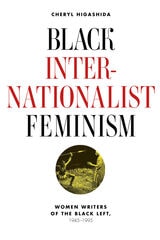
cover of Black Internationalist Feminism: Women Writers of the Black Left, 1945-1995

Black Internationalist Feminism

Women Writers of the Black Left, 1945-1995

Cheryl Higashida

University of Illinois Press, 2013
Black Internationalist Feminism examines how African American women writers affiliated themselves with the post-World War II Black Communist Left and developed a distinct strand of feminism. This vital yet largely overlooked feminist tradition built upon and critically retheorized the postwar Left's "nationalist internationalism," which connected the liberation of Blacks in the United States to the liberation of Third World nations and the worldwide proletariat. Black internationalist feminism critiques racist, heteronormative, and masculinist articulations of nationalism while maintaining the importance of national liberation movements for achieving Black women's social, political, and economic rights.
 
Cheryl Higashida shows how Claudia Jones, Lorraine Hansberry, Alice Childress, Rosa Guy, Audre Lorde, and Maya Angelou worked within and against established literary forms to demonstrate that nationalist internationalism was linked to struggles against heterosexism and patriarchy. Exploring a diverse range of plays, novels, essays, poetry, and reportage, Higashida illustrates how literature is a crucial lens for studying Black internationalist feminism because these authors were at the forefront of bringing the perspectives and problems of black women to light against their marginalization and silencing.
 
In examining writing by Black Left women from 1945–1995, Black Internationalist Feminism contributes to recent efforts to rehistoricize the Old Left, Civil Rights, Black Power, and second-wave Black women's movements.
[more]
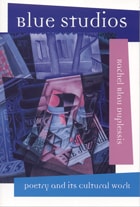
cover of Blue Studios: Poetry and Its Cultural Work

Blue Studios

Poetry and Its Cultural Work

Rachel Blau DuPlessis

University of Alabama Press, 2006
Examines the work of experimental poets and the innovative forms they create to disrupt assumptions about gender and cultural power
 
In her now-classic The Pink Guitar, Rachel Blau DuPlessis examined a number of modern and contemporary poets and artists to explore the possibility of finding a language that would question deeply held assumptions about gender. In the 12 essays and introduction that constitute Blue Studios, DuPlessis continues that task, examining the work of experimental poets and the innovative forms they have fashioned to challenge commonplace assumptions about gender and cultural authority.
 
The essays in “Attitudes and Practices” deal with two questions: what a feminist reading of cultural texts involves, and the nature of the essay itself as a mode of knowing: how poetry can be discursive and how the essay can be poetic. The goal of “Marble Paper,” with its studies of William Wordsworth, Ezra Pound, and Charles Olson is to suggest terms for a “feminist history of poetry.”
 
“Perspectives must be fashioned that displace and estrange the world,” Theodore Adorno wrote, and in the section "Urrealism" DuPlessis examines the work of poets from several schools (the Objectivists, the New York School, the surrealists) whose work embodies that displacement, among them George Oppen, Lorine Niedecker, H.D., and Barbara Guest. These writers’ radical deployment of line, sound, and structure, DuPlessis argues, demonstrate poetry’s power not as a purely literary, artistic, or aesthetic force but as a rhetorical form intricately tied to issues of power and ethics. And in "Migrated Into,” the author probes the ways these issues have informed her, as a poet and a critic; how the political has “migrated into” and suffused her own work; and how the practice of poetry can be an arousal to a deeper understanding of what we stand for.
 
[more]
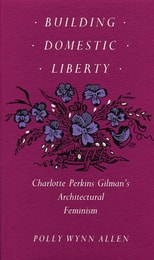
cover of Building Domestic Liberty: Charlotte Perkins Gilman's Architectural Feminism

Building Domestic Liberty

Charlotte Perkins Gilman's Architectural Feminism

Polly Wynn Allen

University of Massachusetts Press, 1988

Building Domestic Liberty offers a critical and admiring analysis of feminist philosopher Charlotte Perkins Gilman (1860–1935). Polly Allen examines Gilman's approach to architecture, landscape, and neighborhood design and discusses Gilman's case against prevailing household design and looks at her philosophy of world improvement.

[more]