Results by title
183 books match the query 'Feminist' and 10 start with b
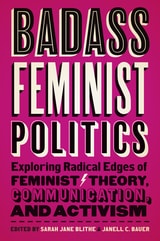
Badass Feminist Politics
Exploring Radical Edges of Feminist Theory, Communication, and ActivismSarah Jane Blithe
Rutgers University Press, 2022
Badass Feminist Politics includes a diverse range of engaging feminist political projects to not only analyze the work being done on the ground but provide an overview for action that can be taken on by those seeking to engage in feminist activism in their own communities. Contributors included here are working for equality and equity and resisting violent, racist, homophobic, transphobic, xenophobic, and sexist language and action during this tension-filled political moment. Collectively, the book explores what it means to live and communicate feminist politics in everyday choices and actions, and how we can facilitate learning by analyzing these examples. Taking up current issues and new theoretical perspectives, the authors offer novel perspectives into what it means to live feminist politics. This book is a testament to resilience, resistance, communication, and forward thinking about what these themes all mean for new feminist agendas. Learning how to resist oppressive structures through words and actions is particularly important for students. Badass Feminist Politics features scholars from non-dominant groups taking up issues of marginalization and oppression, which can help people accomplish their social justice goals of inclusivity on the ground and in the classroom.

Beyond Human
Vital Materialisms in the Andean Avant-GardesDaly, Tara
Bucknell University Press, 2019
Published by Bucknell University Press. Distributed worldwide by Rutgers University Press.
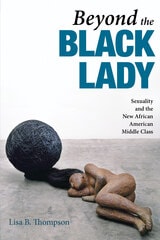
Beyond the Black Lady
Sexuality and the New African American Middle ClassLisa B. Thompson
University of Illinois Press, 2012
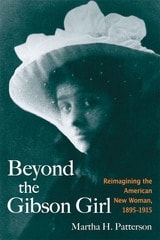
Beyond the Gibson Girl
Reimagining the American New Woman, 1895-1915Martha H. Patterson
University of Illinois Press, 2005
Challenging monolithic images of the New Woman as white, well-educated, and politically progressive, this study focuses on important regional, ethnic, and sociopolitical differences in the use of the New Woman trope at the turn of the twentieth century. Using Charles Dana Gibson's "Gibson Girls" as a point of departure, Martha H. Patterson explores how writers such as Pauline Hopkins, Margaret Murray Washington, Sui Sin Far, Mary Johnston, Edith Wharton, Ellen Glasgow, and Willa Cather challenged and redeployed the New Woman image in light of other “new” conceptions: the "New Negro Woman," the "New Ethics," the "New South," and the "New China."
As she appears in these writers' works, the New Woman both promises and threatens to effect sociopolitical change as a consumer, an instigator of evolutionary and economic development, and (for writers of color) an icon of successful assimilation into dominant Anglo-American culture. Examining a diverse array of cultural products, Patterson shows how the seemingly celebratory term of the New Woman becomes a trope not only of progressive reform, consumer power, transgressive femininity, modern energy, and modern cure, but also of racial and ethnic taxonomies, social Darwinist struggle, imperialist ambition, assimilationist pressures, and modern decay.
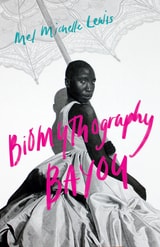
Biomythography Bayou
Mel Michelle Lewis
Bucknell University Press, 2025
Biomythography Bayou is more than just a book of memoir; it is a ritual for conjuring queer embodied knowledges and decolonial perspectives. Blending a rich gumbo of genres—from ingredients such as praise songs, folk tales, recipes, incantations, and invocations—it also includes a multimedia component, with “bayou tableau” images and audio recording links. Inspired by such writers as Audre Lorde, Zora Neale Hurston, and Octavia Butler, Mel Michelle Lewis draws from the well of her ancestors in order to chart a course toward healing Afrofutures. Showcasing the nature, folklore, dialect, foodways, music, and art of the Gulf’s coastal communities, Lewis finds poetic ways to celebrate their power and wisdom.
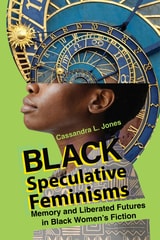
Black Speculative Feminisms
Memory and Liberated Futures in Black Women's FictionCassandra L. Jones
The Ohio State University Press, 2024
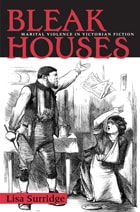
Bleak Houses
Marital Violence in Victorian FictionLisa Surridge
Ohio University Press, 2005
The Offenses Against the Person Act of 1828 opened magistrates' courts to abused working-class wives. Newspapers in turn reported on these proceedings, and in this way the Victorian scrutiny of domestic conduct began. But how did popular fiction treat “private” family violence? Bleak Houses: Marital Violence in Victorian Fiction traces novelists' engagement with the wife-assault debates in the public press between 1828 and the turn of the century.
Lisa Surridge examines the early works of Charles Dickens and reads Dombey and Son and Anne Brontë's The Tenant of Wildfell Hall in the context of the intense debates on wife assault and manliness in the late 1840s and early 1850s. Surridge explores George Eliot's Janet's Repentance in light of the parliamentary debates on the 1857 Divorce Act. Marital cruelty trials provide the structure for both Wilkie Collins's The Woman in White and Anthony Trollope's He Knew He Was Right.
Locating the New Woman fiction of Mona Caird and the reassuring detective investigations of Sherlock Holmes in the context of late-Victorian feminism and the great marriage debate in the Daily Telegraph, Surridge illustrates how fin-de-siècle fiction brought male sexual violence and the viability of marriage itself under public scrutiny. Bleak Houses thus demonstrates how Victorian fiction was concerned about the wife-assault debates of the nineteenth century, debates which both constructed and invaded the privacy of the middle-class home.

Bluestocking Feminism and British-German Cultural Transfer, 1750-1837
Alessa Johns
University of Michigan Press, 2014
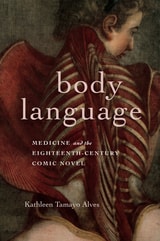
Body Language
Medicine and the Eighteenth-Century Comic NovelKathleen Tamayo Alves
Bucknell University Press, 2026
Body Language examines the complex intersections of British eighteenth-century comic fiction and medical discourse. By engaging medical writings of renowned and widely-read physicians of the Enlightenment such as John Freind, Thomas Sydenham, Albrecht von Haller, John Whytt, and William Cullen, with novels of humor by Henry Fielding, Tobias Smollett, Laurence Sterne, and Charlotte Lennox, Alves explains how medicine shaped comic language by dramatizing female-specific phenomena like menstruation, hysteria, nervous disorders, and pregnancy. In these novels, the medical belief that women are incapable of bodily self-regulation becomes an imperative for policing women’s bodies and highlights the enduring shortcomings of patriarchal systems. Ultimately, these comic representations offer a counternarrative of women’s bodies, agency, and selfhood, exposing masculine anxieties about the effectiveness of marriage to regulate women’s sexuality.
Published by Bucknell University Press. Distributed worldwide by Rutgers University Press.
Born Again
The Christian Right GlobalizedJennifer S. Butler
Pluto Press, 2006
This book reveals how Christian conservative groups are able to shape policy in every corner of the world. Drawing on interviews with religious leaders, it reveals how today's most powerful Christian Right organisations are building interfaith coalitions, connecting Catholic, Mormon and Muslim allies to advance a conservative agenda.
The US under Bush Jr. has given them a significant voice in shaping US policy on issues including women's rights, reproductive health, human cloning, children's rights and AIDS.
In short, the Christian Right is globalising -- a phenomenon that promises to challenge progressive social policy on a world-wide scale - as well as transform the Christian Right itself.