Results by title
72 books match the query 'Field Guide' and 5 start with b
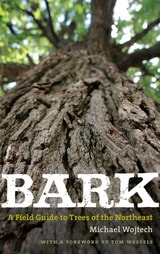
Bark
A Field Guide to Trees of the NortheastMichael Wojtech
Brandeis University Press, 2020
What kind of tree is that? Whether you’re hiking in the woods or simply sitting in your backyard, from Maine to New York you’ll never be without an answer to that question, thanks to this handy companion to the trees of the Northeast. Featuring detailed information and illustrations covering each phase of a tree’s lifecycle, this indispensable guidebook explains how to identify trees by their bark alone—no more need to wait for leaf season. Chapters on the structure and ecology of tree bark, descriptions of bark appearance, an easy-to-use identification key, and supplemental information on non-bark characteristics—all enhanced by more than 450 photographs, illustrations, and maps—will show you how to distinguish the textures, shapes, and colors of bark to recognize various tree species, and also understand why these traits evolved.
Whether you’re a professional naturalist or a parent leading a family hike, this new edition of Bark: A Field Guide to Trees of the Northeast is your essential guide to the region’s 67 native and naturalized tree species.
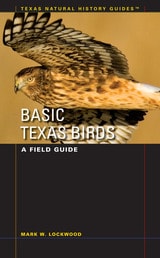
Basic Texas Birds
A Field GuideBy Mark W. Lockwood
University of Texas Press, 2007
Finding all the birds in Texas can be a lifetime pursuit. Basic Texas Birds, an easy-to-use field guide, will help you identify over 180 species of birds that are found across the state, including a selection of the rarer "Texas specialties" that draw birders to Texas from around the world. These are the birds that form the basis of a birder's life list for Texas.
Basic Texas Birds is organized by bird families to aid in identifying any bird you see in the wild. It is loaded with resources, including:
- 200 full-color, close-up photos of the birds
- State-of-the-art range maps—the most accurate of any currently available—that show each species' distribution within the state
- Up-to-date species accounts that provide a wealth of current and historical information, including each bird's appearance, habitat, status, and distribution, and that also identify similar species
- A glossary of terms used in bird identification
- A list of selected readings for learning more about birds found in Texas
- The Texas Ornithological Society's list of birds documented in Texas
Much more convenient for identifying common birds than a comprehensive state or national field guide, Basic Texas Birds is a must-have resource for both beginning and experienced birders.
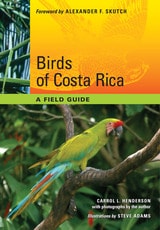
Birds of Costa Rica
A Field GuideText and photographs by Carrol L. Henderson
University of Texas Press, 2010
At the biological crossroads of the Americas, Costa Rica hosts an astonishing array of plants and animals—over half a million species! Ecotourists, birders, and biologists come from around the world, drawn by the likelihood of seeing more than three or four hundred species of birds and other animals during even a short stay. To help all of these visitors, as well as local residents, identify and enjoy the wildlife of Costa Rica, Carrol Henderson published Field Guide to the Wildlife of Costa Rica in 2002, and it became the instant and indispensable guide.
Now Henderson has created a dedicated field guide to the birds that travelers are most likely to see, as well as to the unique or endemic species that are of high interest to birders. Birds of Costa Rica covers 310 birds—an increase of 124 species from the earlier volume—with fascinating accounts of the birds' natural history, identification, and behavior gleaned from Henderson's forty years of traveling and birding in Costa Rica. All of the accounts include beautiful photographs of the birds, most of which were taken in the wild by Henderson. There are new updated distribution maps and a detailed appendix that identifies many of the country's best bird-watching locations and lodges, including contact information for trip planning purposes.
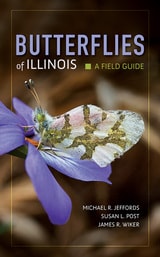
Butterflies of Illinois
A Field GuideMichael R. Jeffords, Susan L. Post, and James R. Wiker
University of Illinois Press, 2019
- identification quick guides depicting the tops and undersides of all butterfly species
- scientific information and photos that explain life cycles, habitats, and ecology
- range maps
- flight period charts
- key characteristics relevant to field identification
- descriptions of rarely seen butterflies and irregular visitors from nearby states
- supplemental information on various species, including collection records and unusual sightings
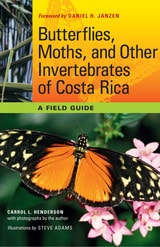
Butterflies, Moths, and Other Invertebrates of Costa Rica
A Field GuideBy Carrol L. Henderson, with photographs by the author
University of Texas Press, 2010
At the biological crossroads of the Americas, Costa Rica hosts an astonishing array of plants and animals—over half a million species! Ecotourists, birders, and biologists come from around the world, drawn by the likelihood of seeing more than three or four hundred species of birds and other animals during even a short stay. To help all these visitors, as well as local residents, identify and enjoy the wildlife of Costa Rica, Carrol Henderson published Field Guide to the Wildlife of Costa Rica in 2002, and it instantly became the indispensable guide.
Now Henderson has created a dedicated field guide to more than one hundred tropical butterflies, moths, and other invertebrates that travelers are most likely to see while exploring the wild lands of Costa Rica. He includes fascinating information on their natural history, ecology, identification, and behavior gleaned from his forty years of travels and wildlife viewing, as well as details on where to see these remarkable and beautiful creatures. The butterflies, moths, and other invertebrates are illustrated by over 180 stunning and colorful photographs—most of which were taken in the wild by Henderson. A detailed and invaluable appendix that identifies many of Costa Rica's best wildlife-watching destinations, lodges, and contact information for trip-planning purposes completes the volume.