Results by title
87 books match the query 'Fire' and 4 start with b

Before Grenfell
Fire, Safety and Deregulation in Twentieth-Century BritainShane Ewen
University of London Press, 2023
An account of the systemic failures that led to the Grenfell tower fire.
The 2017 Grenfell tower fire in London was a “slow disaster,” the product of a long accumulation of faults and errors that resulted from erroneous assumptions and organizational and governmental decision-making. This book offers a critical perspective on the systematic failures that lead to one of the greatest tragedies in Britain in our time.
Before Grenfell is a poignant and timely analysis of risk, fire, and safety in postwar Britain. Tracing the evolution of state housing policy in relation to multistory housing since the mid-1950s, the book adds to a burgeoning history of the British experience of fire and safety in high-rises and investigates a latent housing crisis in contemporary Britain against a backdrop of increasingly deregulated urban building development. Drawing on public inquiries, newspaper accounts, and oral histories, Shane Ewen details other avoidable disasters, including the Ronan Point tower block explosion in 1968, the Summerland leisure center fire in 1972, and the Bradford City Football Club fire in 1985. The book closes with a powerful chapter on fire safety campaigners, including survivor groups, who are seeking justice for the victims of fire disasters. Before Grenfell aims to exert pressure on policy-makers to act on the lessons of fatal disasters in order to both prevent future casualties and establish a legacy for those who lost their lives.
[more]
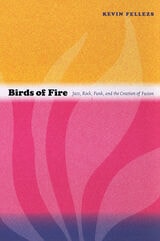
Birds of Fire
Jazz, Rock, Funk, and the Creation of FusionKevin Fellezs
Duke University Press, 2011
Birds of Fire brings overdue critical attention to fusion, a musical idiom that emerged as young musicians blended elements of jazz, rock, and funk in the late 1960s and 1970s. At the time, fusion was disparaged by jazz writers and ignored by rock critics. In the years since, it has come to be seen as a commercially driven jazz substyle. Fusion never did coalesce into a genre. In Birds of Fire, Kevin Fellezs contends that hybridity was its reason for being. By mixing different musical and cultural traditions, fusion artists sought to disrupt generic boundaries, cultural hierarchies, and critical assumptions. Interpreting the work of four distinctive fusion artists—Tony Williams, John McLaughlin, Joni Mitchell, and Herbie Hancock—Fellezs highlights the ways that they challenged convention in the 1960s and 1970s. He also considers the extent to which a musician can be taken seriously as an artist across divergent musical traditions. Birds of Fire concludes with a look at the current activities of McLaughlin, Mitchell, and Hancock; Williams’s final recordings; and the legacy of the fusion music made by these four pioneering artists.
[more]
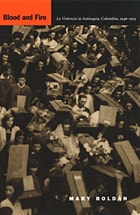
Blood and Fire
La Violencia in Antioquia, Colombia, 1946-1953Mary Roldan
Duke University Press, 2003
Between 1946 and 1966a surge of violence in Colombia left 200,000 dead in one of the worst conflicts the western hemisphere has ever experienced. the first seven years of this little-studied period of terror, known as la Violencia, is the subject of Blood and Fire. Scholars have traditionally assumed that partisan politics drove La Violencia, but Mary Roldán challenges earlier assessments by providing a nuanced account of the political and cultural motives behind the fratricide. Although the author acknowledges that partisan animosities played an important role in the disintegration of peaceful discourse into violence, she argues that conventional political conflicts were intensified by other concerns.
Through an analysis of the evolution of violence in Antioquia, which at the time was the wealthiest and most economically diverse region of Colombia, Roldán demonstrates how tensions between regional politicians and the weak central state, diverse forms of social prejudice, and processes of economic development combined to make violence a preferred mode of political action. Privatization of state violence into paramilitary units and the emergence of armed resistance movements exacted a horrible cost on Colombian civic life, and these processes continue to plague the country.
Roldan’s reading of the historical events suggests that Antioquia’s experience of la Violencia was the culmination of a brand of internal colonialism in which regional identity formation based on assumptions of cultural superiority was used to justify violence against racial or ethnic "others" and as a pretext to seize land and natural resources. Blood and Fire demonstrates that, far from being a peculiarity of the Colombians, la Violencia was a logical product of capitalist development and state formation in the modern world.
This is the first study to analyze intersections of ethnicity, geography, and class to explore the genesis of Colombian violence, and it has implications for the study of repression in many other nations.
[more]
Bullets and Fire
Lynching and Authority in Arkansas, 1840-1950Guy Lancaster
University of Arkansas Press, 2017
Bullets and Fire is the first collection on lynching in Arkansas, exploring all corners of the state from the time of slavery up to the mid-twentieth century and covering stories of the perpetrators, victims, and those who fought against vigilante violence.
Among the topics discussed are the lynching of slaves, the Arkansas Council of the Association of Southern Women for the Prevention of Lynching, the 1927 lynching of John Carter in Little Rock, and the state’s long opposition to a federal anti-lynching law.
Throughout, the work reveals how the phenomenon of lynching—as the means by which a system of white supremacy reified itself, with its perpetrators rarely punished and its defenders never condemned—served to construct authority in Arkansas. Bullets and Fire will add depth to the growing body of literature on American lynching and integrate a deeper understanding of this violence into Arkansas history.
[more]