70 books match the query 'Folk music' and 2 start with b
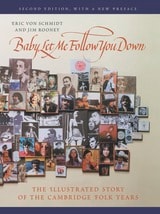
cover of Baby, Let Me Follow You Down: The Illustrated Story of the Cambridge Folk Years

Baby, Let Me Follow You Down

The Illustrated Story of the Cambridge Folk Years

Eric von Schmidt

University of Massachusetts Press, 1979

Baby, Let Me Follow You Down is a classic in the history of American popular culture. The book tells the story of the folk music community in Cambridge, Massachusetts, from its beginnings in living rooms and Harvard Square coffeehouses in the late 1950s to the heyday of the folk music revival in the early 1960s. Hundreds of historical photographs, rescreened for this edition, and dozens of interviews combine to re-create the years when Joan Baez, Bob Dylan, and a lively band of Cambridge folksingers led a generation in the rediscovery of American folk music.

Compiled by two musicians who were active participants in the Cambridge folk scene, the volume documents a special time in United States culture when the honesty and vitality of traditional folk music were combined with the raw power of urban blues and the high energy of electric rock and roll to create a new American popular music.
[more]
cover of Bacchanalian Sentiments: Musical Experiences and Political Counterpoints in Trinidad

Bacchanalian Sentiments

Musical Experiences and Political Counterpoints in Trinidad

Kevin K. Birth

Duke University Press, 2008

Trinidad is known for its vibrant musical traditions, which reflect the island’s ethnic diversity. The annual Carnival, far and away the biggest event in Trinidad, is filled with soca and calypso music. Soca is a dance music derived from calypso, a music with African antecedents. In parang, a Venezuelan and Spanish derived folk music that dominates Trinidadian Christmas festivities, groups of singers and musicians progress from house to house, performing for their neighbors. Chutney is also an Indo-Caribbean music. In Bacchanalian Sentiments, Kevin K. Birth argues that these and other Trinidadian musical genres and traditions not only provide a soundtrack to daily life on the southern Caribbean island; they are central to the ways that Trinidadians experience and navigate their social lives and interpret political events.

Birth draws on fieldwork he conducted in one of Trinidad’s ethnically diverse rural villages to explore the relationship between music and social and political consciousness on the island. He describes how Trinidadians use the affective power of music and the physiological experience of performance to express and work through issues related to identity, ethnicity, and politics. He looks at how the performers and audience members relate to different musical traditions. Turning explicitly to politics, Birth recounts how Trinidadians used music as a means of making sense of the attempted coup d’état in 1990 and the 1995 parliamentary election, which resulted in a tie between the two major political parties. Bacchanalian Sentiments is an innovative ethnographic analysis of the significance of music, and particular musical forms, in the everyday lives of rural Trinidadians.

[more]