147 books match the query 'Freedom' and 6 start with b
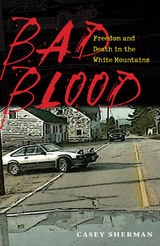
cover of Bad Blood: Freedom and Death in the White Mountains

Bad Blood

Freedom and Death in the White Mountains

Casey Sherman

University Press of New England, 2012

In the shadow of the fallen Old Man of the Mountain, on a lonely stretch of mountain road, two men lay dead. A spasm of violence that took only a few minutes to play out leaves a community divided and searching for answers. From the author of newly released Boston Strong: A City’s Triumph Over Tragedy, about the 2013 Boston Marathon bombings, Bad Blood is the riveting account of the long-standing feud between Franconia, New Hampshire, police officer Bruce McKay, 48, and Liko Kenney, 24. In May 2007, Kenney shot and killed Officer McKay, following a dramatic chase that began with a routine traffic stop. Kenney, cousin of ski legend Bode Miller, was then shot and killed by a shadowy passerby. Almost immediately, the tragic incident revealed deep tensions within this otherwise quiet community in the White Mountains with charges that Kenney was a hell-raiser and mentally unstable and counter-charges that Officer McKay was a rogue cop who dispensed justice as a way to settle personal scores. Striving to get at the truth of the story, the author uncovers a complicated mix of personalities and motivations. Local and statewide interests clash while regional and national media— and even YouTube viewers— supply ready stereotypes to fit their agendas. Amid larger questions of the meaning of individual freedom we are, ultimately, helpless witnesses to an inevitable clash of characters.
[more]
cover of Basic Income: The Material Conditions of Freedom

Basic Income

The Material Conditions of Freedom

Daniel Raventos

Pluto Press, 2007

Basic Income is a policy idea that could help us revolutionize the way we organize society. This book is the first proper guide to basic income-what it is, how we can organize it, and how it can benefit everyone,rich and poor alike.
Basic Income is simply the idea that everyone has a right to a minimal income. This is paid by the state out of taxation. Set at a subsistence level, it would take the place of unemployment and other benefits. This would bring profound social changes. Anyone could opt out of employment at any time. Those with few skills would no longer be forced to take up jobs with poor prospects, and employers offering McJobs would be compelled to offer better terms. And money wasted by the state in means testing and tracing benefit fraud is saved.
The campaign in favor of basic income is growing and governments are beginning to take notice. The is a clear,concise guide to the principles and practicalities of this revolutionaty idea.
[more]
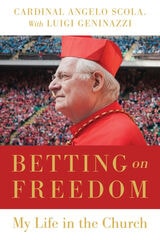
cover of Betting on Freedom: My Life in the Church

Betting on Freedom

My Life in the Church

Carinal Angelo Scola

Catholic University of America Press, 2021
In this wide-ranging conversation with the Italian journalist Luigi Geninazzi, Cardinal Angelo Scola discusses both the salient moments of his own life and the path and situation of the Church and society in Europe over the last half-century. The Cardinal recounts his life, speaking of the extraordinary gift of particular friendships he has had, starting with Luigi Giussani, founder of the ecclesial movement Communion and Liberation (CL), and moving on to discuss Hans Urs von Balthasar, Henri De Lubac, and Joseph Ratzinger. A figure who bridges the past three pontificates, Scola discusses his relationships with St. John Paul II, by whom he was nominated a bishop at the relatively young age of forty nine; Benedict XVI, with whom he has had an intense intellectual friendship for decades; and Pope Francis, of whom he speaks with affection and hope. At the center of this rich fresco of anecdotes and reflections stands a crucial question: what is the true path of the Church today? Between those who reduce Christianity to a mere civil religion and those who propose a purist return to the Gospel, the cardinal indicates a "third way" by betting on the freedom of the human person to recognize the supreme value of Christ. This is at the same time a bet on the active commitment of believers to contribute, starting from faith, to the birth of a new Europe, inevitably more diverse but no loss of its identity.
[more]
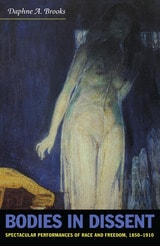
cover of Bodies in Dissent: Spectacular Performances of Race and Freedom, 1850–1910

Bodies in Dissent

Spectacular Performances of Race and Freedom, 1850–1910

Daphne A. Brooks

Duke University Press, 2006

In Bodies in Dissent Daphne A. Brooks argues that from the mid-nineteenth century to the early twentieth, black transatlantic activists, actors, singers, and other entertainers frequently transformed the alienating conditions of social and political marginalization into modes of self-actualization through performance. Brooks considers the work of African American, Anglo, and racially ambiguous performers in a range of popular entertainment, including racial melodrama, spectacular theatre, moving panorama exhibitions, Pan-Africanist musicals, Victorian magic shows, religious and secular song, spiritualism, and dance. She describes how these entertainers experimented with different ways of presenting their bodies in public—through dress, movement, and theatrical technologies—to defamiliarize the spectacle of “blackness” in the transatlantic imaginary.

Brooks pieces together reviews, letters, playbills, fiction, and biography in order to reconstruct not only the contexts of African American performance but also the reception of the stagings of “bodily insurgency” which she examines. Throughout the book, she juxtaposes unlikely texts and entertainers in order to illuminate the complicated transatlantic cultural landscape in which black performers intervened. She places Adah Isaacs Menken, a star of spectacular theatre, next to Sojourner Truth, showing how both used similar strategies of physical gesture to complicate one-dimensional notions of race and gender. She also considers Henry Box Brown’s public re-enactments of his escape from slavery, the Pan-Africanist discourse of Bert Williams’s and George Walker’s musical In Dahomey (1902–04), and the relationship between gender politics, performance, and New Negro activism in the fiction of the novelist and playwright Pauline Hopkins and the postbellum stage work of the cakewalk dancer and choreographer Aida Overton Walker. Highlighting the integral connections between performance and the construction of racial identities, Brooks provides a nuanced understanding of the vitality, complexity, and influence of black performance in the United States and throughout the black Atlantic.
[more]
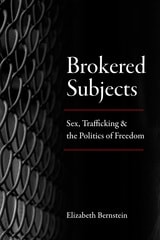
cover of Brokered Subjects: Sex, Trafficking, and the Politics of Freedom

Brokered Subjects

Sex, Trafficking, and the Politics of Freedom

Elizabeth Bernstein

University of Chicago Press, 2018
Brokered Subjects digs deep into the accepted narratives of sex trafficking to reveal the troubling assumptions that have shaped both right- and left-wing agendas around sexual violence. Drawing on years of in-depth fieldwork, Elizabeth Bernstein sheds light not only on trafficking but also on the broader structures that meld the ostensible pursuit of liberation with contemporary techniques of power. Rather than any meaningful commitment to the safety of sex workers, Bernstein argues, what lies behind our current vision of trafficking victims is a transnational mix of putatively humanitarian militaristic interventions, feel-good capitalism, and what she terms carceral feminism: a feminism compatible with police batons.
[more]
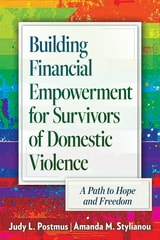
cover of Building Financial Empowerment for Survivors of Domestic Violence: A Path to Hope and Freedom

Building Financial Empowerment for Survivors of Domestic Violence

A Path to Hope and Freedom

Judy L. Postmus

Rutgers University Press, 2023

Each year, millions of women throughout the world experience violence and abuse at the hands of their intimate partner. Abusers coercively control them by using a variety of tactics ranging from physical or sexual violence to emotional or psychological abuse. An additional tactic often used includes financial abuse in which the abuser controls the money in the family, exploits the victim’s financial standing, and interrupts her efforts to be self-sufficient. The impact of financial abuse can leave women financially trapped in the relationship with limited financial management skills, knowledge, or self-confidence. Indeed, survivors often mention financial barriers as a top reason for keeping them trapped by the abuser in the relationship.
 
Curiously, little of the research on domestic violence has sought to either fully understand the impact of financial abuse or to determine which intervention strategies are most effective for the financial empowerment of survivors. Building Financial Empowerment for Survivors of Domestic Violence aims to address this critical knowledge gap by providing those who work with survivors of domestic violence with practical knowledge on how to empower the financial well-being and stability of survivors. Specifically, every practitioner, human service provider, criminal justice practitioner, financial manager, and corporate supervisor should be screening the women they encounter for economic abuse, and when such abuse is found, they should work with the women toward developing financial safety plans and refer survivors to financial empowerment programs to assist survivors to become free from abuse.
[more]