Results by title
130 books match the query 'Gay men' and 7 start with b
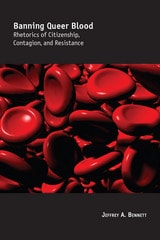
Banning Queer Blood
Rhetorics of Citizenship, Contagion, and ResistanceJeffrey A. Bennett
University of Alabama Press, 2009
In Banning Queer Blood, Jeffrey Bennett frames blood donation as a performance of civic identity closely linked to the meaning of citizenship. However, with the advent of HIV came the notion of blood donation as a potentially dangerous process. Bennett argues that the Food and Drug Administration, by employing images that specifically depict gay men as contagious, has categorized gay men as a menace to the nation. The FDA's ban on blood donation by gay men served to propagate the social misconceptions about gay men that continue to circulate within both the straight and LGBT/Queer communities.
Bennett explores the role of scientific research cited by these banned-blood policies and its disquieting relationship to government agencies, including the FDA. Bennett draws parallels between the FDA's position on homosexuality and the historical precedents of discrimination by government agencies against racial minorities. The author concludes by describing the resistance posed by queer donors, who either lie in order to donate blood or protest discrimination at donation sites, and by calling for these prejudiced policies to be abolished.
Beijing
A NovelPhilip Gambone
University of Wisconsin Press, 2003
Escaping his ghosts, AIDS widower David Masiello accepts a one-year position at a Western medical clinic in Beijing. Lonely but excited, he sets out to explore the city—both its bustling street life and its clandestine gay subculture.
David chronicles his adventures in China as he wrestles with cultural dislocation, loneliness, and sexual and spiritual longing. After a series of both comic and poignant encounters with gay Chinese men, he meets Bosheng, a handsome young artist. Though the attraction is strong, a difficult courtship ensues, during which Bosheng returns to his ancestral village to marry the girl his parents have chosen for him. Eventually, and quite unexpectedly, David and Bosheng reconnect and share an idyllic spring together. As the year ends, David must decide whether to say goodbye or face the uncertainties of a long-distance relationship.
Gambone’s novel is peopled with a host of wonderfully memorable characters: Owen, David’s forthright best friend back home; Auntie Chen, the clinic’s office mom, who wants to fix David up with a girlfriend; Stewart, David’s Beijing roommate, a graduate student doing research on Peking opera; Jiantao and Guoyang, two lovers who lecture David on the fleeting quality of American romance; and Tyson, the Australian doctor with a Chinese girlfriend, who hopes to teach David that love doesn’t need any explanations or justifications.
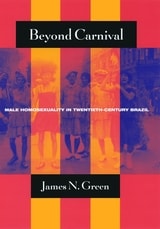
Beyond Carnival
Male Homosexuality in Twentieth-Century BrazilJames N. Green
University of Chicago Press, 1999
Ranging from the late nineteenth century to the rise of a politicized gay and lesbian rights movement in the 1970s, Green's study focuses on male homosexual subcultures in Rio de Janeiro and Sao Paulo. He uncovers the stories of men coping with arrests and street violence, dealing with family restrictions, and resisting both a hostile medical profession and moralizing influences of the Church. Green also describes how these men have created vibrant subcultures with alternative support networks for maintaining romantic and sexual relationships and for surviving in an intolerant social environment. He then goes on to trace how urban parks, plazas, cinemas, and beaches are appropriated for same-sex erotic encounters, bringing us into the world of street cruising, male hustlers, and cross-dressing prostitutes.
Through his creative use of police and medical records, newspapers, literature, newsletters, and extensive interviews, Green has woven a fascinating history, the first of its kind for Latin America, that will set the standard for future works.
"Green brushes aside outworn cultural assumptions about Brazil's queer life to display its full glory, as well as the troubles which homophobia has sent its way. . . . This latest gem in Chicago's 'World of Desire' series offers a shimmering view of queer Brazilian life throughout the 20th century."—Kirkus Reviews
Winner of the 2000 Lambda Literary Awards' Emerging Scholar Award of the Monette/Horwitz Trust
Winner of the 1999 Hubert Herring Award, Pacific Coast Council on Latin American Studies
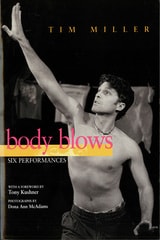
Body Blows
Six PerformancesTim Miller
University of Wisconsin Press, 2002
Hailed for his humor and passion, the internationally acclaimed performance artist Tim Miller has delighted, shocked, and emboldened audiences all over the world. Body Blows gathers six of Miller’s best-known performances that chart the sexual, spiritual, and political topography of his identity as a gay man: Some Golden States, Stretch Marks, My Queer Body, Naked Breath, Fruit Cocktail, and Glory Box. In Body Blows, Tim Miller leaps from the stage to the page, as each performance script is illustrated with striking photographs and accompanied by Miller’s notes and comment.
This book explores the tangible body blows—taken and given—of Miller’s life and times as explored in his performances: the queer-basher’s blow, the sweet blowing breath of a lover, the below-the-belt blow of HIV/AIDS, the psychic blows from a society that disrespects the humanity of lesbian and gay relationships. Miller’s performances are full of the put-up-your-dukes and stand-your-ground of such day-to-day blows that make up being gay in America
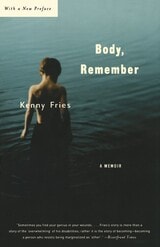
Body, Remember
A MemoirKenny Fries
University of Wisconsin Press, 2003
In this poetic, introspective memoir, Kenny Fries illustrates his intersecting identities as gay, Jewish, and disabled. While learning about the history of his body through medical records and his physical scars, Fries discovers just how deeply the memories and psychic scars run. As he reflects on his relationships with his family, his compassionate doctor, the brother who resented his disability, and the men who taught him to love, he confronts the challenges of his life. Body, Remember is a story about connection, a redemptive and passionate testimony to one man’s search for the sources of identity and difference.
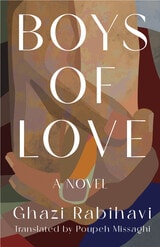
Boys of Love
Ghazi Rabihavi
University of Wisconsin Press, 2024
In Boys of Love, Ghazi Rabihavi offers both a universal story about the ups and downs of all relationships and a clear-eyed portrait of same-sex desire in Iran, where homosexuality remains punishable by death. Banned in Iran, the novel was initially published in Farsi in the UK, then translated into French and shortlisted for the Prix Médicis étranger. Rabihavi avoids both lasciviousness and exoticism in depicting a deep love between male characters living through the Iranian Cultural Revolution. Ultimately, this story challenges preconceived notions about marginalized communities in the Middle East.
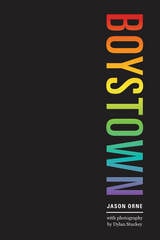
Boystown
Sex and Community in ChicagoJason Orne
University of Chicago Press, 2017
In Boystown, Orne takes readers on a detailed, lively journey through Chicago’s Boystown, which serves as a model for gayborhoods around the country. The neighborhood, he argues, has become an entertainment district—a gay Disneyland—where people get lost in the magic of the night and where straight white women can “go on safari.” In their original form, though, gayborhoods like this one don’t celebrate differences; they create them. By fostering a space outside the mainstream, gay spaces allow people to develop an alternative culture—a queer culture that celebrates sex.
Orne spent three years doing fieldwork in Boystown, searching for ways to ask new questions about the connective power of sex and about what it means to be not just gay, but queer. The result is the striking Boystown, illustrated throughout with street photography by Dylan Stuckey. In the dark backrooms of raunchy clubs where bachelorettes wouldn’t dare tread, people are hooking up and forging “naked intimacy.” Orne is your tour guide to the real Boystown, then, where sex functions as a vital center and an antidote to assimilation.