Results by title
156 books match the query 'Geology' and 4 start with b
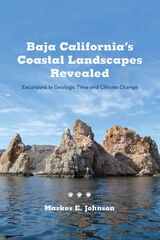
Baja California's Coastal Landscapes Revealed
Excursions in Geologic Time and Climate ChangeMarkes E. Johnson
University of Arizona Press, 2021
Baja California is an improbably long and narrow peninsula. It thrusts out like a spear, parting the Mexican mainland from the Pacific Ocean. In his third installment on the Gulf of California’s coastal setting, expert geologist and guide Markes E. Johnson reveals a previously unexplored side to the region’s five-million-year story beyond the fossil coral reefs, clam banks, and prolific beds of coralline algae vividly described in his earlier books. Through a dozen new excursions, in Baja California’s Coastal Landscapes Revealed, Johnson returns to these yet wild shores to share his gradual recognition of another side to the region.
Johnson reveals a geologic history that is outside the temporal framework of a human lifetime and scored by violent storms. We see how hurricanes have shaped coastal landscapes all along the peninsula’s inner coast, a fascinating story only possible by disassembling the rocks that on first appraisal seem incomprehensible.
Looking closely, Johnson shows us how geology not only helps us look backward but also forward toward an uncertain future. The landscape Johnson describes may be apart from the rest of Mexico, but his expert eye reveals how it is influenced by the unfolding drama of Planet Earth’s global warming.
[more]
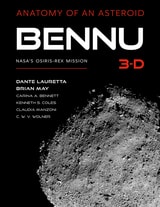
Bennu 3-D
Anatomy of an AsteroidDante Lauretta, Brian May, Carina A. Bennett, Kenneth S. Coles, Claudia Manzoni, and C. W. V. Wolner
University of Arizona Press, 2023
Bennu, named for the ancient Egyptian phoenix, was the chosen destination of OSIRIS-REx, NASA’s premier mission of asteroid exploration, launched in 2016. Study of the asteroid is important in safeguarding the future of planet Earth, but Bennu is also a time capsule from the dawn of our Solar System, holding secrets over four-and-a-half billion years old about the origin of life and Earth as a habitable planet.
In 2020 the OSIRIS-REx spacecraft successfully landed on the surface of Bennu and collected pristine asteroid material for delivery to Earth in September 2023. Scientific studies of the samples, along with data collected during the rendezvous, promise to help find answers to some of humanity’s deepest questions: Where did we come from? What is our destiny in space?
This book, the world’s first complete (and stereoscopic) atlas of an asteroid, is the result of a unique collaboration between OSIRIS-REx mission leader Dante Lauretta and Brian May’s London Stereoscopic Company. Lauretta’s colleagues include Carina Bennett, Kenneth Coles, and Cat Wolner, as well as Brian May and Claudia Manzoni, who became part of the ultimately successful effort to find a safe landing site for sampling. The text details the data collected by the mission so far, and the stereo images have been meticulously created by Manzoni and May from original images collected by the OSIRIS-REx cameras.
[more]
Biostratigraphic and Geological Significance of Planktonic Foraminifera
Marcelle K. BouDagher-Fadel
University College London, 2015
The role of fossil planktonic foraminifera as markers for biostratigraphical zonation and correlation underpins most drilling of marine sedimentary sequences and is key to hydrocarbon exploration. The first - and only - book to synthesize the whole biostratigraphic and geological usefulness of planktonic foraminifera, Biostratigraphic and Geological Significance of Planktonic Foraminifera unifies existing biostratigraphic schemes and provides an improved correlation reflecting regional biogeographies. Renowned micropaleontologist Marcelle K. Boudagher-Fadel presents a comprehensive analysis of existing data on fossil planktonic foraminifera genera and their phylogenetic evolution in time and space.
[more]
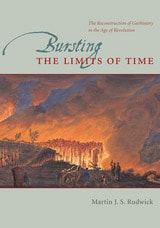
Bursting the Limits of Time
The Reconstruction of Geohistory in the Age of RevolutionMartin J. S. Rudwick
University of Chicago Press, 2005
A masterful, authoritative account of the scientists and discoveries that enabled us to understand the age of the earth
In 1650, Archbishop James Ussher of Armagh joined the long-running theological debate on the age of the earth by famously announcing that creation had occurred on October 23, 4004 B.C. Although widely challenged during the Enlightenment, this belief in a six-thousand-year-old planet was only laid to rest during a revolution of discovery in the late eighteenth and early nineteenth centuries. In this relatively brief period, geologists reconstructed the immensely long history of the earth-and the relatively recent arrival of human life. Highlighting a discovery that radically altered existing perceptions of a human's place in the universe as much as the theories of Copernicus, Darwin, and Freud did, Bursting the Limits of Time is a herculean effort by one of the world's foremost experts on the history of geology and paleontology to sketch this historicization of the natural world in the age of revolution.
Addressing this intellectual revolution for the first time, Rudwick examines the ideas and practices of earth scientists throughout the Western world to show how the story of what we now call "deep time" was pieced together. He explores who was responsible for the discovery of the earth's history, refutes the concept of a rift between science and religion in dating the earth, and details how the study of the history of the earth helped define a new branch of science called geology. Rooting his analysis in a detailed study of primary sources, Rudwick emphasizes the lasting importance of field- and museum-based research of the eighteenth and nineteenth centuries.
Bursting the Limits of Time, the culmination of more than three decades of research, is the first detailed account of this monumental phase in the history of science.
[more]