Results by title
56 books match the query 'Government, Resistance to' and 5 start with b
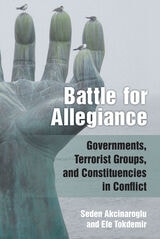
Battle for Allegiance
Governments, Terrorist Groups, and Constituencies in ConflictSeden Akcinaroglu and Efe Tokdemir
University of Michigan Press, 2020
Using a multimethod approach based on exclusive interviews and focus groups from Turkey and large N original data from around the world, Seden Akcinaroglu and Efe Tokdemir present the first systematic empirical analysis of the ways in which terrorist groups, the government, and the citizens relate to each other in a triadic web of action. They study the nonviolent actions of terrorist groups toward their constituencies, the nonviolent actions of governments toward terrorists, and the nonviolent actions of governments toward the terrorist group’s constituencies. By investigating the causes, targets, and consequences of accommodative actions, this book sheds light on an important, but generally ignored, aspect of terrorism: interactive nonviolent strategies.
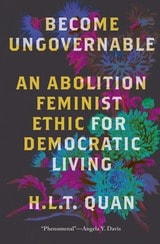
Become Ungovernable
An Abolition Feminist Ethic for Democratic LivingH.L.T. Quan
Pluto Press, 2004
'Phenomenal ... Offers us possibilities for rescuing the concept of democracy from its fatal entanglement with racial, heteropatriarchal capitalism' -- Angela Y. Davis
'Embraces the unruliness of collective struggle, and recognizes freedom not as a destination but practice—an abolitionist, feminist, anticapitalist, antiracist, radically inclusive practice' -- Robin D.G. Kelley, author of Freedom Dreams
'A compelling and inspiring book that belongs in our movements and our classrooms' -- Chandra Talpade Mohanty, author of Feminism Without Borders
'An elegantly written masterpiece' -- Barbara Ransby, author of Making All Black Lives Matter
Become Ungovernable is a provocative new work of political thought setting out to reclaim “freedom”, “justice”, and “democracy”, revolutionary ideas that are all too often warped in the interests of capital and the state. Revealing the mirage of mainstream democratic thought and the false promises of liberal political ideologies, H.L.T. Quan offers an alternative approach: an abolition feminism drawing on a kaleidoscope of refusal praxes, and on a deep engagement with the Black Radical Tradition and queer analytics.
With each chapter anchored by episodes from the long history of resistance and rebellions against tyranny, Quan calls for us to take up a feminist ethic of living rooted in the principles of radical inclusion, mutuality and friendship as part of the larger toolkit for confronting fascism, white supremacy, and the neoliberal labor regime.
H.L.T. Quan is a political theorist, award-winning filmmaker and Associate Professor of Justice and Social Inquiry in the School of Social Transformation at Arizona State University. Quan is the author of Growth Against Democracy and editor of Cedric J. Robinson.

Beyond September 11
An Anthology of DissentEdited by Phil Scraton
Pluto Press, 2002
This anthology includes some of the world's leading commentators - Noam Chomsky, Robert Fisk, Naomi Klein, John Pilger, Paul Foot and A.Sivanandan. It presents accessible, detailed and often deeply personal accounts of the aftermath, the bombing of Afghanistan and the dubious claims for its legality. From investigative journalists to critical academics, human rights lawyers and anti-racist campaigners, the contributors are united in their opposition to military intervention in Afghanistan and beyond and to the attack on civil liberties in the US, the UK and Europe.
From the US and Canada, Herman and Julia Schwendinger, Jonathan Farley, Tony Platt, Cecilia O'Leary, Christian Parenti and Michael Mandel are among critical academics who assess the validity, lawfulness and political consequences of the Bush/Blair agenda. European based commentators include Martti Gronfors and Thomas Mathiesen.
Examining the the context and rhetoric of US vengeance -- ennobled by the symbolic title 'Enduring Freedom' -- they challenge political and popular definitions, constructions,pathologisation and reporting of terrorism. In questioning the representation of war as 'just', the anthology focuses on civilian deaths in Afghanistan, evidence of US/allied atrocities, violations of prisoners' rights and US determination to escalate military offensives, regardless of global destabilisation.
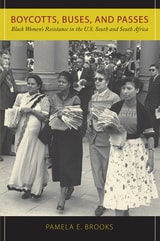
Boycotts, Buses, and Passes
Black Women's Resistance in the U.S. South and South AfricaPamela E. Brooks
University of Massachusetts Press, 2008
In the mid-1950s, as many developing nations sought independence from colonial rule, black women in the American South and in South Africa launched parallel campaigns to end racial injustice within their respective communities. Just as the dignified obstinacy of Mrs. Rosa Parks sparked the Montgomery bus boycott in 1955, the 20,000 South African women who marched in Pretoria a year later to protest the pass laws signaled a new wave of resistance to the system of apartheid. In both places women who had previously been consigned to subordinate roles brought fresh leadership to the struggle for political freedom and social equality.
In this book, Pamela E. Brooks tells their story, documenting the extraordinary achievements of otherwise ordinary women. In comparing the experiences of black women activists in two different parts of the African diaspora, Brooks draws heavily on oral histories that provide clear, and often painful, insight into their backgrounds, their motives, their hopes, and their fears. We learn how black women from all walks of life—domestic and factory workers, householders, teachers, union organizers, churchwomen, clubwomen, rural and urban dwellers alike—had to overcome their class differences and work through the often difficult gender relations within their families and communities. Yet eventually they came together to forge their own political organizations, such as the Women's Political Council and the Federation of South African Women, or joined orga-nizations of women and men, such as the Montgomery Improvement Association and the African National Congress, to advance the common agenda of black liberation.By tracing the dual rise of political consciousness and activism among the black women of the U.S. South and South Africa, Brooks not only illuminates patterns that have long been overlooked but places that shared history within the context of a larger global struggle to bring an end to the vestiges of European colonialism.
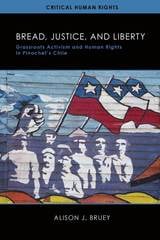
Bread, Justice, and Liberty
Grassroots Activism and Human Rights in Pinochet's ChileAlison J. Bruey
University of Wisconsin Press, 2020
As Bruey shows, crucial to the popular movement built in the 1970s were the activism of both men and women and the coalition forged by liberation-theology Catholics and Marxist-Left militants. These alliances made possible the mass protests of the 1980s that paved the way for Chile's return to democracy, but the changes fell short of many activists' hopes. Their grassroots demands for human rights encompassed not just an end to state terror but an embrace of economic opportunity and participatory democracy for all.
Deeply grounded by both extensive oral history interviews and archival research, Bread, Justice, and Liberty offers innovative contributions to scholarship on Chilean history, social movements, popular protest and democratization, neoliberal economics, and the Cold War in Latin America.