Results by title
133 books match the query 'Guatemala' and 2 start with b
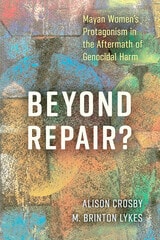
Beyond Repair?
Mayan Women’s Protagonism in the Aftermath of Genocidal HarmAlison Crosby
Rutgers University Press, 2019
Winner of the 2021 Raphael Lemkin Book Award from the Institute for the Study of Genocide
Honorable Mention, 2020 CALACS Book Prize
Beyond Repair? explores Mayan women’s agency in the search for redress for harm suffered during the genocidal violence perpetrated by the Guatemalan state in the early 1980s at the height of the thirty-six-year armed conflict. The book draws on eight years of feminist participatory action research conducted with fifty-four Q’eqchi’, Kaqchikel, Chuj, and Mam women who are seeking truth, justice, and reparation for the violence they experienced during the war, and the women’s rights activists, lawyers, psychologists, Mayan rights activists, and researchers who have accompanied them as intermediaries for over a decade. Alison Crosby and M. Brinton Lykes use the concept of “protagonism” to deconstruct dominant psychological discursive constructions of women as “victims,” “survivors,” “selves,” “individuals,” and/or “subjects.” They argue that at different moments Mayan women have been actively engaged as protagonists in constructivist and discursive performances through which they have narrated new, mobile meanings of “Mayan woman,” repositioning themselves at the interstices of multiple communities and in their pursuit of redress for harm suffered.
[more]
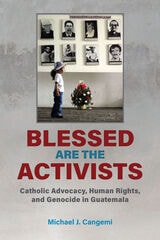
Blessed Are the Activists
Catholic Advocacy, Human Rights, and Genocide in GuatemalaMichael J. Cangemi
University of Alabama Press, 2024
Documents the history of Catholic activism to mitigate human rights abuses in Guatemala and the failed US policies in the country and region during the 1970s and 1980s
Blessed Are the Activists examines US Catholic activists’ influence on US-Guatemalan relations during the Guatemalan civil war’s most violent years in the 1970s and 1980s. Cangemi argues that Catholic activists’ definition of human rights, advocacy methods, and structure caused them to act as a transnational human rights NGO that engaged Guatemalan and US government officials on human rights issues, reported on Guatemala’s human rights violations, and criticized US foreign policy decisions as a contributing factor in Guatemala’s inequality, poverty, and violence. His work foregrounds how Catholic activists emphasized dignity for Guatemala’s poorest citizens and the connections they made between justice, solidarity, and peace and brought Guatemala’s violence, poverty, and inequality to greater global attention, often at great personal risk.
Cangemi pays considerable attention to multiple facets of the strained US-Guatemala diplomatic relationship, including how and why Guatemala’s military dictatorship exposed the internal flaws within the Carter administration’s decision to link military aid to human rights and how internal foreign policy debates in the Carter and Reagan administrations helped to intensify Guatemala’s bloody civil war. He also includes interviews conducted with Guatemalan genocide survivors and refugees to provide firsthand accounts of the consequences of those policymaking decisions. Finally, he offers readers an in-depth examination of the US Catholic press’s sharp rebukes of US policies on Guatemala and all of Central America when the broader Roman Catholic Church began to move farther toward the ideological right under John Paul II.
Blessed Are the Activists offers rich, original research and a gripping narrative. With Guatemala and other countries in Latin America still experiencing human rights abuses, this book will continue to provide context. It will appeal to a broad swath of readers, from scholars to the general public and students.
[more]