Results by title
218 books match the query 'Handbooks, manuals, etc' and 7 start with b

Be a Great Boss
One Year to SuccessCatherine Hakala-Ausperk
American Library Association, 2011
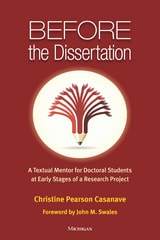
Before the Dissertation
A Textual Mentor for Doctoral Students at Early Stages of a Research ProjectChristine Pearson Casanave
University of Michigan Press, 2014
“This very readable book is what every graduate student needs as they start a program. I wish my own MA and PhD students, during my 40 years of supervising, could have been demystified by having Casanave's ‘textual mentor' as a companion."
--Merrill Swain, Professor Emerita, OISE, University of Toronto
“Before the Dissertation is an insightful, relevant, and accessible resource for doctoral students at any stage. Full of reflections and advice not found in other books, it serves as an indispensable guide for students and their supervisors. And the dispelling of myths is a superb idea!”
--Robert Kohls, PhD candidate, University of Toronto
Before the Dissertation speaks to an audience in the social sciences, but in particular to doctoral students who have experience with and interest in international, multilingual, as well as native English speaking students and settings and who wish to investigate topics in (second) language and multicultural-transcultural education. Athough appropriate for use in English-dominant doctoral programs throughout the world, the book will relate more closely to students in the North American educational system than to ones, for example, in the British system. The main audience for this book is thus doctoral students who are first or second/additional users of English, who are interested in pursuing topics in one of the social sciences, including education and multilingual inquiry, and who may just be finishing course work in an English-dominant university and are wondering what might happen next.
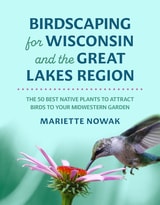
Birdscaping for Wisconsin and the Great Lakes Region
The 50 Best Native Plants to Attract Birds to Your Midwestern GardenMariette Nowak
University of Wisconsin Press, 2025
The book explains the value of particular plants for birds and other wildlife, not only as food sources but as nesting sites and cover. Each plant is described in depth, with details on color, height, blooming time, light requirements, and soil preferences, along with planting tips and suggested companion plants. Nowak offers closer looks at the intriguing features of these diverse plant species and their intertwined relationships with birds, complemented by more than 150 color photos that showcase the beauty of the plants and birds together. Novice gardeners will also find essential information on birdscaping basics, site preparation, management guidelines, and safeguarding songbirds.
Book Repair
A How-To-Do-It ManualArtemis BonaDea
American Library Association, 2011
Book Repair
A How-To-Do-It ManualAmerican Library Association, 2011

Build a Great Team
One Year to SuccessCatherine Hakala-Ausperk
American Library Association, 2013
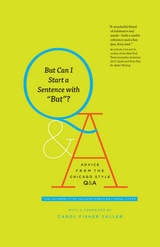
But Can I Start a Sentence with "But"?
Advice from the Chicago Style Q&AThe University of Chicago Press Editorial Staff
University of Chicago Press, 2016
A. The idiom is “happy medium,” but I like the image of commuters taking refuge from road rage on the happy median.
Q. How do I write a title of a song in the body of the work (caps, bold, underline, italics, etc.)? Example: The Zombies’ “She’s Not There” looped in his head.
A. Noooo! Now that song is looping in my head (“but it’s too late to say you’re sorry . . .”). Use quotation marks. Thanks a lot.
Every month, tens of thousands of self-declared word nerds converge upon a single site: The Chicago Manual of Style Online's Q&A. There the Manual’s editors open the mailbag and tackle readers’ questions on topics ranging from abbreviation to word division to how to reform that coworker who still insists on two spaces between sentences. Champions of common sense, the editors offer smart, direct, and occasionally tongue-in-cheek responses that have guided writers and settled arguments for more than fifteen years.
But Can I Start a Sentence with “But”? brings together the best of the Chicago Style Q&A. Curated from years of entries, it features some of the most popular—and hotly debated—rulings and also recovers old favorites long buried in the archives.
Questions touch on myriad matters of editorial style—capitalization, punctuation, alphabetizing, special characters—as well as grammar, usage, and beyond (“How do I spell out the sound of a scream?”). A foreword by Carol Fisher Saller, the Q&A’s longtime editor, takes readers through the history of the Q&A and addresses its reputation for mischief. (“It’s not that we set out to be cheeky,” she writes.)
Taken together, the questions and answers offer insights into some of the most common issues that face anyone who works with words. They’re also a comforting reminder that even the best writer or editor needs a little help—and humor—sometimes.