Results by title
124 books match the query 'Health and hygiene' and 7 start with b
BEYOND THE REPRODUCTIVE BODY
Politics of Women’s Health & Work in Early Victorian EnglandMarjorie Levine-Clark
The Ohio State University Press, 2004
BODIES OF TECHNOLOGY
Women’s Involvement with Reproductive MedicineEdited by Ann R. Saetnan, Nelly Oudshoorn, and Marta Kirejczyk
The Ohio State University Press, 2000
Bodies of Technology is based on the premise that technology and society mutually shape one another, and on a concern for women’s health and autonomy. A basic question is one of cultural appropriation: Do technologies take on different shapes, different practices, and have different impacts as they spread from one place to another? By juxtaposing a number of culturally and historically contextualized studies of similar technologies, the editors demonstrate that although technologies globalize by spreading among cultures, they are also localized by the cultures they encounter.
The first part of the book investigates how potential users of hormone-based contraceptives are represented as these technologies are developed in laboratories and field tests. The next section explores the political and economic processes that regulate access to and practices of assisted fertilization. The final section focuses on individual users engaging with fetal diagnostic technologies in clinical practice. Taken as a whole, the book points out the need and the possibilities for women to become directly involved in the shaping of technologies that so strongly affect their health and their daily lives.
Babylost
Racism, Survival, and the Quiet Politics of Infant Mortality, from A to ZMonica J. Casper
Rutgers University Press, 2021
Bioarchaeological Studies of Life in the Age of Agriculture
A View from the SoutheastEdited by Patricia M. Lambert
University of Alabama Press, 2000
Investigations of skeletal remains from key archaeological sites reveal new data and offer insights on prehistoric life and health in the Southeast.
The shift from foraging to farming had important health consequences for prehistoric peoples, but variations in health existed within communities that had made this transition. This new collection draws on the rich bioarchaeological record of the Southeastern United States to explore variability in health and behavior within the age of agriculture. It offers new perspectives on human adaptation to various geographic and cultural landscapes across the entire Southeast, from Texas to Virginia, and presents new data from both classic and little-known sites.
The contributors question the reliance on simple cause-and-effect relationships in human health and behavior by addressing such key bioarchaeological issues as disease history and epidemiology, dietary composition and sufficiency, workload stress, patterns of violence, mortuary practices, and biological consequences of European contact. They also advance our understanding of agriculture by showing that uses of maize were more varied than has been previously supposed.
Representing some of the best work being done today by physical anthropologists, this volume provides new insights into human adaptation for both archaeologists and osteologists. It attests to the heterogeneous character of Southeastern societies during the late prehistoric and early historic periods while effectively detailing the many factors that have shaped biocultural evolution.
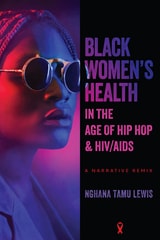
Black Women’s Health in the Age of Hip Hop and HIV/AIDS
A Narrative RemixNghana tamu Lewis
The Ohio State University Press, 2025

Bodies of Knowledge
The Medicalization of Reproduction in GreeceEugenia Georges
Vanderbilt University Press, 2008
Recipient of the 2006 Norman L. and Roselea J. Goldberg Prize for the best project in the area of medicine.
The author, a second-generation Greek American, returned to Greece with her young daughter to do fieldwork over the course of a decade. Focusing on Rhodes, an island that blends continuity with the past and rapid social change in often unexpected ways, she interviewed over a hundred women, doctors, and midwives about issues of reproduction.
The result is a detailed portrait of how a longstanding system of "local" gynecological and obstetrical knowledge under the control of women was rapidly displaced in the the period following World War II, and how the technologically-intensive biomedical model that took its place in turn assumed its own distinctive signature.
Bodies of Knowledge is a vivid ethnographic study of how a presumably globalizing and homogenizing process like medicalization can be reshaped as women and medical experts alike selectively accept or reject new practices and technologies. Georges found, for example, that women in Rhodes have enthusiastically embraced some new technologies, like fetal imaging during pregnancy, but rejected others, like medical contraception. They are also avid consumers of popular childbirth manuals.
This book is the recipient of the 2006 Norman L. and Roselea J. Goldberg Prize for the best project in the area of medicine.
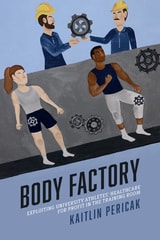
Body Factory
Exploiting University Athletes' Healthcare for Profit in the Training RoomKaitlin Pericak
Temple University Press, 2025
Body Factory enters an NCAA Division I athletic training room to examine the disconnect between what the NCAA states as its goal of athlete healthcare and what is actually happening. Kaitlin Pericak conducts observations in this space and interviews injured athletes and sports medicine staff members to show how institutional control over “best interests” often ends up exploiting the individual athlete. The influences at work are part of a neoliberal paradigm that explains why interest in an athlete’s care is greatly diminished once they are injured and can no longer play.
Body Factory considers how race, gender, and health before and after injury are deciding factors in these university training centers. The bureaucratic organization has a goal of maintaining power to generate profit, and Pericak shows this is almost always at the expense of the athlete.