Results by title
82 books match the query 'Hermeneutics' and 5 start with b
BEFORE READING
NARRATIVE CONVENTIONS AND THE POLITICS OPETER J. RABINOWITZ
The Ohio State University Press, 1998
Beauty and the Bible
Toward a Hermeneutics of Biblical AestheticsRichard J. Bautch
SBL Press, 2013
Beyond Being
Gadamer's Post-Platonic Hermeneutic OntologyBrice R. Wachterhauser
Northwestern University Press, 1999
In Beyond Being, Brice R. Wachterhauser contends that this perceived bifurcation in Gadamer's work oversimplifies and distorts important parts of Gadamer's thought. Wachterhauser argues that only by viewing Gadamer's contribution to philosophy as an integrated whole and by reading Gadamer's hermeneutical studies in light of his Plato studies are we able to avoid certain key misunderstandings of Gadamer, as well as to comprehend more clearly the radical implications of Gadamer's thought.
Bible and Transformation
The Promise of Intercultural Bible ReadingHans de Wit
SBL Press, 2015
Engage the delightful and inspiring, sometimes rough and rocky road to inclusive and transformative Bible reading
This book offers the results of research within a new area of discipline—empirical hermeneutics in intercultural perspective. The book includes interpretations from the homeless in Amsterdam, to Indonesia, from African Xhosa readers to Norway, to Madagascar, American youths, Germany, Czech Republic, Colombia, and Haitian refugees in the Dominican Republic.
Features:
- Interpretations from ordinary readers in more than twenty-five countries
- Background introduction with history of the text
- Discussion of intertextual connections with Greco-Roman authors
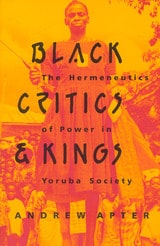
Black Critics and Kings
The Hermeneutics of Power in Yoruba SocietyAndrew Apter
University of Chicago Press, 1992
Documenting the development of a Yoruba kingdom from its nineteenth-century genesis to Nigeria's 1983 elections and subsequent military coup, Apter identifies the central role of ritual in reconfiguring power relations both internally and in relation to wider political arenas. What emerges is an ethnography of an interpretive vision that has broadened the horizons of local knowledge to embrace Christianity, colonialism, class formation, and the contemporary Nigerian state. In this capacity, Yoruba òrìsà worship remains a critical site of response to hegemonic interventions.
With sustained theoretical argument and empirical rigor, Apter answers critical anthropologists who interrogate the possibility of ethnography. He reveals how an indigenous hermeneutics of power is put into ritual practice—-with multiple voices, self-reflexive awareness, and concrete political results. Black Critics and Kings eloquently illustrates the ethnographic value of listening to the voice of the other, with implications extending beyond anthropology to engage leading debates in black critical theory.