Results by title
73 books match the query 'Higher Education' and 3 start with b

Betrayal U
The Politics of Belonging in Higher EducationEdited by Rebecca G. Martínez and Monica J. Casper
University of Arizona Press, 2025
Higher education is in trouble, and not only due to a decline of public trust. As a microcosm of our broader culture, universities are inequitable and often harmful, especially for marginalized people. This is despite the democratic promise of higher education as a path for learning and social mobility. Women, people of color, First Gen, disabled, LGBTQ+, and other minoritized groups are disproportionately harmed in educational institutions that are hierarchical and reproduce inequality. Efforts to foster belonging for faculty, staff, and students may be highly effective but are under attack.
Betrayal U intervenes in this context with a diverse, rich collection of essays, art, poetry, and research that explores these inequities through the lens of institutional betrayal, theorized by psychologist Jennifer Freyd. Edited by Rebecca G. Martínez and Monica J. Casper, this collection brings together thirty-six contributors who share personal experiences covering a range of topics in higher education. The work spans five thematic sections that examine the complexities of belonging and exclusion in academic settings.
The contributors share their lived experiences of academic life from diverse vantage points, showing the ways minoritized groups are made to feel unwelcome, further marginalized, and often positioned as the problem. Exhibiting courage, compassion, and a commitment to better futures, the voices in this collection offer both a searing indictment of higher education and pathways to alternative practices and structures. They shine a spotlight on academia today, including the promise of inclusion and the perils of exclusion.
Contributors
Celeste Atkins
Jasmine Banks
Krista L. Benson
Jessica Bishop-Royse
Samit Dipon Bordoloi
Monica J. Casper
Aparajita De
Kathy Diehl
Taylor Marie Doherty
Reshmi Dutt-Ballerstadt
Alma Flores
Alanna Gillis
C. Goldberg
Jennifer M. Gómez
Kristina Gupta
Jasmine L. Harris
Susan Hillock
Doreen Hsu
Jennifer Lai
Amy Andrea Martinez
Rebecca G. Martínez
Shantel Martinez
Sara A. Mata
Rachael McCollum
Wang Ping
Emily Rosser
Angélica Ruvalcaba
Brandy L. Simula
Rashna Batliwala Singh
Cierra Raine Sorin
Connor Spencer
Chantelle Spicer
James M. Thomas
Mercedes Valadez
Meg A. Warren
Matthew Wills
[more]
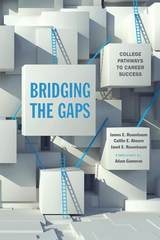
Bridging the Gaps
College Pathways to Career SuccessJames E. Rosenbaum
Russell Sage Foundation, 2017
College-for-all has become the new American dream. Most high school students today express a desire to attend college, and 90% of on-time high school graduates enroll in higher education in the eight years following high school. Yet, degree completion rates remain low for non-traditional students—students who are older, low-income, or have poor academic achievement—even at community colleges that endeavor to serve them. What can colleges do to reduce dropouts? In Bridging the Gaps, education scholars James Rosenbaum, Caitlin Ahearn, and Janet Rosenbaum argue that when institutions focus only on bachelor’s degrees and traditional college procedures, they ignore other pathways to educational and career success. Using multiple longitudinal studies, the authors evaluate the shortcomings and successes of community colleges and investigate how these institutions can promote alternatives to BAs and traditional college procedures to increase graduation rates and improve job payoffs.
The authors find that sub-baccalaureate credentials—associate degrees and college certificates—can improve employment outcomes. Young adults who complete these credentials have higher employment rates, earnings, autonomy, career opportunities, and job satisfaction than those who enroll but do not complete credentials. Sub-BA credentials can be completed at community college in less time than bachelor’s degrees, making them an affordable option for many low-income students.
Bridging the Gaps shows that when community colleges overemphasize bachelor’s degrees, they tend to funnel resources into remedial programs, and try to get low-performing students on track for a BA. Yet, remedial programs have inconsistent success rates and can create unrealistic expectations, leading struggling students to drop out before completing any degree. The authors show that colleges can devise procedures that reduce remedial placements and help students discover unseen abilities, attain valued credentials, get good jobs, and progress on degree ladders to higher credentials.
To turn college-for-all into a reality, community college students must be aware of their multiple credential and career options. Bridging the Gaps shows how colleges can create new pathways for non-traditional students to achieve success in their schooling and careers.
[more]
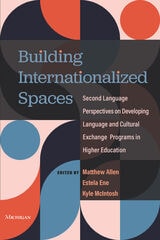
Building Internationalized Spaces
Second Language Perspectives on Developing Language and Cultural Exchange Programs in Higher EducationEdited by Matthew Allen, Estela Ene, and Kyle McIntosh
University of Michigan Press, 2022
This book provides case studies from several higher education contexts to represent the diverse ways that L2 specialists can build up programs and courses that contribute to their institutions' internationalization by promoting language and cultural exchange.
This volume contributes to emerging interdisciplinary conversations in higher education about how to refine internationalization in terms of praxis and how to coordinate curricular and pedagogical efforts to achieve meaningful learning outcomes for all students. The chapters provide suggestions for how L2 specialists can reframe their work in their individual programs to help internationalize the entire university in ways that lead to improved learning outcomes for students at different points in their degree programs, including:
This volume contributes to emerging interdisciplinary conversations in higher education about how to refine internationalization in terms of praxis and how to coordinate curricular and pedagogical efforts to achieve meaningful learning outcomes for all students. The chapters provide suggestions for how L2 specialists can reframe their work in their individual programs to help internationalize the entire university in ways that lead to improved learning outcomes for students at different points in their degree programs, including:
- Orientation programs (early arrival on campus, before classes start)
- Language Center contexts (support during studies)
- Volunteer programs for International Teaching Assistants (ITA) and undergraduate students
- Graduate-level writing support structures
- Instructional design (virtual learning spaces)
- Virtual Partner programs (co-curricular)
- Intercultural composition (placement, interdisciplinary collaborations)
[more]