Results by title
783 books match the query 'History & Theory' and 22 start with b
Badiou and Politics
Bruno Bosteels
Duke University Press, 2011
Barry Goldwater and the Remaking of the American Political Landscape
Edited by Elizabeth Tandy Shermer
University of Arizona Press, 2013
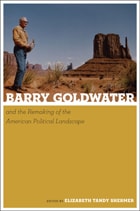
Since Goldwater’s death in 1998, politicians, pundits, and academics have been assessing his achievements and his shortcomings. The twelve essays in this volume thoroughly examine the life, times, and impact of “Mr. Conservative.” Scrutinizing the transformation of a Phoenix department store owner into a politician, de facto political philosopher, and five-time US senator, contributors highlight the importance of power, showcasing the relationship between the nascent conservative movement’s cadre of elite businessmen, newsmen, and intellectuals and their followers at the grassroots—or sagebrush—level.
Goldwater, who was born in the Arizona Territory in 1909, was deeply influenced by his Western upbringing. With his appearance on the national stage in 1964, he not only articulated a new brand of conservatism but gave a voice to many Americans who were not enamored with the social and political changes of the era. He may have lost the battle for the presidency, but he energized a coalition of journalists, publishers, women’s groups, and Southerners to band together in a movement that reshaped the nation.
Become Ungovernable
An Abolition Feminist Ethic for Democratic LivingH.L.T. Quan
Pluto Press, 2004
'Phenomenal ... Offers us possibilities for rescuing the concept of democracy from its fatal entanglement with racial, heteropatriarchal capitalism' -- Angela Y. Davis
'Embraces the unruliness of collective struggle, and recognizes freedom not as a destination but practice—an abolitionist, feminist, anticapitalist, antiracist, radically inclusive practice' -- Robin D.G. Kelley, author of Freedom Dreams
'A compelling and inspiring book that belongs in our movements and our classrooms' -- Chandra Talpade Mohanty, author of Feminism Without Borders
'An elegantly written masterpiece' -- Barbara Ransby, author of Making All Black Lives Matter
Become Ungovernable is a provocative new work of political thought setting out to reclaim “freedom”, “justice”, and “democracy”, revolutionary ideas that are all too often warped in the interests of capital and the state. Revealing the mirage of mainstream democratic thought and the false promises of liberal political ideologies, H.L.T. Quan offers an alternative approach: an abolition feminism drawing on a kaleidoscope of refusal praxes, and on a deep engagement with the Black Radical Tradition and queer analytics.
With each chapter anchored by episodes from the long history of resistance and rebellions against tyranny, Quan calls for us to take up a feminist ethic of living rooted in the principles of radical inclusion, mutuality and friendship as part of the larger toolkit for confronting fascism, white supremacy, and the neoliberal labor regime.
H.L.T. Quan is a political theorist, award-winning filmmaker and Associate Professor of Justice and Social Inquiry in the School of Social Transformation at Arizona State University. Quan is the author of Growth Against Democracy and editor of Cedric J. Robinson.
Becoming Political
Spinoza’s Vital Republicanism and the Democratic Power of JudgmentChristopher Skeaff
University of Chicago Press, 2018
Bergson, Politics, and Religion
Alexandre Lefebvre and Melanie White, eds.
Duke University Press, 2012
Contributors. Keith Ansell-Pearson, G. William Barnard, Claire Colebrook, Hisashi Fujita, Suzanne Guerlac, Vladimir Jankélévitch, Frédéric Keck, Leonard Lawlor, Alexandre Lefebvre, Paola Marrati, John Mullarkey, Paulina Ochoa Espejo, Carl Power, Philippe Soulez, Jim Urpeth, Melanie White, Frédéric Worms
Between Jesus and the Market
The Emotions that Matter in Right-Wing AmericaLinda Kintz
Duke University Press, 1997
With texts from such organizations as the Christian Coalition, the Heritage Foundation, and Concerned Women for America, and writings by Elizabeth Dole, Newt Gingrich, Pat Robertson, and Rush Limbaugh, Kintz traces the usefulness of this activism for the secular claim that conservative political economy is, in fact, simply an expression of the deepest and most admirable elements of human nature itself. The discussion of Limbaugh shows how he draws on the skepticism of contemporary culture to create a sense of absolute truth within his own media performance—its truth guaranteed by the market. Kintz also describes how conservative interpretations of the Holy Scriptures, the U.S. Constitution, and the Declaration of Independence have been used to challenge causes such as feminism, women’s reproductive rights, and gay and lesbian rights. In addition to critiquing the intellectual and political left for underestimating the power of right-wing grassroots organizing, corporate interests, and postmodern media sophistication, Between Jesus and the Market discusses the proliferation of militia groups, Christian entrepreneurship, and the explosive growth and "selling" of the Promise Keepers.
Beyond Practical Virtue
A Defense of Liberal Democracy through LiteratureJoel A. Johnson
University of Missouri Press, 2007
Why hasn’t democracy been embraced worldwide as the best form of government?
Aesthetic critics of democracy such as Carlyle and Nietzsche have argued that modern democracy, by removing the hierarchical institutions that once elevated society’s character, turns citizens into bland, mediocre souls. Joel A. Johnson now offers a rebuttal to these critics, drawing surprising inspiration from American literary classics.
Addressing the question from a new perspective, Johnson takes a fresh look at the worth of liberal democracy in these uncertain times and tackles head-on the thorny question of cultural development. Examining the novels of James Fenimore Cooper, Mark Twain, and William Dean Howells, he shows that through their fiction we can gain a better appreciation of the rich detail of everyday life, making the debate relevant to contemporary discussions of liberal democracy.
Johnson focuses on an issue that liberals have inadequately addressed: whether people tend to develop fully as individuals under liberal democracy when such a regime does little formally to encourage their development. He argues that, though the liberal fear of state-guided culture is well founded, it should not prevent us from evaluating liberalism’s effect on individual flourishing. By extending the debate over the worthiness of liberal democracy to include democracy’s effect on individual development, he contends that the democratic experience is much fuller than the aristocratic one and thus expands the faculties of its citizens.
Critics of American democracy such as John Rawls have sought to transform it into a social or egalitarian democracy in the European style. Johnson shows that neither the debate between Rawls and his communitarian critics nor the ongoing discussion of the globalization of American values adequately addresses the fundamental critique of democratic culture advanced by the aesthetic critics. Johnson’s cogent analysis reaches out to those readers who are ready for a more comprehensive evaluation of liberal democracy, offering new insight into the relationship between the state and the individual while blazing new trails in the intersection of politics and literature.

Beyond September 11
An Anthology of DissentEdited by Phil Scraton
Pluto Press, 2002
This anthology includes some of the world's leading commentators - Noam Chomsky, Robert Fisk, Naomi Klein, John Pilger, Paul Foot and A.Sivanandan. It presents accessible, detailed and often deeply personal accounts of the aftermath, the bombing of Afghanistan and the dubious claims for its legality. From investigative journalists to critical academics, human rights lawyers and anti-racist campaigners, the contributors are united in their opposition to military intervention in Afghanistan and beyond and to the attack on civil liberties in the US, the UK and Europe.
From the US and Canada, Herman and Julia Schwendinger, Jonathan Farley, Tony Platt, Cecilia O'Leary, Christian Parenti and Michael Mandel are among critical academics who assess the validity, lawfulness and political consequences of the Bush/Blair agenda. European based commentators include Martti Gronfors and Thomas Mathiesen.
Examining the the context and rhetoric of US vengeance -- ennobled by the symbolic title 'Enduring Freedom' -- they challenge political and popular definitions, constructions,pathologisation and reporting of terrorism. In questioning the representation of war as 'just', the anthology focuses on civilian deaths in Afghanistan, evidence of US/allied atrocities, violations of prisoners' rights and US determination to escalate military offensives, regardless of global destabilisation.
Biopower
Foucault and BeyondEdited by Vernon W. Cisney and Nicolae Morar
University of Chicago Press, 2015
Situating biopower as a radical alternative to traditional conceptions of power—what Foucault called “sovereign power”—the contributors examine a host of matters centered on life, the body, and the subject as a living citizen. Altogether, they pay testament to the lasting relevance of biopower in some of our most important contemporary debates on issues ranging from health care rights to immigration laws, HIV prevention discourse, genomics medicine, and many other topics.
Black Star
African American Activism in the International Political EconomyRamla M. Bandele
University of Illinois Press, 2007
This book describes how the first African American mass political organization was able to gain support from throughout the African diaspora to finance the Black Star Line, a black merchant marine that would form the basis of an enclave economy after World War I. Ramla M. Bandele explores the concept of diaspora itself and how it has been applied to the study of émigré and other ethnic networks.
In characterizing the historical and political context of the Black Star Line, Bandele analyzes the international political economy during 1919-25 and considers the black politics of the era, focusing particularly on Marcus Garvey's Universal Negro Improvement Association for its creation of the Black Star Line. She offers an in-depth case study of the Black Star Line as an instance of the African diaspora attempting to link communities and carry out a transnational political and economic project. Arguing that ethnic networks can be legitimate actors in international politics and economics, Bandele also suggests, however, that activists in any given diaspora do not always function as a unit.
Black Visions
The Roots of Contemporary African-American Political IdeologiesMichael C. Dawson
University of Chicago Press, 2001

Blacks, Coloureds and National Identity in Nineteenth-century Latin America
Edited by Nancy Priscilla Naro
University of London Press, 2003
Blood and Religion
The Unmasking of the Jewish and Democratic StateJonathan Cook
Pluto Press, 2006
"An original and powerful book." --Ilan Pappe, Senior Lecturer in Political Science, Haifa University, and author of A Modern History of Palestine
"Very impressive. . . . Some of his findings will astound even the knowledgeable reader." --Salim Tamari, Director, Institute of Jerusalem Studies
What is Israel hoping to achieve with its recent withdrawal from Gaza and the buildiing of a 700 km wall? Journalist Jonathan Cook presents a lucid account of the motives. The heart of the issue, he argues, is demography. Israel fears the moment when the region's Palestinians--Israel's own Palestinian citizens and those in the Occupied Territories--become a majority. Inevitable omparisons with apartheid in South Africa will be drawn. The book charts Israel's increasingly desperate responses, including military repression of Palestinian dissent; a ban on marriages between Israel's Palestinian population and Palestinians living under occupation to prevent a right of return "through the back door;" and the redrawing of the Green Line to create an expanded state. Ultimately, the author concludes, these abuses will lead to a third, far deadlier intifada.
Jonathan Cook, a former staff journalist of the Guardian newspaper, has written for the Times, Le Monde diplomatique, the International Herald Tribune, al-Ahram Weekly, and Aljazeera.net. He is based in Nazareth.
Border Diplomacy
The Caroline and McLeod Affairs in Anglo-American-Canadian Relations, 1837-1842Kenneth R. Stevens
University of Alabama Press, 1989
Long after Americans and Britons signed treaties ending the Revolutionary War and the War of 1812, ill will between the two nations simmered under the surface of their relations and periodically boiled over. In the mid-nineteenth century, Americans, the British, and British subjects in Canada continued to dispute borders, sovereign rights and responsibilities, and the American republican experiment.
Some of the antagonism arose from a fundamental difference in attitude toward democracy. Britons believed that democratic government was inadequate to control the baser elements of a population. Further, they disliked the aggressiveness and arrogance of their former colonists. Americans sensed and resented this contempt; in turn, they regarded British aristocratic pretensions with scorn and believed that country sought world domination. In view of such attitudes, even relatively minor incidents threatened to erupt into violence between the two nations. Such was the case in 1837, when British troops set fire to the American steamer Caroline in American waters, killing a United States citizen, and in 1840, when the state of New York arrested a Canadian, Alexander McLeod, for the murder.
These events, taken together, are not simply examples of diplomatic relations or political problems for particular administrations. The dash of attitudes and loyalties along the American-Canadian frontier also demonstrates the instability of the border region, socially as well as politically, and conflicting motives of patriotism and political opportunism in both the American and British governments. Thus, the Caroline and McLeod affairs, occurring as they did at a pivotal moment in American history, reveal how the republic began to mature in its relations with its long-established forebear, refined its own definitions of state and federal powers, and established itself as a nation contributing to, as well as influenced by, international law.
Border as Method, or, the Multiplication of Labor
Sandro Mezzadra and Brett Neilson
Duke University Press, 2013
Bound Together
The Secularization of Turkey’s Literary Fields and the Western Promise of FreedomBaris Büyükokutan
University of Michigan Press, 2021
Bound Together takes a new look at twentieth-century Turkey, asking what it will take for Turkish women and men to regain their lost freedoms, and what the Turkish case means for the prospects of freedom and democracy elsewhere. Contrasting the country’s field of poetry, where secularization was the joint work of pious and nonpious people, with that of the novel, this book inquires into the nature of western-nonwestern difference.
Turkey’s poets were more fortunate than its novelists for two reasons. Poets were slightly better at developing the idea of the autonomy of art from politics. While piety was a marker of political identity everywhere, poets were better able than novelists to bracket political differences when assessing their peers as the country was bitterly polarized politically and as the century wore on. Second, and more important, poets of all stripes were more connected to each other than were novelists. Their greater ability to find and keep one another in coffeehouses and literary journals made it less likely for prospective cross-aisle partnerships to remain untested propositions.

Boundaries of the State in US History
Edited by James T. Sparrow, William J. Novak, and Stephen W. Sawyer
University of Chicago Press, 2015
Here, James T. Sparrow, William J. Novak, and Stephen W. Sawyer assemble definitional essays that search for explanations to account for the extraordinary growth of US power without resorting to exceptionalist narratives. Turning away from abstract, metaphysical questions about what the state is, or schematic models of how it must work, these essays focus instead on the more pragmatic, historical question of what it does. By historicizing the construction of the boundaries dividing America and the world, civil society and the state, they are able to explain the dynamism and flexibility of a government whose powers appear so natural as to be given, invisible, inevitable, and exceptional.
Bourbon Democracy in Alabama, 1874–1890
Allen Johnston Going
University of Alabama Press, 1951
A definitive study of the political forces that reshaped Alabama after Reconstruction.
In Bourbon Democracy in Alabama, 1874-1890, historian Johnston Allen Going offers a seminal examination of the political transformation of Alabama during the years following Reconstruction. Focusing on the rise of Bourbon Democratic leadership, Going explores how a new political elite consolidated power, reshaped state institutions, and directed Alabama's economic and social development during a pivotal period in Southern history.
Drawing on extensive historical research, the book traces the efforts of Democratic leaders to restore political control after Reconstruction while promoting policies associated with the emerging New South. Going analyzes the complex interplay of political ideology, economic modernization, class interests, and racial dynamics that influenced governance and public life between 1874 and 1890. Through detailed accounts of elections, legislative initiatives, and political struggles, the study reveals how Alabama's leaders sought to balance progress, stability, and authority in a rapidly changing society.
A landmark contribution to both Alabama history and the broader study of the post-Reconstruction South, Bourbon Democracy in Alabama provides critical insight into the forces that shaped regional politics and helped define the course of Southern development in the late nineteenth century. Essential for understanding the origins of modern Alabama politics, this book is a valuable resource for historians, students, political scientists, genealogists, and anyone interested in Southern history and government.
Bourgeois Equality
How Ideas, Not Capital or Institutions, Enriched the WorldDeirdre Nansen McCloskey
University of Chicago Press, 2016
Why? Most economists—from Adam Smith and Karl Marx to Thomas Piketty—say the Great Enrichment since 1800 came from accumulated capital. McCloskey disagrees, fiercely. “Our riches,” she argues, “were made not by piling brick on brick, bank balance on bank balance, but by piling idea on idea.” Capital was necessary, but so was the presence of oxygen. It was ideas, not matter, that drove “trade-tested betterment.” Nor were institutions the drivers. The World Bank orthodoxy of “add institutions and stir” doesn’t work, and didn’t. McCloskey builds a powerful case for the initiating role of ideas—ideas for electric motors and free elections, of course, but more deeply the bizarre and liberal ideas of equal liberty and dignity for ordinary folk. Liberalism arose from theological and political revolutions in northwest Europe, yielding a unique respect for betterment and its practitioners, and upending ancient hierarchies. Commoners were encouraged to have a go, and the bourgeoisie took up the Bourgeois Deal, and we were all enriched.
Few economists or historians write like McCloskey—her ability to invest the facts of economic history with the urgency of a novel, or of a leading case at law, is unmatched. She summarizes modern economics and modern economic history with verve and lucidity, yet sees through to the really big scientific conclusion. Not matter, but ideas. Big books don’t come any more ambitious, or captivating, than Bourgeois Equality.
Brazil Since 1985
Economy, Polity and SocietyEdited by Maria D'Alva G. Kinzo and James Dunkerley
University of London Press, 2003
Contributors include Edmund Amann (School of Economic Studies, University of Manchester, UK), Maria Celi Scalon (Insituto Universitario de Pesquisas do Rio de Janeiro, Brazil), Carlos Antonio Costa Ribeiro (Universidade Federal de Minas Gerais, Brazil), Mauricio Coutinho (Universidade Estadual de Campinas, Brazil), Argelina Cheibub Figueiredo (Universidade de Sao Paulo, Brazil), James Dunkerley (Institute of Latin American Studies and Queen Mary, University of London, UK), Antonio Sergio A. Guimaraes (Universidade de Sao Paulo, Brazil), Anthony Hall (London School of Economics and Political Science, UK), Fernando Limongi (Universidade de Sao Paulo, Brazil), Fiona Macaulay (Centre for Brazilian Studies, University of Oxford and Institute of Latin American Studies, University of London, UK), Celso Martone (Universidade de Sao Paulo, Brazil), Leandro Piquet Carneiro (Universidade de Sao Paulo, Brazil), Mauro Porto (Universidade de Brasilia, Brazil), and Brasilio Sallum Jr. (Universidade de Sao Paulo, Brazil).
Building the American Republic, Volume 1
A Narrative History to 1877Harry L. Watson
University of Chicago Press, 2018
Volume 1 starts at sea and ends on the battlefield. Beginning with the earliest Americans and the arrival of strangers on the eastern shore, it then moves through colonial society to the fight for independence and the construction of a federalist republic. From there, it explains the renegotiations and refinements that took place as a new nation found its footing, and it traces the actions that eventually rippled into the Civil War.
This volume goes beyond famous names and battles to incorporate politics, economics, science, arts, and culture. And it shows that issues that resonate today—immigration, race, labor, gender roles, and the power of technology—have been part of the American fabric since the very beginning.
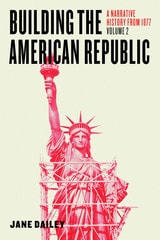
Building the American Republic, Volume 2
A Narrative History from 1877Jane Dailey
University of Chicago Press, 2018
The American nation came apart in a violent civil war less than a century after ratification of the Constitution. When it was reborn five years later, both the republic and its Constitution were transformed. Volume 2 opens as America struggles to regain its footing, reeling from a presidential assassination and facing massive economic growth, rapid demographic change, and combustive politics.
The next century and a half saw the United States enter and then dominate the world stage, even as the country struggled to live up to its own principles of liberty, justice, and equality. Volume 2 of Building the American Republic takes the reader from the Gilded Age to the present, as the nation becomes an imperial power, rethinks the Constitution, witnesses the rise of powerful new technologies, and navigates an always-shifting cultural landscape shaped by an increasingly diverse population. Ending with the 2016 election, this volume provides a needed reminder that the future of the American republic depends on a citizenry that understands—and can learn from—its history.