Results by title
260 books match the query 'Holocaust' and 10 start with b
Between Home and Homeland
Youth Aliyah from Nazi GermanyBrian Amkraut
University of Alabama Press, 2006
As Hitler consolidated power, Jews and their allies in Germany began efforts to leave the country. Among them was the organization, Youth Aliyah. Based on abundant archival sources and a thorough use of secondary literature, Brian Amkraut details the story of the organization from its origins through its alliances and antagonisms with other Jewish organizations, and the challenges that vexed its efforts from every side, perhaps the greatest being sheer human naiveté ("surely things will get better").
Amkraut also discusses the identity dilemma for Jews who grew up feeling German, and then had to alter their self-image in the face of growing discrimination. He highlights the internal disagreements of Jewish agencies who wrestled with myriad problems. The author explores how German Jews were ideologically heterogeneous, and details how different groups coped with increasing antagonism in a variety of ways.
To this day, Youth Aliyah is considered by Israelis as a major contributor to the foundation of a Jewish presence leading to the modern state of Israel. Between Home and Homeland is an essential account of an important episode in the history of the Holocaust and the founding of the Isreali state.
Between Mussolini and Hitler
The Jews and the Italian Authorities in France and TunisiaDaniel Carpi
University Press of New England, 2002
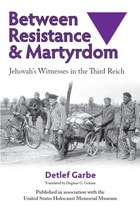
Between Resistance and Martyrdom
Jehovah's Witnesses in the Third ReichDetlef Garbe
University of Wisconsin Press, 2008
Although persecuted and banned from practicing their beliefs by the Nazi regime in 1933, the Jehovah’s Witnesses’ unified resistance has been largely forgotten. Basing his work on a wide range of sources, including documents and archives previously unconsidered as well as critical analyses of Jehovah’s Witness literature and survivor interviews, Detlef Garbe chronicles the Nazi’s relentless persecution of this religious group before and during World War II.
The English translation of this important work features a series of original photographs not published in the German edition. These striking images bring a sense of individual humanity to this story and help readers comprehend the reality of the events documented. Between Resistance and Martyrdom is an indispensable work that will introduce an English-speaking audience to this important but lesser-known part of Holocaust history.
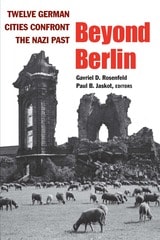
Beyond Berlin
Twelve German Cities Confront the Nazi PastGavriel D. Rosenfeld and Paul B. Jaskot, Editors
University of Michigan Press, 2015
Beyond Berlin breaks new ground in the ongoing effort to understand how memorials, buildings, and other spaces have figured in Germany's confrontation with its Nazi past. The contributors challenge reigning views of Germany's postwar memory work by examining how specific urban centers apart from the nation's capital have wrestled with their respective Nazi legacies. A wide range of West and East German cities is profiled in the volume: prominent metropolises like Hamburg, dynamic regional centers like Dresden, gritty industrial cities like Wolfsburg, and idyllic rural towns like Quedlinburg. In employing historical, art historical, anthropological, and geographical methodologies to examine these and other important urban centers, the volume's case studies shed new light upon the complex ways in which the confrontation with the Nazi past has directly shaped the German urban landscape since the end of the Second World War.
"Beyond Berlin is one of the most fascinating, deeply probing collections ever published on Germany's ongoing confrontation with its Nazi past. Its editors, Gavriel Rosenfeld and Paul Jaskot, have taken the exploration of Germany's urban memorial landscape to its highest level yet."
---James E. Young, Professor and Chair, Department of Judaic and Near Eastern Studies, University of Massachusetts Amherst, and author of The Texture of Memory and At Memory's Edge
"This is a top-notch collection of essays that positions itself in the populated field of memory studies by bringing together original contributions representing the best of new scholarship on architecture, urban design, monuments, and memory in East and West Germany. Taken together, the essays remind readers that the Nazi past is always present when German architects, urban planners, and politicians make decisions to tear down, rebuild, restore, and memorialize."
---S. Jonathan Wiesen, Department of History, Southern Illinois University, Carbondale
Beyond Lament
Poets of the World Bearing Witness to the HolocaustMarguerite Striar
Northwestern University Press, 1998
Editor Marguerite M. Striar has arranged the nearly 300 poems in this volume to tell the story beginmning with the early premonitions of Nazi evil in 1933, through the course of the unthinkable violence that ended in 1945 with Hitler's demise, to the flourishing of concern for human rights in the aftermath of the Holocaust. These works by well-known poets such as Paul Celan, Nelly Sachs, Czeslaw Milosz, Dannie Abse, and Robert Pinsky, as well as many lesser-known or unknown poets, show how poetry makes history memorable, confirm the resiliance of the human spirit, and prove that even in the fact of great suffering, the flame of creation will not be extinguished.
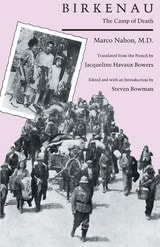
Birkenau, The Camp Of Death
Marco Nahon
University of Alabama Press, 1989

Birkenau
The Camp of DeathMarco Nahon, translated from the French by Jacqueline Bowers, edited and with an introduction by Steven B. Bowan
University of Alabama Press, 1989
Step into Birkenau, Marco Nahon’s unflinching memoir of survival in Auschwitz, where a Greek doctor bears witness to brutality, loss, and endurance—preserving forgotten voices and compelling readers to confront history through one unforgettable, human testimony
Birkenau is a searing firsthand Holocaust memoir by Greek physician Marco Nahon, recounting his deportation to Auschwitz-Birkenau and survival of one of history’s most lethal extermination camps. Writing soon after liberation, Nahon offers a deeply personal chronicle of Nazi persecution. He recounts the occupation of Greece, the ghettoization of Greek Jews, their transport to German death camps, and the daily horrors of camp life. He documents the dehumanization and destruction of Greek Jews while preserving the memory of those who perished.
Nahon presents his story episodically, guiding readers through his arrest, transport, forced labor, and survival. He illuminates the historical context of the Holocaust with vivid stories from daily life in the death camps. Rounding out the work are maps, appendices, and Bowman’s introduction, which provides background on Greek Jewry—whose complex story is little known—and describes the progress of the Nazi occupation of Greece and the Balkans.
Nahon, an MD trained in Beirut who lost much of his family, writes with restrained objectivity that heightens the emotional force of his account, while the translation and editorial framing make this early memoir accessible to modern readers.
This book will resonate with scholars of the Holocaust, students of World War II, and general readers seeking an authentic survivor voice. It is especially valuable for those interested in lesser-known aspects of the genocide, such as the fate of Greek Jewish communities. Both an indispensable historical document and a powerful act of remembrance, it speaks urgently to anyone committed to understanding—and never forgetting—the human realities of genocide.
Breaking the Silence
The German Who Exposed the Final Solution.Walter Laqueur and Richard Breitman
Brandeis University Press, 1994
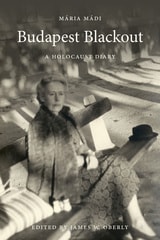
Budapest Blackout
A Holocaust Diaryby Máriá Mádi, edited by James W. Oberly
University of Wisconsin Press, 2023
Mádi’s family donated the entire collection of her diaries to the US Holocaust Memorial Museum. This edition transcribes a selection of Mádi’s writings focusing on the period of March 1944 to November 1945, from the Nazi invasion and occupation of Hungary, through the Battle of Budapest, to the ensuing Soviet occupation. While bearing witness to the catastrophe in Hungary, Mádi hid a Jewish family in her small flat from October 1944 to February 1945. She received a posthumous Righteous among Nations Medal from Yad Vashem, the World Holocaust Remembrance Center.
Editorial commentary by James W. Oberly situates Mádi’s observations, and a critical introduction by the Holocaust scholar András Lénárt outlines the wider sociopolitical context in which her diaries gain meaning.
By Words Alone
The Holocaust in LiteratureSidra DeKoven Ezrahi
University of Chicago Press, 1980