219 books match the query 'Holocaust, Jewish (1939-1945)' and 7 start with b
cover of Between Mussolini and Hitler: The Jews and the Italian Authorities in France and Tunisia

Between Mussolini and Hitler

The Jews and the Italian Authorities in France and Tunisia

Daniel Carpi

University Press of New England, 2002
The Nazi invasion of Poland in 1939 plunged the world into its second global conflict. The Third Reich's attack, mounted without consulting its Italian ally, had other reverberations as well. Chief among them was Mussolini's decision to conduct a "parallel war" based on his own tactical and political agendas. Against this backdrop, Daniel Carpi depicts the fate of some 5000 Jews in Tunisia and as many as 30,000 in southeastern France, all of whom came under the aegis of the Italian Fascist regime early in the war. Many were unskilled immigrants: still others were political refugees, activists, or anti-fascist emigres, the fuoriusciti who fled oppression in Italy only to find themselves under its rule once again after the fall of France. While the Fascist regime disagreed with Hitler's final solution for the "Jewish problem," it also saw actions by Vichy French police or German security forces against Jews in Italian-controlled regions as an erosion of Rome's power. Thus, although these Jews were not free from oppression, Carpi shows that as long as Italy maintained control over them its consular officials were able to block the arrests and mass deportations occurring elsewhere.
[more]
cover of Beyond Lament: Poets of the World Bearing Witness to the Holocaust

Beyond Lament

Poets of the World Bearing Witness to the Holocaust

Marguerite Striar

Northwestern University Press, 1998

Challenging Theodor Adorno's famous statement that "writing poetry after Auschwitz is barbaric," Beyond Lament is a rich and varied anthology consisting of new and previously published poems about the atrocity of the Holocaust. While writing poetry about the Holocaust may be considered by some to be a futile attempt to express the inexpressible, for many the need to give voice to the anger and despair of the Holocaust is as essential as the need to come to grips with its unspeakable horror. 

Editor Marguerite M. Striar has arranged the nearly 300 poems in this volume to tell the story beginmning with the early premonitions of Nazi evil in 1933, through the course of the unthinkable violence that ended in 1945 with Hitler's demise, to the flourishing of concern for human rights in the aftermath of the Holocaust. These works by well-known poets such as Paul Celan, Nelly Sachs, Czeslaw Milosz, Dannie Abse, and Robert Pinsky, as well as many lesser-known or unknown poets, show how poetry makes history memorable, confirm the resiliance of the human spirit, and prove that even in the fact of great suffering, the flame of creation will not be extinguished. 
[more]
cover of Birkenau, The Camp Of Death

Birkenau, The Camp Of Death

Marco Nahon

University of Alabama Press, 1989
[more]
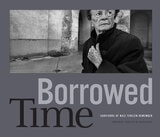
cover of Borrowed Time: Survivors of Nazi Terezín Remember

Borrowed Time

Survivors of Nazi Terezín Remember

Dennis Carlyle Darling

University of Texas Press, 2024

Honorable Mention — The International Photography Awards 2024 Book Category

Documentation, through photographs and interviews, of those who survived the unique Nazi ghetto/camp located at Terezín, Czech Republic.

Dennis Carlyle Darling has photographed and interviewed hundreds of Holocaust survivors who spent time at the German transit camp and ghetto at Terezín, a former eighteenth-century military garrison located north of Prague. Many of the prisoners were kept there until they could be transported to Auschwitz or other camps, but unlike German captives elsewhere, they were allowed to participate in creative activities that the Nazis used for propaganda purposes to show the world how well they were treating Jews. Although it was not classified as a “death camp,” more than 33,000 prisoners died at Terezín from hunger, disease, and mistreatment.

In Borrowed Time, Darling reveals Terezín as a place of painful contradictions, through striking and intimate portraits that retrace time and place with his subjects, the last remnants of those who survived the experience. Returning to sites of painful memories with his interview subjects to photograph them, Darling respectfully depicts these survivors and tells their stories.
[more]
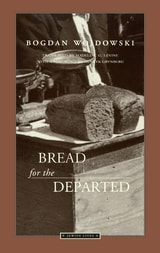
cover of Bread for the Departed

Bread for the Departed

Bogdan Wojdowski

Northwestern University Press, 1997
Bread for the Departed details the experience of the Jewish community in Warsaw between 1940 and 1942; the final chapters take place during the mass deportation of Warsaw's Jewish community to death camps. Episodic, chaotic as the teeming ghetto itself, the novel records the inexorable breakdown of morals and loyalties that accompanied the physical deterioration of the ghetto population.
[more]
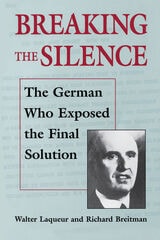
cover of Breaking the Silence: The German Who Exposed the Final Solution.

Breaking the Silence

The German Who Exposed the Final Solution.

Walter Laqueur and Richard Breitman

Brandeis University Press, 1994
Through unparalleled historical detective work, noted scholars Walter Laqueur and Richard Breitman reveal the inspiring tale of Eduard Schulte, the Breslau business leader who risked his life to gather information about such Nazi activities as the revised date of the German attack on Poland and the Nazi plan for mass extermination of European Jews. First published in 1986, Breaking the Silence is reissued with both a new foreword and afterword by the authors.
[more]
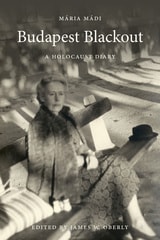
cover of Budapest Blackout: A Holocaust Diary

Budapest Blackout

A Holocaust Diary

by Máriá Mádi, edited by James W. Oberly

University of Wisconsin Press, 2023

Mária Mádi (1898–1970) was a Roman Catholic Hungarian physician living in Budapest during World War II. Stuck in the city, she vowed to become a witness to events as they unfolded and began keeping a diary to chronicle her everyday life, as well as the lives of her Jewish neighbors, during what would be the darkest periods of the Holocaust. From the time Hungary declared war on the United States in December 1941 until she secured an immigrant’s visa to the US in late 1946, she wrote nearly daily in English, offering current-day readers one of the most complete pictures of ordinary life during the Holocaust in Hungary. In the form of letters to her American relatives, Mádi addressed a wide range of subjects, from the fate of small countries like Hungary caught between the major powers of Germany and the Soviet Union, to the Nazi pogrom against Budapest’s Jews, to family news and the price of food.

Mádi’s family donated the entire collection of her diaries to the US Holocaust Memorial Museum. This edition transcribes a selection of Mádi’s writings focusing on the period of March 1944 to November 1945, from the Nazi invasion and occupation of Hungary, through the Battle of Budapest, to the ensuing Soviet occupation. While bearing witness to the catastrophe in Hungary, Mádi hid a Jewish family in her small flat from October 1944 to February 1945. She received a posthumous Righteous among Nations Medal from Yad Vashem, the World Holocaust Remembrance Center.

Editorial commentary by James W. Oberly situates Mádi’s observations, and a critical introduction by the Holocaust scholar András Lénárt outlines the wider sociopolitical context in which her diaries gain meaning.
[more]