163 books match the query 'Homosexuality' and 4 start with b

cover of Bad Education: Why Queer Theory Teaches Us Nothing

Bad Education

Why Queer Theory Teaches Us Nothing

Lee Edelman

Duke University Press, 2022

Long awaited after No Future, and making queer theory controversial again, Lee Edelman’s Bad Education proposes a queerness without positive identity—a queerness understood as a figural name for the void, itself unnamable, around which the social order takes shape. Like Blackness, woman, incest, and sex, queerness, as Edelman explains it, designates the antagonism, the structuring negativity, preventing that order from achieving coherence. But when certain types of persons get read as literalizing queerness, the negation of their negativity can seem to resolve the social antagonism and totalize community. By translating the nothing of queerness into the something of “the queer,” the order of meaning defends against the senselessness that undoes it, thus mirroring, Edelman argues, education’s response to queerness: its sublimation of irony into the meaningfulness of a world. Putting queerness in relation to Lacan’s “ab-sens” and in dialogue with feminist and Afropessimist thought, Edelman reads works by Shakespeare, Jacobs, Almodóvar, Lemmons, and Haneke, among others, to show why queer theory’s engagement with queerness necessarily results in a bad education that is destined to teach us nothing.
[more]
cover of Barbie's Queer Accessories

Barbie's Queer Accessories

Erica Rand

Duke University Press, 1995

She’s skinny, white, and blond. She’s Barbie—an icon of femininity to generations of American girls. She’s also multiethnic and straight—or so says Mattel, Barbie’s manufacturer. But, as Barbie’s Queer Accessories demonstrates, many girls do things with Barbie never seen in any commercial. Erica Rand looks at the corporate marketing strategies used to create Barbie’s versatile (She’s a rapper! She’s an astronaut! She’s a bride!) but nonetheless premolded and still predominantly white image. Rand weighs the values Mattel seeks to embody in Barbie—evident, for example, in her improbably thin waist and her heterosexual partner—against the naked, dyked out, transgendered, and trashed versions favored by many juvenile owners and adult collectors of the doll.
Rand begins by focusing on the production and marketing of Barbie, starting in 1959, including Mattel’s numerous tie-ins and spin-offs. These variations, which include the much-promoted multiethnic Barbies and the controversial Earring Magic Ken, helped make the doll one of the most profitable toys on the market. In lively chapters based on extensive interviews, the author discusses adult testimony from both Barbie "survivors" and enthusiasts and explores how memories of the doll fit into women’s lives. Finally, Rand looks at cultural reappropriations of Barbie by artists, collectors, and especially lesbians and gay men, and considers resistance to Barbie as a form of social and political activism.
Illustrated with photographs of various interpretations and alterations of Barbie, this book encompasses both Barbie glorification and abjection as it testifies to the irrefutably compelling qualities of this bestselling toy. Anyone who has played with Barbie—or, more importantly, thought or worried about playing with Barbie—will find this book fascinating.

[more]
cover of Before Homosexuality in the Arab-Islamic World, 1500-1800

Before Homosexuality in the Arab-Islamic World, 1500-1800

Khaled El-Rouayheb

University of Chicago Press, 2005

Attitudes toward homosexuality in the pre-modern Arab-Islamic world are commonly depicted as schizophrenic—visible and tolerated on one hand, prohibited by Islam on the other. Khaled El-Rouayheb argues that this apparent paradox is based on the anachronistic assumption that homosexuality is a timeless, self-evident fact to which a particular culture reacts with some degree of tolerance or intolerance. Drawing on poetry, biographical literature, medicine, dream interpretation, and Islamic texts, he shows that the culture of the period lacked the concept of homosexuality.
[more]
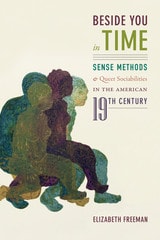
cover of Beside You in Time: Sense Methods and Queer Sociabilities in the American Nineteenth Century

Beside You in Time

Sense Methods and Queer Sociabilities in the American Nineteenth Century

Elizabeth Freeman

Duke University Press, 2019

In Beside You in Time Elizabeth Freeman expands biopolitical and queer theory by outlining a temporal view of the long nineteenth century. Drawing on Foucauldian notions of discipline as a regime that yoked the human body to time, Freeman shows how time became a social and sensory means by which people assembled into groups in ways that resisted disciplinary forces. She tracks temporalized bodies across many entangled regimes—religion, secularity, race, historiography, health, and sexuality—and examines how those bodies act in relation to those regimes. In analyses of the use of rhythmic dance by the Shakers; African American slave narratives; literature by Mark Twain, Pauline Hopkins, Herman Melville, and others; and how Catholic sacraments conjoined people across historical boundaries, Freeman makes the case for the body as an instrument of what she calls queer hypersociality. As a mode of being in which bodies are connected to others and their histories across and throughout time, queer hypersociality, Freeman contends, provides the means for subjugated bodies to escape disciplinary regimes of time and to create new social worlds.
[more]