Results by title
56 books match the query 'Homosexuality in literature' and 5 start with b
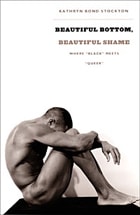
Beautiful Bottom, Beautiful Shame
Where "Black" Meets "Queer"Kathryn Bond Stockton
Duke University Press, 2006
Stockton engages the domains of African American studies, queer theory, psychoanalysis, film theory, photography, semiotics, and gender studies. She brings together thinkers rarely, if ever, read together in a single study—James Baldwin, Radclyffe Hall, Jean Genet, Toni Morrison, Robert Mapplethorpe, Eldridge Cleaver, Todd Haynes, Norman Mailer, Leslie Feinberg, David Fincher, and Quentin Tarantino—and reads them with and against major theorists, including Georges Bataille, Sigmund Freud, Eve Kosofsky Sedgwick, Jacques Lacan, Roland Barthes, and Leo Bersani. Stockton asserts that there is no clear, mirrored relation between the terms “black” and “queer”; rather, seemingly definitive associations attached to each are often taken up or crossed through by the other. Stockton explores dramatic switchpoints between these terms: the stigmatized “skin” of some queers’ clothes, the description of blacks as an “economic bottom,” the visual force of interracial homosexual rape, the complicated logic of so-called same-sex miscegenation, and the ways in which a famous depiction of slavery (namely, Morrison’s Beloved) seems bound up with depictions of AIDS. All of the thinkers Stockton considers scrutinize the social nature of shame as they examine the structures that make debasements possible, bearable, pleasurable, and creative, even in their darkness.
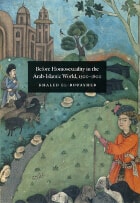
Before Homosexuality in the Arab-Islamic World, 1500-1800
Khaled El-Rouayheb
University of Chicago Press, 2005
Attitudes toward homosexuality in the pre-modern Arab-Islamic world are commonly depicted as schizophrenic—visible and tolerated on one hand, prohibited by Islam on the other. Khaled El-Rouayheb argues that this apparent paradox is based on the anachronistic assumption that homosexuality is a timeless, self-evident fact to which a particular culture reacts with some degree of tolerance or intolerance. Drawing on poetry, biographical literature, medicine, dream interpretation, and Islamic texts, he shows that the culture of the period lacked the concept of homosexuality.
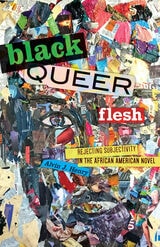
Black Queer Flesh
Rejecting Subjectivity in the African American NovelAlvin J. Henry
University of Minnesota Press, 2021
A groundbreaking examination of how twentieth-century African American writers use queer characters to challenge and ultimately reject subjectivity
Black Queer Flesh reinterprets key African American novels from the Harlem Renaissance to Black Modernism to contemporary literature, showing how authors have imagined a new model of Black queer selfhood. African American authors blame liberal humanism’s model of subjectivity for double consciousness and find that liberal humanism’s celebration of individual autonomy and agency is a way of disciplining Black queer lives. These authors thus reject subjectivity in search of a new mode of the self that Alvin J. Henry names “Black queer flesh”—a model of selfhood that is collective, plural, fluctuating, and deeply connected to the Black queer past.
Henry begins with early twentieth-century authors such as Jessie Redmon Fauset and James Weldon Johnson. These authors adapted the Bildungsroman, the novel of self-formation, to show African Americans gaining freedom and agency by becoming a liberal, autonomous subjects. These authors, however, discovered that the promise of liberal autonomy held out by the Bildungsroman was yet another tool of antiblack racism. As a result, they tentatively experimented with repurposing the Bildungsroman to throw off subjectivity and its attendant double consciousness. In contrast, Nella Larsen, Henry shows, was the first author to fully reject subjectivity. In Quicksand and Passing, Larsen invented a new genre showing her queer characters—characters whose queerness already positioned them on the margins of subjectivity—escaping subjectivity altogether. Using Ralph Ellison’s archival drafts, Henry then powerfully rereads Invisible Man, revealing that the protagonist as a queer, disabled character taught by the novel’s many other queer, disabled characters to likewise seek a selfhood beyond subjectivity. Although Larsen and Ellison sketch glimpses of this selfhood beyond subjectivity, only Saidiya Hartman’s Wayward Lives, Beautiful Experiments shows a protagonist fully inhabiting Black queer flesh—a new mode of selfhood that is collective, plural, always evolving, and no longer alienated from the black past.
Black Queer Flesh is an original and necessary contribution to Black literary studies, offering new ways to understand and appreciate the canonical texts and far more.
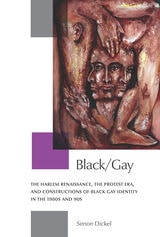
Black/Gay
The Harlem Renaissance, the Protest Era, and the Constructions of Black Gay Identity in the 1980s and 90sSimon Dickel
Michigan State University Press, 2011
This book explores key texts of the black gay culture of the 1980s and ’90s. Starting with an analysis of the political discourse in anthologies such as In the Life and Brother to Brother, it identifies the references to the Harlem Renaissance and the Protest Era as common elements of black gay discourse. This connection to African American cultural and political traditions legitimizes black gay identity and criticizes the construction of gay identity as white. Readings of Isaac Julien’s Looking for Langston, Samuel R. Delany’s “Atlantis: Model 1924” and The Motion of Light in Water, Melvin Dixon’s Vanishing Rooms, Randall Kenan’s A Visitation of Spirits, and Steven Corbin’s No Easy Place to Be demonstrate how these strategies of signifying are used in affirmative, humorous, and ironic ways.
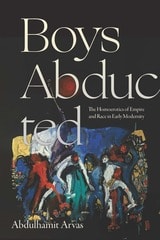
Boys Abducted
The Homoerotics of Empire and Race in Early ModernityAbdulhamit Arvas
Duke University Press, 2025