Results by title
85 books match the query 'Housing' and 3 start with b

Beyond Inhabitation
Housing and Ordinary Desire at the EdgeMichele Lancione and AbdouMaliq Simone
Duke University Press, 2027
In this provocative exploration, Michele Lancione and AbdouMaliq Simone examine housing not as shelter or asset but as an operation shaping desires, bodies, and possibilities of urban life. Drawing on experiences from Jakarta to Naples, Bucharest to Dakar, Lancione and Simone reveal how the “thing of the house” works as a magnetic field, promising belonging while simultaneously producing forms of captivity and violence. Through three key operations—spacing, seeing, and surfacing—they unpack how housing interrupts and rearranges life under racial capitalism, creating subjects who must constantly negotiate between habitation and its annihilation. Beyond Inhabitation challenges conventional housing studies by centering the house itself as an active force that mediates between the intimate and structural, the ordinary and catastrophic. By attending to how people at the thresholds of dispossession hold onto housing’s promise despite its failures, the authors illuminate the edges where new forms of collective life might emerge—beyond the current fold of habitation, toward more liberatory futures.
[more]
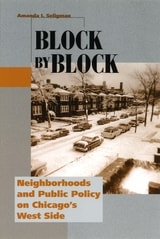
Block by Block
Neighborhoods and Public Policy on Chicago's West SideAmanda I. Seligman
University of Chicago Press, 2005
In the decades following World War II, cities across the United States saw an influx of African American families into otherwise homogeneously white areas. This racial transformation of urban neighborhoods led many whites to migrate to the suburbs, producing the phenomenon commonly known as white flight. In Block by Block, Amanda I. Seligman draws on the surprisingly understudied West Side communities of Chicago to shed new light on this story of postwar urban America.
Seligman's study reveals that the responses of white West Siders to racial changes occurring in their neighborhoods were both multifaceted and extensive. She shows that, despite rehabilitation efforts, deterioration in these areas began long before the color of their inhabitants changed from white to black. And ultimately, the riots that erupted on Chicago's West Side and across the country in the mid-1960s stemmed not only from the tribulations specific to blacks in urban centers but also from the legacy of accumulated neglect after decades of white occupancy. Seligman's careful and evenhanded account will be essential to understanding that the "flight" of whites to the suburbs was the eventual result of a series of responses to transformations in Chicago's physical and social landscape, occurring one block at a time.
Seligman's study reveals that the responses of white West Siders to racial changes occurring in their neighborhoods were both multifaceted and extensive. She shows that, despite rehabilitation efforts, deterioration in these areas began long before the color of their inhabitants changed from white to black. And ultimately, the riots that erupted on Chicago's West Side and across the country in the mid-1960s stemmed not only from the tribulations specific to blacks in urban centers but also from the legacy of accumulated neglect after decades of white occupancy. Seligman's careful and evenhanded account will be essential to understanding that the "flight" of whites to the suburbs was the eventual result of a series of responses to transformations in Chicago's physical and social landscape, occurring one block at a time.
[more]
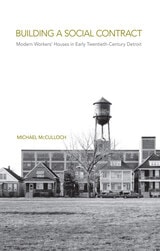
Building a Social Contract
Modern Workers' Houses in Early-Twentieth Century DetroitMcCulloch, Michael
Temple University Press, 2023
The dream of the modern worker’s house emerged in early twentieth-century America as wage earners gained access to new, larger, and better-equipped dwellings. Building a Social Contract is a cogent history of the houses those workers dreamed of and labored for. Michael McCulloch chronicles the efforts of employers, government agencies, and the building industry who, along with workers themselves, produced an unprecedented boom in housing construction that peaked in the mid-1920s.
Through oral histories, letters, photographs, and period fiction, McCulloch traces wage earners’ agency in negotiating a new implicit social contract, one that rewarded hard work with upward mobility in modern houses. This promise reflected workers’ increased bargaining power but, at the same time, left them increasingly vulnerable to layoffs.
Building a Social Contract focuses on Detroit, the quintessential city of the era, where migrant workers came and were Americanized, and real estate agents and the speculative housebuilding industry thrived. The Motor City epitomized the struggle of Black workers in this period, who sought better lives through industrial labor but struggled to translate their wages into housing security amid racist segregation and violence. When Depression-era unemployment created an eviction crisis, the social contract unraveled, and workers rose up—at the polls and in the streets—to create a labor movement that reshaped American capitalism for decades.
Today, the lessons McCulloch provides from early twentieth-century Detroit are a necessary reminder that wages are not enough, and only working-class political power can secure affordable housing.
[more]