Results by title
58 books match the query 'Identity (Psychology) in literature' and 6 start with b
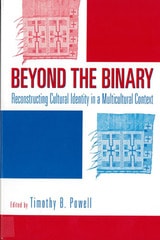
Beyond the Binary
Reconstructing Cultural Identity In a Multicultural ContextEdited by Timothy B. Powell
Rutgers University Press, 1999
"Beyond the Binary offers a coherently presented collection of uniformly strong essays that speak to what is perhaps the most widely discussed, contested and conflicted topic in the study of US culture. It joins the growing body of work that seeks to move beyond identity politics and racial essentialism to formulate racial identity as a more complex series of social, cultural and political gestures." -Priscilla Wald, author of Constituting Americans: Cultural Anxiety and Narrative Form and Constituting Americans
Cultural studies have reached a theoretical impasse. As scholars continue to topple the previously entrenched concept of Eurocentrism, this field has fragmented into works covering many separate cultural enclaves. In the first wave of this "post-Eurocentric" scholarship, a binary model ensued, using the designations of "Self" and "Other:" i.e., black/white, gay/straight. This model, however, also has found disfavor. As a result, recent scholarship has focused on a single group studied in isolation.
What is needed is a new critical phase of reconstruction that will bring discussion of these disparate cultural enclaves back into a more organized, critical sphere. Researchers must have the necessary conceptual tools so they can study the ways in which cultures overlap, intersect, or else violently conflict with one another.
Beyond the Binary: Reconstructing Cultural Identity in a Multicultural Context addresses this theoretical impasse by proposing new critical models that fully engage the dilemmas posed by multiculturalism. Rather than becoming entangled in the polarizing rhetoric of the culture wars, these essays are firmly grounded in the lived perplexities of specific historical moments. One piece, for example, considers the cultural identity of "freaks" exhibited in P. T. Barnum's circus, the contested place of hemophiliacs within Queer Nation, and "white" working-class musicians who proudly proclaim themselves to be "black lesbians."
Beyond the Binary is meant to be read in its entirety as a many-voiced narrative dedicated to bringing the divisions within cultural studies back into contact with one another. By doing so, Powell ushers in a new era of multicultural analysis that recognizes the historical existence of racism, yet also acknowledges the dynamic fluidity of cultural identity.
Black Aliveness, or A Poetics of Being
Kevin Quashie
Duke University Press, 2021
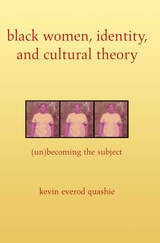
Black Women, Identity, and Cultural Theory
(Un)Becoming the SubjectKevin Everod Quashie
Rutgers University Press, 2004
In Black Women, Identity, and Cultural Theory, Kevin Everod Quashie explores the metaphor of the “girlfriend” as a new way of understanding three central concepts of cultural studies: self, memory, and language. He considers how the work of writers such as Toni Morrison, Ama Ata Aidoo, Dionne Brand, photographer Lorna Simpson, and many others, inform debates over the concept of identity. Quashie argues that these authors and artists replace the notion of a stable, singular identity with the concept of the self developing in a process both communal and perpetually fluid, a relationship that functions in much the same way that an adult woman negotiates with her girlfriend(s). He suggests that memory itself is corporeal, a literal body that is crucial to the process of becoming. Quashie also explores the problem language poses for the black woman artist and her commitment to a mastery that neither colonizes nor excludes.
The analysis throughout interacts with schools of thought such as psychoanalysis, postmodernism, and post-colonialism, but ultimately moves beyond these to propose a new cultural aesthetic, one that ultimately aims to center black women and their philosophies.
Blood Lines
Myth, Indigenism, and Chicana/o LiteratureBy Sheila Marie Contreras
University of Texas Press, 2008
2009 — Runner-up, Modern Language Association Prize in United States Latina and Latino and Chicana and Chicano Literary and Cultural Studies
Blood Lines: Myth, Indigenism, and Chicana/o Literature examines a broad array of texts that have contributed to the formation of an indigenous strand of Chicano cultural politics. In particular, this book exposes the ethnographic and poetic discourses that shaped the aesthetics and stylistics of Chicano nationalism and Chicana feminism. Contreras offers original perspectives on writers ranging from Alurista and Gloria Anzaldúa to Lorna Dee Cervantes and Alma Luz Villanueva, effectively marking the invocation of a Chicano indigeneity whose foundations and formulations can be linked to U.S. and British modernist writing.
By highlighting intertextualities such as those between Anzaldúa and D. H. Lawrence, Contreras critiques the resilience of primitivism in the Mexican borderlands. She questions established cultural perspectives on "the native," which paradoxically challenge and reaffirm racialized representations of Indians in the Americas. In doing so, Blood Lines brings a new understanding to the contradictory and richly textured literary relationship that links the projects of European modernism and Anglo-American authors, on the one hand, and the imaginary of the post-revolutionary Mexican state and Chicano/a writers, on the other hand.
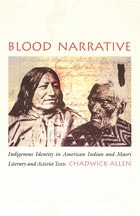
Blood Narrative
Indigenous Identity in American Indian and Maori Literary and Activist TextsChadwick Allen
Duke University Press, 2002
Allen shows how both Maori and Native Americans resisted the assimilationist tide rising out of World War II and how, in the 1960s and 1970s, they each experienced a renaissance of political and cultural activism and literary production that culminated in the formation of the first general assembly of the World Council of Indigenous Peoples. He focuses his comparison on two fronts: first, the blood/land/memory complex that refers to these groups' struggles to define indigeneity and to be freed from the definitions of authenticity imposed by dominant settler cultures. Allen's second focus is on the discourse of treaties between American Indians and the U.S. government and between Maori and Great Britain, which he contends offers strong legal and moral bases from which these indigenous minorities can argue land and resource rights as well as cultural and identity politics.
With its implicit critique of multiculturalism and of postcolonial studies that have tended to neglect the colonized status of indigenous First World minorities, Blood Narrative will appeal to students and scholars of literature, American and European history, multiculturalism, postcolonialism, and comparative cultural studies.
Borrowed Voices
Writing and Racial Ventriloquism in the Jewish American ImaginationGlaser, Jennifer
Rutgers University Press, 2016