Results by title
72 books match the query 'Indian authors' and 4 start with b
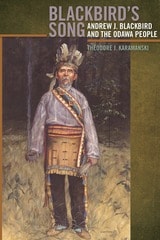
Blackbird's Song
Andrew J. Blackbird and the Odawa PeopleTheodore J. Karamanski
Michigan State University Press, 2012
For much of U.S. history, the story of native people has been written by historians and anthropologists relying on the often biased accounts of European-American observers. Though we have become well acquainted with war chiefs like Pontiac and Crazy Horse, it has been at the expense of better knowing civic-minded intellectuals like Andrew J. Blackbird, who sought in 1887 to give a voice to his people through his landmark book History of the Ottawa and Chippewa People. Blackbird chronicled the numerous ways in which these Great Lakes people fought to retain their land and culture, first with military resistance and later by claiming the tools of citizenship. This stirring account reflects on the lived experience of the Odawa people and the work of one of their greatest advocates.
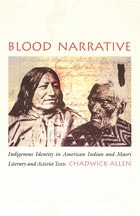
Blood Narrative
Indigenous Identity in American Indian and Maori Literary and Activist TextsChadwick Allen
Duke University Press, 2002
Allen shows how both Maori and Native Americans resisted the assimilationist tide rising out of World War II and how, in the 1960s and 1970s, they each experienced a renaissance of political and cultural activism and literary production that culminated in the formation of the first general assembly of the World Council of Indigenous Peoples. He focuses his comparison on two fronts: first, the blood/land/memory complex that refers to these groups' struggles to define indigeneity and to be freed from the definitions of authenticity imposed by dominant settler cultures. Allen's second focus is on the discourse of treaties between American Indians and the U.S. government and between Maori and Great Britain, which he contends offers strong legal and moral bases from which these indigenous minorities can argue land and resource rights as well as cultural and identity politics.
With its implicit critique of multiculturalism and of postcolonial studies that have tended to neglect the colonized status of indigenous First World minorities, Blood Narrative will appeal to students and scholars of literature, American and European history, multiculturalism, postcolonialism, and comparative cultural studies.
Book Anatomy
Body Politics and the Materiality of Indigenous Book HistoryAmy Gore
University of Massachusetts Press, 2023
Winner of the Beatrice Medicine Award for Scholarship in American Indian Studies
From the marginalia of their readers to the social and cultural means of their production, books bear the imprint of our humanity. Embodying the marks, traces, and scars of colonial survival, Indigenous books are contested spaces. A constellation of nontextual components surrounded Native American–authored publications of the long nineteenth century, shaping how these books were read and understood—including illustrations, typefaces, explanatory prefaces, appendices, copyright statements, author portraits, and more.
Centering Indigenous writers, Book Anatomy explores works from John Rollin Ridge, Sarah Winnemucca Hopkins, Pretty Shield, and D’Arcy McNickle published between 1854 and 1936. In examining critical moments of junction between Indigenous books and a mainstream literary marketplace, Amy Gore argues that the reprints, editions, and paratextual elements of Indigenous books matter: they embody a frontline of colonization in which Native authors battle the public perception and reception of Indigenous books, negotiate representations of Indigenous bodies, and fight for authority and ownership over their literary work.
Boundless
Native American Abundance in Art and LiteratureLisa A. Crossman and Heid E. Erdrich
Amherst College Press, 2025
Amherst College’s Collection of Native American Literature contains thousands of Indigenous-authored works spanning centuries. The Collection’s abundance of books, prints, music, ephemera, and artist-made works, all by Native people, provide rich selections for Boundless. Crosscurrents of Indigenous visual art and literature are considered in this broad and interdisciplinary project. Boundless crosses generations to explore relatedness, kinship, and collegiality.
Boundless brings artists and writers together across generations, often drawing together works by members of the same tribe or even the same family to show the history, presence, and futurity of Native American creative and intellectual production.