69 books match the query 'Indiana' and 3 start with b
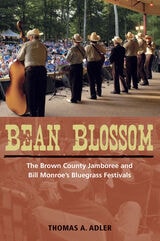
cover of Bean Blossom: The Brown County Jamboree and Bill Monroe's Bluegrass Festivals

Bean Blossom

The Brown County Jamboree and Bill Monroe's Bluegrass Festivals

Thomas A. Adler

University of Illinois Press, 2011

Bean Blossom, Indiana--near Brown County State Park and the artist-colony town of Nashville, Indiana--is home to the annual Bean Blossom Bluegrass Festival, founded in 1967 by Bill Monroe, the father of bluegrass. Widely recognized as the oldest continuously running bluegrass music festival in the world, this June festival's roots run back to late 1951, when Monroe purchased the Brown County Jamboree, a live weekly country music show presented between April and November each year. Over the years, Monroe's festival featured the top performers in bluegrass music, including Jimmy Martin, Lester Flatt, Earl Scruggs, the Goins Brothers, the Stanley Brothers, and many more.
 
Thomas A. Adler's history of Bean Blossom traces the long and colorful life of the Brown County Jamboree and Bill Monroe's Bluegrass Festival. Adler discusses the development of bluegrass music, the many personalities involved in the bluegrass music scene, the interplay of local, regional, and national interests, and the meaning of this venue to the music's many performers--both professional and amateur--and its legions of fans.
[more]
cover of Big Sister: Feminism, Conservatism, and Conspiracy in the Heartland

Big Sister

Feminism, Conservatism, and Conspiracy in the Heartland

Erin M. Kempker

University of Illinois Press, 2018

The mid-Seventies represented a watershed era for feminism. A historic National Women's Conference convened in Houston in 1977. The Equal Rights Amendment inched toward passage. Conservative women in the Midwest, however, saw an event like the International Year of the Woman not as a celebration, but as part of a conspiracy that would lead to radicalism and one-world government. Erin M. Kempker delves into how conspiracy theories affected--and undermined--second wave feminism in the Midwest. Focusing on Indiana, Kempker views this phenomenon within the larger history of right-wing fears of subversion during the Cold War. Feminists and conservative women each believed they spoke in women's best interests. Though baffled by the conservative dread of "collectivism," feminists compromised by trimming radicals from their ranks. Conservative women, meanwhile, proved adept at applying old fears to new targets. Kemper's analysis places the women's opposing viewpoints side by side to unlock the differences that separated the groups, explain one to the other, and reveal feminism's fate in the Midwest.
[more]
cover of Boundary Conditions: Macrobotanical Remains and the Oliver Phase of Central Indiana, A.D. 1200-1450

Boundary Conditions

Macrobotanical Remains and the Oliver Phase of Central Indiana, A.D. 1200-1450

Leslie L. Bush

University of Alabama Press, 2004

Prehistoric plant use in the Late Woodland Period of central Indiana

This book explores the extent to which foodways, an important marker of group identity, can be recognized in charred macrobotanical remains from archaeological sites. From analysis of mere bits of burned plants we can discern what ancient people chose to eat, and how they cooked it, stored it, and preserved it.

Leslie Bush compares archaeobotanical remains from 13 Oliver Phase sites in Indiana to other late prehistoric sites through correspondence analysis. The Oliver area is adjacent to the territories of three of the largest and best-known archaeological cultures of the region—Mississippian, Fort Ancient, and Oneota—so findings about Oliver foodways have implications for studies of migration, ethnogenesis, social risk, and culture contact. Historical records of three Native American tribes (Shawnee, Miami, and Huron) are also examined for potential insights into Oliver foodways.

The study determines that people who inhabited central Indiana during late prehistoric times had a distinctive signature of plant use that separates them from other archaeological groups, not just in space and time but also in ideas about appropriate uses of plants. The uniqueness of the Oliver botanical pattern is found to lie in the choice of particular crops, the intensity of growing versus gathering, and the use of a large number of wild resources.

[more]