Results by title
174 books match the query 'Indigenous peoples' and 6 start with b
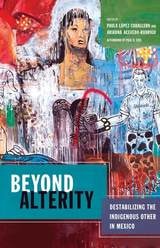
Beyond Alterity
Destabilizing the Indigenous Other in MexicoEdited by Paula López Caballero and Ariadna Acevedo-Rodrigo; Afterword by Paul K. Eiss
University of Arizona Press, 2018
The concept of “indigenous” has been entwined with notions of exoticism and alterity throughout Mexico’s history. In Beyond Alterity, authors from across disciplines question the persistent association between indigenous people and radical difference, and demonstrate that alterity is often the product of specific political contexts.
Although previous studies have usually focused on the most visible aspects of differences—cosmovision, language, customs, resistance—the contributors to this volume show that emphasizing difference prevents researchers from seeing all the social phenomena where alterity is not obvious. Those phenomena are equally or even more constitutive of social life and include property relations (especially individual or private ones), participation in national projects, and the use of national languages.
The category of “indigenous” has commonly been used as if it were an objective term referring to an already given social subject. Beyond Alterity shows how this usage overlooks the fact that the social markers of differentiation (language, race or ethnic group, phenotype) are historical and therefore unstable. In opposition to any reification of geographical, cultural, or social boundaries, this volume shows that people who (self-)identify as indigenous share a multitude of practices with the rest of society and that the association between indigenous identification and alterity is the product of a specific political history.
Beyond Alterity is essential reading for anyone interested in understanding indigenous identity, race, and Mexican history and politics.
Contributors
Ariadna Acevedo-Rodrigo
Laura Cházaro
Michael T. Ducey
Paul K. Eiss
José Luis Escalona-Victoria
Vivette García Deister
Peter Guardino
Emilio Kourí
Paula López Caballero
Elsie Rockwell
Diana Lynn Schwartz
Gabriela Torres-Mazuera
[more]
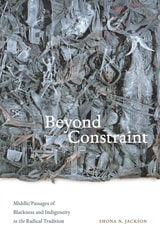
Beyond Constraint
Middle/Passages of Blackness and Indigeneity in the Radical TraditionShona N. Jackson
Duke University Press, 2024
In Beyond Constraint, Shona N. Jackson offers a new approach to labour and its analysis by demonstrating the fundamental relation between black and Indigenous People’s sovereign, free, and coerced labour in the Americas. Through the writings of Cedric Robinson, Walter Rodney, C. L. R. James, and Sylvia Wynter, Jackson confronts the elision of Indigenous People’s labour in the black radical tradition. She argues that this elision is an effect of the structural relation of antiblackness to anti-indigeneity through which native and black bodies are arranged on either side of a split between unproductive labour and productive work necessary for capital accumulation and for how we read capital in political economic critique. This division between labour and work forces the radical tradition to sustain the break between black and Indigenous peoples as part of its critical strategies of liberation. To address this impasse, Jackson reads the tradition against the grain for openings to indigeneity and a method for recovering lost labours.
[more]
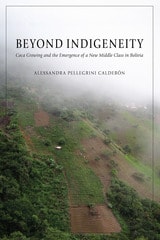
Beyond Indigeneity
Coca Growing and the Emergence of a New Middle Class in BoliviaAlessandra Pellegrini Calderón
University of Arizona Press, 2016
In Bolivia, the discourse on indigenous peoples intensified in the last few decades, culminating in the election of Evo Morales as president in 2005. Indigenous people are portrayed by the Morales government as modest, communitarian, humble, poor, anticapitalist, and economically marginalized. In his 2006 inaugural speech, Morales famously described indigenous people as “the moral reserve of humanity.” His rhetoric has reached all levels of society—most notably the new political constitution of 2009. This constitution initiated a new regime of considerable ethnic character by defining thirty-six indigenous nations and languages.
Beyond Indigeneity offers new analysis into indigenous identity and social mobility that changes the discourse in Latin American social anthropology. Author Alessandra Pellegrini Calderón points out that Morales’s presidency has led to heightened publicity of coca issues and an intensification of indigeneity discourse, echoing a global trend of increased recognition of indigenous peoples’ claims. The “living well” attitude (vivir bien) enshrined in the new political constitution is generally represented as an indigenous way of life, one based on harmony and reciprocity, in sharp contrast to the capitalist logic of “living better” that is based on accumulation and expansion.
In this ethnography, Pellegrini explores the positioning of coca growers in Bolivia and their reluctance to embrace the politics of indigeneity by rejecting the “indigenous peoples’ slot,” even while they emerge as a new middle class. By staying in a space between ethnic categories and also between social classes, the coca growers break with the traditional model of social mobility in Latin America and create new forms of political positioning that challenge the dominant culturalist framework about indigeneity and peasants.
[more]
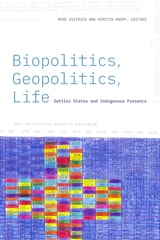
Biopolitics, Geopolitics, Life
Settler States and Indigenous PresenceRené Dietrich and Kerstin Knopf, editors
Duke University Press, 2023
The contributors to Biopolitics, Geopolitics, Life investigate biopolitics and geopolitics as two distinct yet entangled techniques of settler-colonial states across the globe, from the Americas and Hawai‘i to Australia and Aotearoa/New Zealand. Drawing on literary and cultural studies, social sciences, political theory, visual culture, and film studies, they show how biopolitics and geopolitics produce norms of social life and land use that delegitimize and target Indigenous bodies, lives, lands, and political formations. Among other topics, the contributors explore the representations of sexual violence against Native women in literature, Indigenous critiques of the carceral state in North America, Indigenous elders’ refusal of dominant formulations of aging, the governance of Indigenous peoples in Guyana, the displacement of Guaraní in Brazil, and the 2016 rule to formally acknowledge a government-to-government relationship between the US federal government and the Native Hawaiian community. Throughout, the contributors contend that Indigenous life and practices cannot be contained and defined by the racialization and dispossession of settler colonialism, thereby pointing to the transformative potential of an Indigenous-centered decolonization.
Contributors René Dietrich, Jacqueline Fear-Segal, Mishuana Goeman, Alyosha Goldstein, Sandy Grande, Michael R. Griffiths, Shona N. Jackson, Kerstin Knopf, Sabine N. Meyer, Robert Nichols, Mark Rifkin, David Uahikeaikaleiʻohu Maile
Contributors René Dietrich, Jacqueline Fear-Segal, Mishuana Goeman, Alyosha Goldstein, Sandy Grande, Michael R. Griffiths, Shona N. Jackson, Kerstin Knopf, Sabine N. Meyer, Robert Nichols, Mark Rifkin, David Uahikeaikaleiʻohu Maile
[more]

Boundless
Native American Abundance in Art and LiteratureLisa A. Crossman and Heid E. Erdrich
Amherst College Press, 2025
Boundless expands conversations on Native and Indigenous art and literature by presenting words and images in kinship. Starting in the collections of the Mead Art Museum and the Collection of Native American Literature at Amherst College and centered on the creative production of Native peoples of the Northeast, the project follows relationships between Indigenous authors and artists across the United States and beyond borders. Boundless presents an engagement of Indigenous curatorial methods as practiced by guest curator Heid E. Erdrich (Ojibwe) in an exhibition in two iterations hosted by the Mead in 2023 and 2024. Advisors to Boundless include Mohegan, Nipmuc, Shinnecock, and Wampanoag artists and scholars, along with others, who supported Erdrich in her urge to center the project in the Northeast. Advisors contributed both visual art and writing to the exhibition and publication. Collaborative co-creation between artists, students, faculty, Mead staff Lisa Crossman and Emily Potter-Ndiaye and the guest curator are also explored in this illustrated volume.
Amherst College’s Collection of Native American Literature contains thousands of Indigenous-authored works spanning centuries. The Collection’s abundance of books, prints, music, ephemera, and artist-made works, all by Native people, provide rich selections for Boundless. Crosscurrents of Indigenous visual art and literature are considered in this broad and interdisciplinary project. Boundless crosses generations to explore relatedness, kinship, and collegiality.
Boundless brings artists and writers together across generations, often drawing together works by members of the same tribe or even the same family to show the history, presence, and futurity of Native American creative and intellectual production.
[more]

By Strength, We Are Still Here
Indigenous Peoples and Indian Residential Schooling in Inuvik, Northwest TerritoriesCrystal Gail Fraser
University of Manitoba Press, 2024
[more]