Results by title
185 books match the query 'Jazz' and 16 start with b

Bach Perspectives, Volume 13
Bach ReworkedEdited by Laura Buch
University of Illinois Press, 2020
An insightful look at how composers build on each other's work, Bach Reworked reveals how nuanced understandings of parody procedures can fuel both musical innovation and historically informed performance.
Contributors: Stephen A. Crist, Ellen Exner, Moira Leanne Hill, Erinn E. Knyt, and Markus Zepf
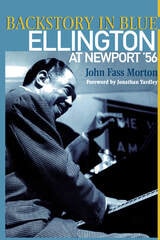
Backstory in Blue
Ellington at Newport '56John Fass Morton
Rutgers University Press, 2008
Certificate of Merit for the 2009 Association for Recorded Sound Collections Award for Excellence in Historical Recorded Sound Research
It may be that the song most baby boomers identify from July 1956 is a simple twelve-bar blues, hyped on national television by a twenty-one-year-old Elvis Presley and his handlers. But it is a very different song, with its elongated fourteen-bar choruses of rhythm and dissonance, played on the night of July 7, 1956, by a fifty-seven-year-old Duke Ellington and his big band that got everybody on their feet and moving as one. More than fifty years later, “Diminuendo and Crescendo in Blue,” recorded at the 1956 Newport Jazz Festival, still makes a profound statement about postwar America—how we got there and where it all went.
Backstory in Blue is a behind-the-scenes look at this epic moment in American cultural history. It is the story of who and what made Ellington’s composition so compelling and how one piece of music reflected the feelings and shaped the sensibilities of the postwar generation. As John Fass Morton explains, it was music expressed as much by those who performed offstage as by those who performed on.
Written from the point of view of the audience, this unique account draws on interviews with fans and music professionals of all kinds who were there and whose lives were touched, and in some cases changed, by the experience. Included are profiles of George Avakian, who recorded and produced Ellington at Newport 1956; Paul Gonsalves, the tenor sax player responsible for the legendary twenty-seven choruses that enabled the rebirth of Ellington’s career; and the “Bedford Blonde,” Elaine Anderson, whose dance ignited both the band and the crowd.
Duke Ellington once remarked, “I was born at Newport.” Here we learn that Newport was much more than the turning point for Ellington’s career. It was the tipping point for a generation and a musical genre.
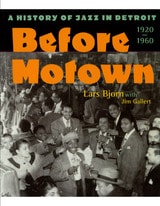
Before Motown
A History of Jazz in Detroit, 1920-60Lars Bjorn with Jim Gallert
University of Michigan Press, 2001

Beneath Missouri Skies
Pat Metheny in Kansas City, 1964-1972Carolyn Glenn Brewer
University of North Texas Press, 2021

Beneath the Skin of Sorrow
Improvisations on LossNnenna Freelon
Duke University Press, 2025
Part love story, part homage to jazz, and part guide to creative practice within bereavement, Beneath the Skin of Sorrow follows Freelon’s difficult and personal journey to healing. Calling on the improvisational skills that she had built over her forty-year career as a jazz singer, Freelon crafted her new reality by improvising—thinking about grieving as a series of small, daily engagements with the world around her. Slowly, Freelon regained the pieces of her musical sensibility, realizing that flowing between words spoken and words sung allowed her to understand what could not be fully realized in either realm.
By improvising a new life, Freelon forged a new companionship between grief, art, and daily life. In the essays, poems, lyrics, and explorations of jazz standards that comprise this lyrical and elegiac memoir, Freelon shows how thinking about grief as an exercise in improvisation can lead to a creative coexistence with grief in all its forms.
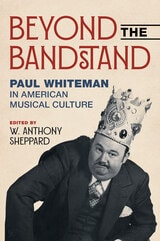
Beyond the Bandstand
Paul Whiteman in American Musical CultureEdited by W. Anthony Sheppard
University of Illinois Press, 2024
The most successful bandleader of the 1920s, Paul Whiteman was an entertainment icon who played a major role in the mainstreaming of jazz. Whiteman and his band premiered Gershwin’s Rhapsody in Blue. Duke Ellington acknowledged his achievements. His astonishing ear for talent vaulted a who’s who of artists toward prominence. But Whiteman’s oversized presence eclipsed Black jazz musicians while his middlebrow music prompted later generations to jettison him from jazz history.
W. Anthony Sheppard’s collection of essays confronts the racial implications of Whiteman’s career. The contributors explore Whiteman’s broad impact on popular culture, tracking his work and influence in American marketing, animated films, the Black press, Hollywood, and the music publication industry, and following him behind the scenes with arrangers, into grand concert halls, across the Atlantic, into the courtroom, and on television.
Multifaceted and cutting-edge, Beyond the Bandstand explores the racial politics and artistic questions surrounding a controversial figure in popular music.
Contributors: Ryan Raul Bañagale, Stephanie Doktor, John Howland, Katherine M. Leo, Sarah Caissie Provost, W. Anthony Sheppard, Catherine Tackley, Elijah Wald, and Christi Jay Wells
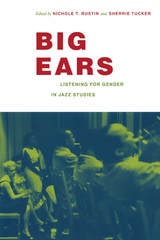
Big Ears
Listening for Gender in Jazz StudiesNichole T. Rustin and Sherrie Tucker, eds.
Duke University Press, 2008
Scholars of music, ethnomusicology, American studies, literature, anthropology, and cultural studies approach the question of gender in jazz from multiple perspectives. One contributor scrutinizes the tendency of jazz historiography to treat singing as subordinate to the predominantly male domain of instrumental music, while another reflects on her doubly inappropriate position as a female trumpet player and a white jazz musician and scholar. Other essays explore the composer George Russell’s Lydian Chromatic Concept as a critique of mid-twentieth-century discourses of embodiment, madness, and black masculinity; performances of “female hysteria” by Les Diaboliques, a feminist improvising trio; and the BBC radio broadcasts of Ivy Benson and Her Ladies’ Dance Orchestra during the Second World War. By incorporating gender analysis into jazz studies, Big Ears transforms ideas of who counts as a subject of study and even of what counts as jazz.
Contributors: Christina Baade, Jayna Brown, Farah Jasmine Griffin, Monica Hairston, Kristin McGee, Tracy McMullen, Ingrid Monson, Lara Pellegrinelli, Eric Porter, Nichole T. Rustin, Ursel Schlicht, Julie Dawn Smith, Jeffrey Taylor, Sherrie Tucker, João H. Costa Vargas
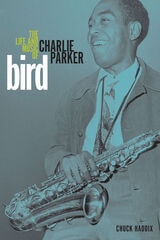
Bird
The Life and Music of Charlie ParkerChuck Haddix
University of Illinois Press, 2013

Birds of Fire
Jazz, Rock, Funk, and the Creation of FusionKevin Fellezs
Duke University Press, 2011
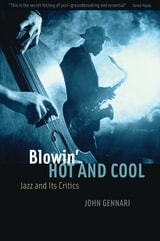
Blowin' Hot and Cool
Jazz and Its CriticsJohn Gennari
University of Chicago Press, 2006
In Blowin’ Hot and Cool, John Gennari provides a definitive history of jazz criticism from the 1920s to the present. The music itself is prominent in his account, as are the musicians—from Louis Armstrong and Duke Ellington to Charlie Parker, John Coltrane, Roscoe Mitchell, and beyond. But the work takes its shape from fascinating stories of the tradition’s key critics—Leonard Feather, Martin Williams, Whitney Balliett, Dan Morgenstern, Gary Giddins, and Stanley Crouch, among many others. Gennari is the first to show the many ways these critics have mediated the relationship between the musicians and the audience—not merely as writers, but in many cases as producers, broadcasters, concert organizers, and public intellectuals as well.
For Gennari, the jazz tradition is not so much a collection of recordings and performances as it is a rancorous debate—the dissonant noise clamoring in response to the sounds of jazz. Against the backdrop of racial strife, class and gender issues, war, and protest that has defined the past seventy-five years in America, Blowin’ Hot and Cool brings to the fore jazz’s most vital critics and the role they have played not only in defining the history of jazz but also in shaping jazz’s significance in American culture and life.
Blue Nippon
Authenticating Jazz in JapanE. Taylor Atkins
Duke University Press, 2001
Engagingly told through the voices of many musicians, Blue Nippon explores the true and legitimate nature of Japanese jazz. Atkins peers into 1920s dancehalls to examine the Japanese Jazz Age and reveal the origins of urban modernism with its new set of social mores, gender relations, and consumer practices. He shows how the interwar jazz period then became a troubling symbol of Japan’s intimacy with the West—but how, even during the Pacific war, the roots of jazz had taken hold too deeply for the “total jazz ban” that some nationalists desired. While the allied occupation was a setback in the search for an indigenous jazz sound, Japanese musicians again sought American validation. Atkins closes out his cultural history with an examination of the contemporary jazz scene that rose up out of Japan’s spectacular economic prominence in the 1960s and 1970s but then leveled off by the 1990s, as tensions over authenticity and identity persisted.
With its depiction of jazz as a transforming global phenomenon, Blue Nippon will make enjoyable reading not only for jazz fans worldwide but also for ethnomusicologists, and students of cultural studies, Asian studies, and modernism.
Blue Notes in Black and White
Photography and JazzBenjamin Cawthra
University of Chicago Press, 2011
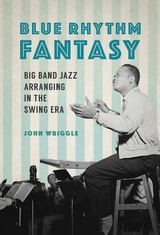
Blue Rhythm Fantasy
Big Band Jazz Arranging in the Swing EraJohn Wriggle
University of Illinois Press, 2016
Blue Rhythm Fantasy traces the extraordinary career of arranger Chappie Willet--a collaborator of Louis Armstrong, Cab Calloway, Duke Ellington, Gene Krupa, and many others--to revisit legendary Swing Era venues and performers from Harlem to Times Square. Wriggle's insightful music analyses of big band arranging techniques explore representations of cultural modernism, discourses on art and commercialism, conceptions of race and cultural identity, music industry marketing strategies, and stage entertainment variety genres.
Drawing on archives, obscure recordings, untapped sources in the African American press, and interviews with participants, Blue Rhythm Fantasy is a long-overdue study of the arranger during this dynamic era of American music history.
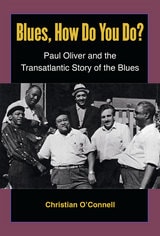
Blues, How Do You Do?
Paul Oliver and the Transatlantic Story of the BluesChristian O’Connell
University of Michigan Press, 2015
Blutopia
Visions of the Future and Revisions of the Past in the Work of Sun Ra, Duke Ellington, and Anthony BraxtonGraham Lock
Duke University Press, 2000
A century after Ellington’s birth, Lock reassesses his use of music as a form of black history and compares the different approaches of Ra, a band leader who focused on the future and cosmology, and Braxton, a contemporary composer whose work creates its own elaborate mythology. Arguing that the majority of writing on black music and musicians has—even if inadvertently—incorporated racial stereotypes, he explains how each artist reacted to criticism and sought to break free of categorical confines. Drawing on social history, musicology, biography, cultural theory, and, most of all, statements by the musicians themselves, Lock writes of their influential work.
Blutopia will be a welcome contribution to the literature on twentieth-century African American music and creativity. It will interest students of jazz, American music, African American studies, American culture, and cultural studies.
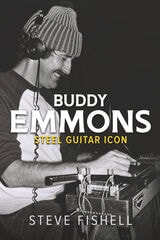
Buddy Emmons
Steel Guitar IconSteve Fishell
University of Illinois Press, 2022
The acknowledged maestro of the pedal steel guitar, Buddy Emmons lent his unparalleled virtuosity to over five decades of hit recordings and set standards that remain the benchmark for musicians today.
Steve Fishell’s merger of biography and memoir draws extensively on in-depth interviews with Emmons and the artist's autobiographical writings. Emmons went from playing strip clubs to a Grand Ole Opry debut with Little Jimmy Dickens at age 18. His restless experimentation led to work with Ernest Tubb and Ray Price--and established him in a career that saw him play alongside a who’s who of American music. Fishell weaves in stories and anecdotes from Willie Nelson, Brenda Lee, Linda Ronstadt, Pat Martino, and many others to provide a fascinating musical and personal portrait of an innovator whose peerless playing and countless recordings recognized no boundaries.
A one-of-a-kind life story, Buddy Emmons expands our view of a groundbreaking artist and his impact on country music, jazz, and beyond.