73 books match the query 'Jazz musicians' and 6 start with b

cover of Bangkok after Dark: Maurice Rocco, Transnational Nightlife, and the Making of Cold War Intimacies

Bangkok after Dark

Maurice Rocco, Transnational Nightlife, and the Making of Cold War Intimacies

Benjamin Tausig

Duke University Press, 2025

From the 1930s to the 1950s, jazz pianist Maurice Rocco was a mainstay in Hollywood and American nightlife scenes. As rock and roll surpassed jazz as America’s most popular music in the 1950s, the queer Black pianist’s fortunes faded and he was forced to go abroad for new opportunities. In 1964 Rocco settled in Bangkok, where he thrived and enjoyed a relatively privileged life until he was murdered by two young male sex workers in 1976. In Bangkok after Dark, Benjamin Tausig uses Rocco’s intriguing story to trace the history of transnational nightlife encounters between Thais and Americans during the long American war in Vietnam. Tausig shows how these encounters, which included musical collaborations, romantic and sexual relationships, and new labor, identity, and geopolitical configurations, remade Thailand in crucial and enduring ways. As Tausig demonstrates, Rocco’s Blackness, queerness, and musical life in Thailand illuminate how Thai-American relationships complicated neat distinctions between the two countries. In teasing out these complexities through the figure of Rocco, Tausig challenges conventional understandings of the global Cold War on individual and transnational scales.
[more]
cover of Beneath Missouri Skies: Pat Metheny in Kansas City, 1964-1972

Beneath Missouri Skies

Pat Metheny in Kansas City, 1964-1972

Carolyn Glenn Brewer

University of North Texas Press, 2021
[more]
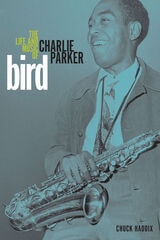
cover of Bird: The Life and Music of Charlie Parker

Bird

The Life and Music of Charlie Parker

Chuck Haddix

University of Illinois Press, 2013
Saxophone virtuoso Charlie "Bird" Parker began playing professionally in his early teens, became a heroin addict at 16, changed the course of music, and then died when only 34 years old. His friend Robert Reisner observed, "Parker, in the brief span of his life, crowded more living into it than any other human being." Like Louis Armstrong, Duke Ellington, Miles Davis, and John Coltrane, he was a transitional composer and improviser who ushered in a new era of jazz by pioneering bebop and influenced subsequent generations of musicians.
 
Meticulously researched and written, Bird: The Life and Music of Charlie Parker tells the story of his life, music, and career. This new biography artfully weaves together firsthand accounts from those who knew him with new information about his life and career to create a compelling narrative portrait of a tragic genius.
 
While other books about Parker have focused primarily on his music and recordings, this portrait reveals the troubled man behind the music, illustrating how his addictions and struggles with mental health affected his life and career. He was alternatively generous and miserly; a loving husband and father at home but an incorrigible philanderer on the road; and a chronic addict who lectured younger musicians about the dangers of drugs. Above all he was a musician, who overcame humiliation, disappointment, and a life-threatening car wreck to take wing as Bird, a brilliant improviser and composer.
 
With in-depth research into previously overlooked sources and illustrated with several never-before-seen images, Bird: The Life and Music of Charlie Parker corrects much of the misinformation and myth about one of the most influential musicians of the twentieth century.
[more]
cover of Blue Notes in Black and White: Photography and Jazz

Blue Notes in Black and White

Photography and Jazz

Benjamin Cawthra

University of Chicago Press, 2011
Miles Davis, supremely cool behind his shades. Billie Holiday, eyes closed and head tilted back in full cry. John Coltrane, one hand behind his neck and a finger held pensively to his lips. These iconic images have captivated jazz fans nearly as much as the music has. Jazz photographs are visual landmarks in American history, acting as both a reflection and a vital part of African American culture in a time of immense upheaval, conflict, and celebration. Charting the development of jazz photography from the swing era of the 1930s to the rise of black nationalism in the ’60s, Blue Notes in Black and White is the first of its kind: a fascinating account of the partnership between two of the twentieth century’s most innovative art forms.
 
Benjamin Cawthra introduces us to the great jazz photographers—including Gjon Mili, William Gottlieb, Herman Leonard, Francis Wolff, Roy DeCarava, and William Claxton—and their struggles, hustles, styles, and creative visions. We also meet their legendary subjects, such as Duke Ellington, sweating through a late-night jam session for the troops during World War II, and Dizzy Gillespie, stylish in beret, glasses, and goatee. Cawthra shows us the connections between the photographers, art directors, editors, and record producers who crafted a look for jazz that would sell magazines and albums. And on the other side of the lens, he explores how the musicians shaped their public images to further their own financial and political goals.
 
This mixture of art, commerce, and racial politics resulted in a rich visual legacy that is vividly on display in Blue Notes in Black and White. Beyond illuminating the aesthetic power of these images, Cawthra ultimately shows how jazz and its imagery served a crucial function in the struggle for civil rights, making African Americans proudly, powerfully visible.
[more]
cover of Blues All Day Long: The Jimmy Rogers Story

Blues All Day Long

The Jimmy Rogers Story

Wayne Everett Goins, foreword by Kim Wilson

University of Illinois Press, 2014

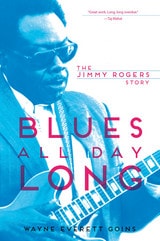
A member of Muddy Waters' legendary late 1940s-1950s band, Jimmy Rogers pioneered a blues guitar style that made him one of the most revered sidemen of all time. Rogers also had a significant if star-crossed career as a singer and solo artist for Chess Records, releasing the classic singles "That's All Right" and "Walking By Myself."
 
In Blues All Day Long, Wayne Everett Goins mines seventy-five hours of interviews with Rogers' family, collaborators, and peers to follow a life spent in the blues. Goins' account takes Rogers from recording Chess classics and barnstorming across the South to a late-in-life renaissance that included new music, entry into the Blues Hall of Fame, and high profile tours with Eric Clapton and the Rolling Stones. Informed and definitive, Blues All Day Long fills a gap in twentieth century music history with the story of one of the blues' eminent figures and one of the genre's seminal bands.

[more]
cover of Buddy Emmons: Steel Guitar Icon

Buddy Emmons

Steel Guitar Icon

Steve Fishell

University of Illinois Press, 2022

A No Depression Most Memorable Music Book of 2022

The acknowledged maestro of the pedal steel guitar, Buddy Emmons lent his unparalleled virtuosity to over five decades of hit recordings and set standards that remain the benchmark for musicians today.

Steve Fishell’s merger of biography and memoir draws extensively on in-depth interviews with Emmons and the artist's autobiographical writings. Emmons went from playing strip clubs to a Grand Ole Opry debut with Little Jimmy Dickens at age 18. His restless experimentation led to work with Ernest Tubb and Ray Price--and established him in a career that saw him play alongside a who’s who of American music. Fishell weaves in stories and anecdotes from Willie Nelson, Brenda Lee, Linda Ronstadt, Pat Martino, and many others to provide a fascinating musical and personal portrait of an innovator whose peerless playing and countless recordings recognized no boundaries.

A one-of-a-kind life story, Buddy Emmons expands our view of a groundbreaking artist and his impact on country music, jazz, and beyond.

[more]