Results by title
496 books match the query 'Jewish' and 22 start with b
Baghdadi Judeo-Arabic
An Introductory TextAssaf Bar-Moshe
University College London, 2024
This textbook is dedicated to spoken Baghdadi Judeo-Arabic—the native tongue spoken by the Jews of Baghdad and other towns of Southern Iraq—and is designed to guide beginners to an advanced level of speaking. It focuses on common expressions, introduces Baghdad’s historic Jewish culture, and guides readers through sample texts, key vocabulary, grammar points, and exercises, as well as particular topics, such as greetings, family, shopping, and cuisine.
Bait
David Albahari
Northwestern University Press, 2001
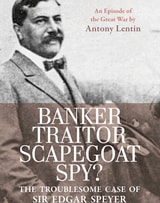
Banker, Traitor, Scapegoat, Spy?
The Troublesome Case of Sir Edgar SpeyerAntony Lentin
Haus Publishing, 2013
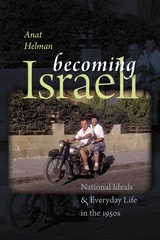
Becoming Israeli
National Ideals and Everyday Life in the 1950sAnat Helman
Brandeis University Press, 2014
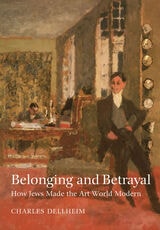
Belonging and Betrayal
How Jews Made the Art World ModernCharles Dellheim
Brandeis University Press, 2021
The story of dealers of Old Masters, champions of modern art, and victims of Nazi plunder.
Since the late 1990s, the fate of Nazi-stolen art has become a cause célèbre. In Belonging and Betrayal, Charles Dellheim turns this story on its head by revealing how certain Jewish outsiders came to acquire so many old and modern masterpieces in the first place—and what this reveals about Jews, art, and modernity. This book tells the epic story of the fortunes and misfortunes of a small number of eminent art dealers and collectors who, against the odds, played a pivotal role in the migration of works of art from Europe to the United States and in the triumph of modern art.
Beautifully written and compellingly told, this story spans both sides of the Atlantic from the late nineteenth century to the present. It is set against the backdrop of critical transformations, among them the gradual opening of European high culture, the ambiguities of Jewish acculturation, the massive sell-off of aristocratic family art collections, the emergence of different schools of modern art, the cultural impact of World War I, and the Nazi war against the Jews.

Ben Hecht's Theatre of Jewish Protest
Garrett Eisler
Rutgers University Press, 2025
Hecht introduced a new heroic Jewish identity to the American stage, one that challenged popular stereotypes of villainy or weakness. This powerful and (still) controversial body of work stands as a striking testament to the power of theatre to rise to the moment. The book also features a supporting cast of famous collaborators on these projects, including Paul Muni, Edward G. Robinson, John Garfield, Moss Hart, Kurt Weill, and a young Marlon Brando. In their use of the stage to aggressively engage with history as it was happening, the story of Hecht and his colleagues is a compelling case of artists who made a difference.
Between Home and Homeland
Youth Aliyah from Nazi GermanyBrian Amkraut
University of Alabama Press, 2006
As Hitler consolidated power, Jews and their allies in Germany began efforts to leave the country. Among them was the organization, Youth Aliyah. Based on abundant archival sources and a thorough use of secondary literature, Brian Amkraut details the story of the organization from its origins through its alliances and antagonisms with other Jewish organizations, and the challenges that vexed its efforts from every side, perhaps the greatest being sheer human naiveté ("surely things will get better").
Amkraut also discusses the identity dilemma for Jews who grew up feeling German, and then had to alter their self-image in the face of growing discrimination. He highlights the internal disagreements of Jewish agencies who wrestled with myriad problems. The author explores how German Jews were ideologically heterogeneous, and details how different groups coped with increasing antagonism in a variety of ways.
To this day, Youth Aliyah is considered by Israelis as a major contributor to the foundation of a Jewish presence leading to the modern state of Israel. Between Home and Homeland is an essential account of an important episode in the history of the Holocaust and the founding of the Isreali state.
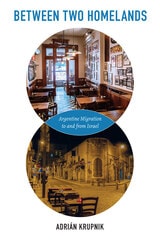
Between Two Homelands
Argentine Migration to and from IsraelAdrián Krupnik
University of Alabama Press, 2024
Emigration from Israel to other parts of the world has not yet received significant scholarly attention, as the subject is a sensitive one in Israeli society. Zionist ideology has long compelled Israelis to approach emigration from Israel through a biased lens. The Hebrew words aliyah and yerida, which mean, respectively, “ascent” and “descent,” are often used to refer to immigration and emigration. These ideological terms, which are charged with religious meaning, are heavily loaded with praise for immigrants and scorn for emigrants. Yet, thousands of Jews from all over the world have lived between two homelands, as the Israeli-Argentine case demonstrates. This study challenges the formerly dominant Zionist narrative that presents immigration to Israel as unique and emigration as a disgrace, shedding light on issues of immigrant identities, belonging, and expectations.
Covering the better part of the twentieth century and extending into the twenty-first, Adrián Krupnik bases his study both on interviews and on archival documents in English, Spanish, and Hebrew to give voice to Argentine migrants to and from Israel. The pursuit of two often irreconcilable ways of living—peace and economic prosperity—repeatedly vexed migrants moving in either direction. Many Jewish-Argentine migrants between 1980 and 2006 lost everything and became the “new poor” in both countries. Protracted recessions and incessant political crises in Argentina continued to drive migrants in one direction, only to arrive in an Israel submerged in the violence of multiple intifadas.
In our own era, one that will see unprecedented global migration patterns based on similar economic and political—and environmental—upheavals, Between Two Homelands serves as an important and informative cautionary tale of the personal, social, and economic stakes at play in an utterly unsettled globalized landscape.
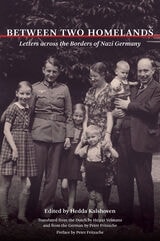
Between Two Homelands
Letters across the Borders of Nazi GermanyEdited by Hedda Kalshoven
University of Illinois Press, 2014
In 1920, at the age of thirteen, Irmgard Gebensleben first traveled from Germany to The Netherlands on a "war-children transport." She would later marry a Dutch man and live and raise her family there while keeping close to her German family and friends through the frequent exchange of letters. Yet during this period geography was not all that separated them. Increasing divergence in political opinions and eventual war between their countries meant letters contained not only family news but personal perspectives on the individual, local, and national choices that would result in the most destructive war in history.
This important collection, first assembled by Irmgard Gebensleben's daughter Hedda Kalshoven, gives voice to ordinary Germans in the Weimar Republic and the Third Reich and in the occupied Netherlands. The correspondence between Irmgard, her friends, and four generations of her family delve into their most intimate and candid thoughts and feelings about the rise of National Socialism. The responses to the German invasion and occupation of the Netherlands expose the deeply divided loyalties of the family and reveal their attempts to bridge them. Of particular value to historians, the letters evoke the writers' beliefs and their understanding of the events happening around them.
This first English translation of Ik denk zoveel aan jullie: Een briefwisseling tussen Nederland en Duitsland 1920-1949, has been edited, abridged, and annotated by Peter Fritzsche with the assent and collaboration of Hedda Kalshoven. After the book's original publication the diary of Irmgard's brother and loyal Wehrmacht soldier, Eberhard, was discovered and edited by Hedda Kalshoven. Fritzsche has drawn on this important additional source in his preface.
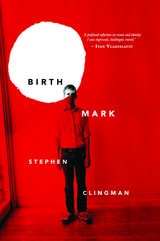
Birthmark
Stephen Clingman
University of Massachusetts Press, 2016
Not only was the operation unsuccessful, it affected his vision, and his eyes came to see differently from each other. Birthmark explores the questions raised by living with divided vision in a divided world—the world of South Africa under apartheid, where every view was governed by the markings of birth, the accidents of color, race, and skin. But what were the effects on the mind? Clingman's book engages a number of questions. How, in such circumstances, can we come to a deeper kind of vision? How can we achieve wholeness and acceptance? How can we find our place in the midst of turmoil and change?
In a beguiling narrative set on three continents, this is a story that is personal, painful, comic, and ultimately uplifting: a book not so much of the coming of age but the coming of perspective.
Black, Jewish, and Interracial
It’s Not the Color of Your Skin, but the Race of Your Kin, and Other Myths of IdentityKatya Gibel Azoulay
Duke University Press, 1997
Beginning with an examination of the concept of identity as it figures in philosophical and political thought, Gibel Azoulay moves on to consider and compare the politics and traditions of the Black and Jewish experience in America. Her inquiry draws together such diverse subjects as Plessy v. Ferguson, the Leo Frank case, "passing," intermarriage, civil rights, and anti-Semitism. The paradoxical presence of being both Black and Jewish, she argues, leads questions of identity, identity politics, and diversity in a new direction as it challenges distinct notions of whiteness and blackness. Rising above familiar notions of identity crisis and cultural confrontation, she offers new insights into the discourse of race and multiculturalism as she suggests that identity can be a more encompassing concept than is usually thought. Gibel Azoulay adds her own personal history and interviews with eight other Black and Jewish individuals to reveal various ways in which interracial identities are being lived, experienced, and understood in contemporary America.
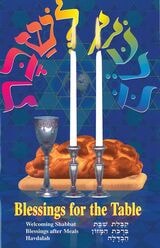
Blessings for the Table - Birkon L'Shabbat
Rabbi Elyse D. Frishman
Central Conference of American Rabbis, 1997
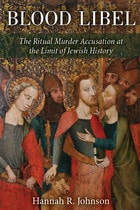
Blood Libel
The Ritual Murder Accusation at the Limit of Jewish HistoryHannah R. Johnson
University of Michigan Press, 2012
The ritual murder accusation is one of a series of myths that fall under the label blood libel, and describes the medieval legend that Jews require Christian blood for obscure religious purposes and are capable of committing murder to obtain it. This malicious myth continues to have an explosive afterlife in the public sphere, where Sarah Palin's 2011 gaffe is only the latest reminder of its power to excite controversy. Blood Libel is the first book-length study to analyze the recent historiography of the ritual murder accusation and to consider these debates in the context of intellectual and cultural history as well as methodology. Hannah R. Johnson articulates how ethics shapes methodological decisions in the study of the accusation and how questions about methodology, in turn, pose ethical problems of interpretation and understanding. Examining recent debates over the scholarship of historians such as Gavin Langmuir, Israel Yuval, and Ariel Toaff, Johnson argues that these discussions highlight an ongoing paradigm shift that seeks to reimagine questions of responsibility by deliberately refraining from a discourse of moral judgment and blame in favor of an emphasis on historical contingencies and hostile intergroup dynamics.
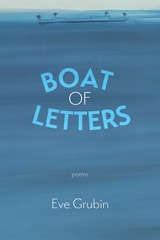
Boat of Letters
Eve Grubin
Four Way Books, 2025
In her much anticipated second full-length collection of poems, Eve Grubin conjures an "inky swamp, wild and warm, / where leaves hang down like muted lamps." Grubin navigates wild waters in a "boat of letters" she constructs, with poems narrating a daughter in mourning for her mother in adulthood's half-light; a wife in the middle of life's existential marathon; a mother raising two children in the terrifying present; an American living in London; a Jewish woman following religious tradition in what can feel like a faithless world. Grubin shapes language and silences into a bridge that holds us between longing and understanding, between effort and the holy ground of that unattainable destination. "The Poetics of Reticence" describes hovering above the waters where "there is no vessel; there are no oars," just the "sounds of a boat creaking," a material contradiction in the hushed void. "Silence is praise: words cannot touch glory," Grubin writes, but she also demonstrates what wonders our speech makes possible. In one poem, the narrator looks back at her wedding and considers how little she knew about marriage, and thinking in the context of her husband's area of expertise, palaeography, she reflects, "I didn't know that when two graphemes join / in a single glyph there is potential for stylistic re-imaginings, / for inventive, elegant variations." All is preordained, she seems to say, while paradoxically, we re-imagine and invent. And even as we create our future, we embrace the beauty of all that we cannot know: "Yesterday, we talked about the shade / of a certain blue mentioned in the Torah. / Was it the blue of our son's lips after a bath? // Or the blue of redemption? // Or the dark blue of the sky / the night we walked across the sands, the seas all around us."
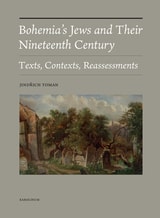
Bohemia's Jews and Their Nineteenth Century
Texts, Contexts, ReassessmentsJindrich Toman
Karolinum Press, 2023
This book on Jewish culture and literature focuses on the “quiet” decades of the nineteenth century, a scarcely written-about period of time in Bohemian Jewish history. Using a myriad of sources, including travelers’ accounts, poems, essays, short stories, guides, and newspaper articles, the volume explores Jewish expression, Jewish-Czech relations, and the changing attitudes toward Jews between the 1820s and 1880s. It offers close readings of writers like Karel Havlíćek Borovský, Ján Kollár, Siegfried Kapper, and Jan Neruda, as well as lesser-known authors and sources. Combining skillful sustained analysis, judicious argumentation, and elegant writing, the book is a truly enriching reading experience.
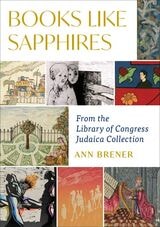
Books Like Sapphires
From the Library of Congress Judaica CollectionAnn Brener
Brandeis University Press, 2024
Books Like Sapphires showcases a wide range of Hebraic treasures from the storied collection at the Library of Congress, many of them for the first time. Tracing the history of Judaica collecting in the twentieth-century United States, the book illuminates varied works, telling their stories alongside vibrant color images. These include a unique manuscript about a betrothal scandal in Renaissance Crete, an illustrated Esther Scroll, a poem from 1477 celebrating the new technology of printing, amusing rhymed couplets in sixteenth-century Padua, and the Washington Haggadah. This book also tells the story of the patrons and collectors, first among them Jacob Schiff, as well as archivists and curators, who made the storied Judaica archive at the Library of Congress the precious resource that it is today.
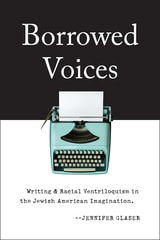
Borrowed Voices
Writing and Racial Ventriloquism in the Jewish American ImaginationGlaser, Jennifer
Rutgers University Press, 2016
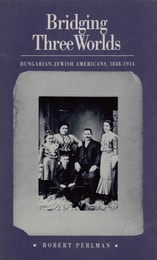
Bridging Three Worlds
Hungarian-Jewish Americans, 1848-1914Robert Perlman
University of Massachusetts Press, 1991
Between 1848 and 1914, approximately 100,000 Jews emigrated from Hungary to the United States. They came in two waves. The first group, catalyzed by the 1848 revolutions against the Austrian monarchy, consisted mainly of political dissidents and well educated, cosmopolitan, middle-class Jews seeking greater personal, religious, and political freedoms in the New World. The second and much larger group, which began to arrive around 1880, consisted primarily of unskilled laborers and lower-middle-class artisans and tradespeople, beckoned to America by the promise of vast economic opportunity.
In the abundant literature on Jewish immigration to the United States, virtually nothing has been written specifically about the Hungarian-Jewish experience, which differed in many respects from that of other Jewish national groups. Bridging Three Worlds offers such a chronicle, relating the immigrants’ history from their political and cultural roots in the Old Country to their acculturation as citizens in a newly adopted land. Based on primary archival materials, oral histories, and secondary sources, the book is also informed by the author’s own experiences as an American of Hungarian-Jewish origins.

Broken Promises, Broken Dreams
Stories of Jewish and Palestinian Trauma and ResilienceAlice Rothchild
Pluto Press, 2010
The tragedies of the conflict between Israelis and Palestinians are never far from the pages of the mainstream press. Yet it is rare to hear about the reality of life on the ground -- and it is rarer still when these voices belong to women.
This book records the journey of a Jewish American physician travelling and working within Israel and the Occupied Territories. Alice Rothchild grew up in a family grounded by the traumas of the Holocaust and passionately devoted to Israel. This book recounts her experiences as she grapples with the reality of life in Israel and the hardships of Palestinians living in the West Bank and Gaza.
The new edition includes a new preface, two chapters on Israeli dissent and a chapter which explores the impact of a Palestinian home demolition and the work of Israeli soldiers and Palestinian fighters who have joined together to form Combatants for Peace.
Ultimately, the book raises troubling questions regarding US policy and the mainstream Jewish community's insistence on giving unquestioning support to all Israeli policy.
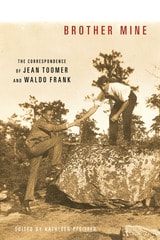
Brother Mine
The Correspondence of Jean Toomer and Waldo FrankEdited by Kathleen Pfeiffer
University of Illinois Press, 2010
The friendship of Jean Toomer and Waldo Frank was one of the most emotionally intense, racially complicated, and aesthetically significant relationships in the history of American literary modernism. Waldo Frank was an established white writer who advised and assisted the younger African American Jean Toomer as he pursued a literary career. They met in 1920, began corresponding regularly in 1922, and were estranged by the end of 1923, the same year that Toomer published his ambitiously modernist debut novel, Cane.
While individual letters between Frank and Toomer have been published separately on occasion, they have always been presented out of context. This volume presents for the first time their entire correspondence in chronological order, comprising 121 letters ranging from 200 to 800 words each. Kathleen Pfeiffer annotates and introduces the letters, framing the correspondence and explaining the literary and historical allusions in the letters themselves.
Reading like an epistolary novel, Brother Mine captures the sheer emotional force of the story that unfolds in these letters: two men discover an extraordinary friendship, and their intellectual and emotional intimacy takes shape before our eyes. This unprecedented collection preserves the raw honesty of their exchanges, together with the developing drama of their ambition, their disappointments, their assessment of their world, and ultimately, the betrayal that ended the friendship.
Brothers and Strangers
The East European Jew in German and German Jewish Consciousness, 1800–1923Steven E. Aschheim
University of Wisconsin Press, 1983
Brothers and Strangers traces the history of German Jewish attitudes, policies, and stereotypical images toward Eastern European Jews, demonstrating the ways in which the historic rupture between Eastern and Western Jewry developed as a function of modernism and its imperatives. By the 1880s, most German Jews had inherited and used such negative images to symbolize rejection of their own ghetto past and to emphasize the contrast between modern “enlightened” Jewry and its “half-Asian” counterpart. Moreover, stereotypes of the ghetto and the Eastern Jew figured prominently in the growth and disposition of German anti-Semitism. Not everyone shared these negative preconceptions, however, and over the years a competing post-liberal image emerged of the Ostjude as cultural hero. Brothers and Strangers examines the genesis, development, and consequences of these changing forces in their often complex cultural, political, and intellectual contexts.

Business Of Jews In Louisiana, 1840–1875
Elliot Ashkenazi
University of Alabama Press, 1988
Goes beyond institutional history to concentrate on commercial and social matters
The author’s findings imply that Jewish immigrants to the South in the first half of the 19th century came from particular locales with similar social, economic, and religious backgrounds, and they chose to live in the South because of those traditions. The experience of Jews with commercial capitalism, rather than landowning, in agricultural societies, gave the Jews of Louisiana a comparable niche in America, and they participated in the commercial aspects of a regional economy based on agricultural production. Commercial and family connections with other Jewish groups facilitated their development into a settled community. In growth and decline, Jewish communities in Louisiana and elsewhere became permanent features of the landscape and influenced, and were influenced, by the areas in which they lived.