Results by title
98 books match the query 'Labor movement' and 3 start with b
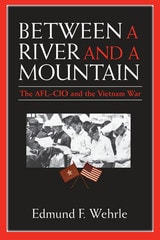
Between a River and a Mountain
The AFL-CIO and the Vietnam WarEdmund F. Wehrle
University of Michigan Press, 2010
Between a River and a Mountain details American labor's surprisingly complex relationship to the American war in Vietnam. Breaking from the simplistic story of "hard hat patriotism," Wehrle uses newly released archival material to demonstrate the AFL-CIO's continuing dedication to social, political, and economic reform in Vietnam. The complex, sometimes turbulent, relationship between American union leaders and their counterparts in the Vietnamese Confederation of Labor (known as the CVT) led to dangerous political compromises: the AFL-CIO eventually accepted much-needed support for their Vietnamese activities from the CIA, while the CVT's need to sustain their relationship with the Americans lured them into entanglements with a succession of corrupt Saigon governments. Although the story's endpoint--the painfully divided and weakened labor movement of the 1970s--may be familiar, Wehrle offers an entirely new understanding of the historical forces leading up to that decline, unraveling his story with considerable sophistication and narrative skill.
"Stunning in its research and sophisticated in its analysis, Between a River and a Mountain is one of the best studies we have of labor and the Vietnam War."
--Robert K. Brigham, Shirley Ecker Boskey Professor of History and International Relations, Vassar College
"Skillfully blending diplomatic and labor history, Wehrle's book is a valuable contribution to the ever-widening literature on the Vietnam War."
--George Herring, University of Kentucky
"Wehrle has written a compelling and original study of the AFL-CIO, the South Vietnamese labor movement and the Vietnam War."
--Judith Stein, Professor of History, City College and Graduate School of the City University of New York
"With this important book, Edmund Wehrle gives us the first full-fledged scholarly examination of organized labor's relationship to the Vietnam War. Based on deep research in U.S. and foreign archives, and presented in clear and graceful prose, Between a River and a Mountain adds a great deal to our understanding of how the AFL-CIO approached the war and in turn was fundamentally altered by its staunch support for Americanization. Nor is it merely an American story that Wehrle tells, for he also presents fascinating information on the Vietnamese Confederation of Labor and its sometimes-strained relations with U.S. labor."
--Fredrik Logevall, Cornell University
Edmund F. Wehrle is Assistant Professor of History, Eastern Illinois University.
[more]
Beyond Equality
Labor and the Radical Republicans, 1862-1872David Montgomery
University of Illinois Press, 1981
"For anyone who believes that there was no important labor movement before Roosevelt, or before Gompers, or before the Knights of Labor, this well-documented work should prove a shocker. And for those who look to the past for enlightenment to guide us through our troubled tomorrows, this book is a reservoir of historic information and insights." -- New Leader
"Beyond Equality is a masterpiece. . . . A book of bold and brilliant originality, it is now shaping the perspective of a new generation of graduate students." -- David Brion Davis, author of The Problem of Slavery in Western Culture
"Beyond Equality is a masterpiece. . . . A book of bold and brilliant originality, it is now shaping the perspective of a new generation of graduate students." -- David Brion Davis, author of The Problem of Slavery in Western Culture
[more]
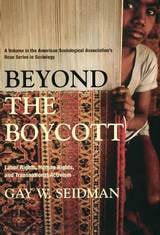
Beyond the Boycott
Labor Rights, Human Rights, and Transnational ActivismGay W. Seidman
Russell Sage Foundation, 2007
As the world economy becomes increasingly integrated, companies can shift production to wherever wages are lowest and unions weakest. How can workers defend their rights in an era of mobile capital? With national governments forced to compete for foreign investment by rolling back legal protections for workers, fair trade advocates are enlisting consumers to put market pressure on companies to treat their workers fairly. In Beyond the Boycott, sociologist Gay Seidman asks whether this non-governmental approach can reverse the "race to the bottom" in global labor standards. Beyond the Boycott examines three campaigns in which activists successfully used the threat of a consumer boycott to pressure companies to accept voluntary codes of conduct and independent monitoring of work sites. The voluntary Sullivan Code required American corporations operating in apartheid-era South Africa to improve treatment of their workers; in India, the Rugmark inspection team provides 'social labels' for handknotted carpets made without child labor; and in Guatemala, COVERCO monitors conditions in factories producing clothing under contract for major American brands. Seidman compares these cases to explore the ingredients of successful campaigns, as well as the inherent limitations facing voluntary monitoring schemes. Despite activists' emphasis on educating individual consumers to support ethical companies, Seidman finds that, in practice, they have been most successful when they mobilized institutions—such as universities, churches, and shareholder organizations. Moreover, although activists tend to dismiss states' capabilities, all three cases involved governmental threats of trade sanctions against companies and countries with poor labor records. Finally, Seidman points to an intractable difficulty of independent workplace monitoring: since consumers rarely distinguish between monitoring schemes and labels, companies can hand pick monitoring organizations, selecting those with the lowest standards for working conditions and the least aggressive inspections. Transnational consumer movements can increase the bargaining power of the global workforce, Seidman argues, but they cannot replace national governments or local campaigns to expand the meaning of citizenship. As trade and capital move across borders in growing volume and with greater speed, civil society and human rights movements are also becoming more global. Highly original and thought-provoking, Beyond the Boycott vividly depicts the contemporary movement to humanize globalization—its present and its possible future. A Volume in the American Sociological Association's Rose Series in Sociology
[more]