171 books match the query 'Labor unions' and 6 start with b
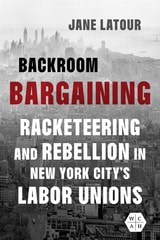
cover of Backroom Bargaining: Racketeering and Rebellion in New York City's Labor Unions

Backroom Bargaining

Racketeering and Rebellion in New York City's Labor Unions

Jane LaTour

University of Illinois Press, 2026
Organized crime figures and their minions honeycombed unions while leadership instituted nepotism, salary padding, and other practices that undermined the well-being of the rank and file. But in New York City, groups of union members and their legal allies waged a years-long struggle against corruption and for better working conditions. Jane LaTour combines rich oral histories with research to take readers into the construction sites, power plants, and Merchant Marine ships where the dramas played out. Dissidents risked their livelihoods for a variety of reasons, from practical concerns like job security and safety to larger ideas like union democracy. LaTour examines the factors that allowed unchecked corruption and kept unions from living up to their potential. But she also tells the eyewitness stories of solidarity and worker spirit that fueled the fight to retake labor power. A rare history of union corruption, Backroom Bargaining shines a light on worker campaigns to uphold fairness and equity in the workplace.
[more]
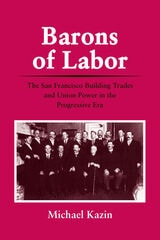
cover of Barons of Labor: The San Francisco Building Trades and Union Power in the Progressive Era

Barons of Labor

The San Francisco Building Trades and Union Power in the Progressive Era

Michael Kazin

University of Illinois Press, 1989
From the depression of the 1890s through World War I, construction tradesman held an important place in San Francisco's economic, political, and social life. Michael Kazin's award-winning study delves into how the city’s Building Trades Council (BTC) created, accumulated, used, and lost their power. He traces the rise of the BTC into a force that helped govern San Francisco, controlled its potential progress, and articulated an ideology that made sense of the changes sweeping the West and the country. Believing themselves the equals of officeholders and corporate managers, these working and retired craftsmen pursued and protected their own power while challenging conservatives and urban elites for the right to govern. What emerges is a long-overdue look at building trades as a force in labor history within the dramatic story of how the city's 25,000 building workers exercised power on the job site and within the halls of government, until the forces of reaction all but destroyed the BTC.
[more]
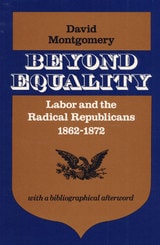
cover of Beyond Equality: Labor and the Radical Republicans, 1862-1872

Beyond Equality

Labor and the Radical Republicans, 1862-1872

David Montgomery

University of Illinois Press, 1981

"For anyone who believes that there was no important labor movement before Roosevelt, or before Gompers, or before the Knights of Labor, this well-documented work should prove a shocker. And for those who look to the past for enlightenment to guide us through our troubled tomorrows, this book is a reservoir of historic information and insights." -- New Leader
"Beyond Equality is a masterpiece. . . . A book of bold and brilliant originality, it is now shaping the perspective of a new generation of graduate students." -- David Brion Davis, author of The Problem of Slavery in Western Culture
 
[more]
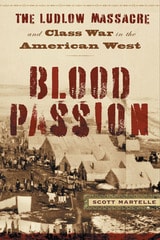
cover of Blood Passion: The Ludlow Massacre and Class War in the American West, First Paperback Edition

Blood Passion

The Ludlow Massacre and Class War in the American West, First Paperback Edition

Scott Martelle

Rutgers University Press, 2008

By early April 1914, Colorado Governor Elias Ammons thought the violence in his state’s strike-bound southern coal district had eased enough that he could begin withdrawing the Colorado National Guard, deployed six months earlier as military occupiers. But Ammons misread the signals, and on April 20, 1914, a full-scale battle erupted between the remaining militiamen and armed strikers living in a tent colony at the small railroad town of Ludlow. Eight men were killed in the fighting, which culminated in the burning of the colony. The next day, the bodies of two women and eleven children were found suffocated in a below-ground shelter. The “Ludlow Massacre,” as it quickly became known, launched a national call-to-arms for union supporters to join a ten-day guerrilla war along more than two hundred miles of the eastern Rockies. The convulsion of arson and violence killed more than thirty people and didn’t end until President Woodrow Wilson sent in the U.S. Army. Overall at least seventy-five men, women, and children were killed in seven months, likely the nation’s deadliest labor struggle.

In Blood Passion, journalist Scott Martelle explores this little-noted tale of political corruption and repression and immigrants’ struggles against dominant social codes of race, ethnicity, and class. More than a simple labor dispute, the events surrounding Ludlow embraced some of the most volatile social movements of the early twentieth century, pitting labor activists, socialists, and anarchists against the era’s powerful business class, including John D. Rockefeller, Jr., and helped give rise to the modern twins of corporate public relations and political “spin.” But at its heart, Blood Passion is the dramatic story of small lives merging into a movement for change and of the human struggle for freedom and dignity.
[more]
cover of Blue Jenkins: Working for Workers

Blue Jenkins

Working for Workers

Julia Pferdehirt

Wisconsin Historical Society Press, 2011
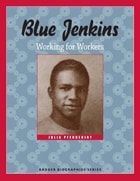
When William "Blue" Jenkins was only six months old, he moved with his parents from a Mississippi sharecropper’s farm to the industrial city of Racine, Wisconsin with dreams of a new life. As an African-American in the pre–civil rights era, Blue came face to face with racism: the Ku Klux Klan hung a black figure in effigy from a tree in the Jenkins family’s yard. Growing up, Blue knew where blacks could shop, eat, and get a job in Racine—and where they couldn’t. The injustices that confronted Blue in his young life would drive his desire to make positive changes to his community and workplace in adulthood.
 
This addition to the Badger Biographies series shares Blue Jenkins’s story as it acquaints young readers with African-American and labor history. Following an all-star career as a high school football player, Blue became involved in unions through his work at Belle City Malleable. As World War II raged on, he participated in the home-front battle against discrimination in work, housing, and economic opportunity. When Blue became president of the union at Belle City, he organized blood drives and fought for safety regulations. He also helped to integrate labor union offices. In 1962, he became president of the U.A.W. National Foundry in the Midwest, and found himself in charge of 50,000 foundry union members.
[more]
cover of By The Ore Docks: A Working People’s History Of Duluth

By The Ore Docks

A Working People’s History Of Duluth

Richard Hudelson

University of Minnesota Press, 2006

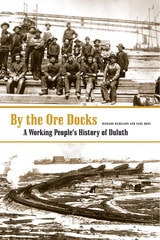
Located on the shore of Lake Superior near the Iron Range of Minnesota and, for much of its history, the site of vast steel, lumber, and shipping industries, Duluth has been home to people who worked tirelessly in the rail yards, grain elevators, and harbor. Here, for the first time, By the Ore Docks presents a compelling, full-length history of the people who built this port city and struggled for both the growth of the city and the rights of their fellow workers.

In By the Ore Docks, Richard Hudelson and Carl Ross trace seventy years in the lives of Duluth’s multi-ethnic working class—Scandinavians, Finns, Italians, Poles, Irish, Jews, and African Americans—and chronicle, along with the events of the times, the city’s vibrant neighborhoods, religious traditions, and communities. But they also tell the dramatic story of how a populist worker’s coalition challenged the “legitimate American” business interests of the city, including the major corporation U.S. Steel.

From the Knights of Labor in the 1880s to the Industrial Workers of the World, the AFL and CIO, and the Democratic Farmer-Labor party, radical organizations and their immigrant visionaries put Duluth on the national map as a center in the fight for worker’s rights—a struggle inflamed by major strikes in the copper and iron mines.

By the Ore Docks is at once an important history of Duluth and a story of its working people, common laborers as well as union activists like Ernie Pearson, journalist Irene Paull, and Communist party gubernatorial candidate Sam Davis. Hudelson and Ross reveal tension between Duluth’s ethnic groups, while also highlighting the ability of the people to overcome those differences and shape the legacy of the city’s unsettled and remarkable past.

Richard Hudelson is professor of philosophy at the University of Wisconsin, Superior. He is the author of, among other works, Marxism and Philosophy in the Twentieth Century and The Rise and Fall of Communism.

Carl Ross (1913–2004) was a labor activist and the author of The Finn Factor in American Labor, Culture, and Society. He was director of the Twentieth-Century Radicalism in Minnesota Project of the Minnesota Historical Society.
[more]